


You searched “affordable SEO services” and got two kinds of results. Agencies promising page one for $99 a month, and agencies that won’t tell you a price until you book a call.
Neither one answers the question you actually have: what does SEO cost when it’s done properly, and what’s the least you can spend and still get something real?
The short answer is that affordable SEO is a scope, not a price. The long answer is below, with the market numbers from the people who collect them, the red flags that separate a cheap SEO company from a small one, and the free work to do before you pay anyone.
This post covers the budget end of the market. For the full picture of how SEO is priced, start with our SEO pricing guide.
Key Takeaways
Affordable and cheap are different products. Affordable SEO is a plan scoped to your budget. Cheap SEO is the same template sold to hundreds of businesses at once.
The market has a wide middle. Ahrefs' survey of 439 providers puts the average SEO retainer at $2,917 a month, while SE Ranking found 64% of the 260 agencies it surveyed charge under $1,000.
Under $1,000 a month is not automatically cheap SEO. Most agencies that charge that much serve small and local businesses, and a narrow scope at that price can be legitimate.
$99 a month cannot buy real work. At that price the math only works with automation, templates or link schemes, and Google's spam policies say sites that use link schemes may rank lower or not appear at all.
Nobody can guarantee rankings. Google's own hiring guide says to find someone else if a provider guarantees first place.
Do the free work first. Google Business Profile, Search Console and a handful of free SEO tools cover the basics before you pay anyone.
Scope beats price. The right question isn't "what's the cheapest SEO service" but "what's the smallest scope that can move my numbers."
What Affordable SEO Services Actually Mean
SEO (search engine optimization) is the work that gets your website found in Google for the searches your customers type. Affordable SEO services are that same work, scoped down to a budget a small business can sustain for a year.
That last part matters. SEO compounds. A plan you can afford for twelve months beats a plan you can afford for two.
So “affordable” is not a price band. It’s a fit between three things:
- Your business goals. More calls, more online orders, more qualified leads. Pick one to lead with.
- Your market. A plumber in one city and a national software company are not competing for the same searches, so they shouldn’t pay for the same plan.
- Your site’s starting point. A site with technical problems needs a technical SEO audit before anything else. A clean site with thin pages needs content. A site with neither problem may just need better targeting.
An affordable SEO plan picks the two or three things that will move your numbers at your budget and does them properly. It leaves the rest for later. That’s different from a cheap SEO package, which does a little of everything, badly, for everyone.
Cheap SEO vs Affordable SEO: The Difference Is The Work, Not The Price
Cheap SEO services aren’t defined by the dollar amount. They’re defined by what gets cut to hit that dollar amount.
Cheap SEO companies run on volume. They sign as many clients as they can, run the same checklist on every one, and move on before anyone notices the rankings never arrived. Whether you sell diabetes supplies or dog leashes, you get the same template, the same auto-generated content, the same “strategy.”
Affordable SEO starts from the other direction. It starts with your business needs, then asks what scope fits your budget.
| Cheap SEO | Affordable SEO | |
|---|---|---|
| How the price is set | One package price for everyone | Scoped to your goals and market |
| Keyword research | A list pulled from a tool, no intent check | Keywords tied to what your customers actually buy |
| Content | Thin or mass-produced pages | Fewer pages, written for the people searching |
| Links | Bought links, link networks, directory spam | Earned links from relevant sites, or none until it's worth it |
| Technical SEO | A plugin install | A site audit, then fixes in priority order |
| Reporting | Ranking screenshots | Traffic, leads and revenue, with the rankings behind them |
| What happens after an update | Rankings vanish | Rankings hold, because nothing was faked |
| Who it suits | Nobody, long term | Small businesses that need a plan they can sustain |
The last row is the one to remember. Cheap SEO is not a smaller version of affordable SEO. It’s a different product that happens to use the same three letters.

If a provider can describe your entire SEO strategy before they've looked at your site, your market or your analytics, they're describing their template, not your plan. The honest answer to "what will you do for me" is "it depends on what we find," followed by what they'd check first.
How Much Do Affordable SEO Services Cost?
There’s no universal number, and anyone who gives you one without asking about your business is guessing. What exists is survey data from named sources, and the sources disagree in a useful way.
Ahrefs polled 439 SEO providers (page updated August 2024). The average retainer across all respondents was $2,917 a month. Agencies averaged $3,209, freelancers $1,348.63. The single most common retainer band was $501 to $1,000 a month, chosen by 20.4% of respondents. The average hourly rate was $111, and the most common per-project band was $2,501 to $5,000.
Backlinko surveyed more than 300 SEO professionals (page updated December 2025). It puts the average monthly cost at $1,000 to $2,500, hourly work at $50 to $100 an hour, and project pricing at $1,000 to $5,000. It also found agencies charge about 30% more than freelancers, and that US-based SEO services cost three to five times more than providers in emerging markets. For small local businesses, Backlinko lists retainers of $500 or less; for established small businesses with simple websites, $501 to $1,000.
SE Ranking surveyed 260 agencies with Duda (published December 2024, and the author notes the sample may be too small for statistical significance). The most popular retainer band was $500 to $1,000 a month. 64% of those agencies charge under $1,000, 30% charge under $500, and 94% focus on small or local businesses. In North America, 22% of agencies charge over $2,000 a month and 40% charge over $125 an hour.
Clutch, the agency review directory, publishes its own pricing guide (updated September 2026) built from 65,550 SEO company profiles and their client reviews. It puts the average monthly SEO cost at $3,199 and says agencies on its platform typically charge $2,000 to $20,000 a month, at $100 to $149 an hour.
Those four sources look like they contradict each other. They don’t. Ahrefs’ and Clutch’s averages are pulled up by larger agencies and consultancies. SE Ranking’s sample is 78% agencies with fewer than ten people, serving local clients. All of it is the real market. The spread tells you something a single “average” never will: the price of SEO depends on who’s doing it and for whom.
Ahrefs’ own data makes the same point. Providers serving a local market charge $1,557 a month on average. Providers serving a worldwide market charge $3,474. Same service name, more than double the price, because the competition is different.
For the full breakdown of pricing models and what drives the price up or down, our guide to SEO pricing goes through it line by line.
What Each Tier Buys
The useful way to read those ranges is by provider type. Each tier buys a different amount of attention, and attention is what you’re actually paying for.
| Tier | What you get | Typical range (source) | Who it fits |
|---|---|---|---|
| Do it yourself | Your time, free tools, Google's own documentation | $0 plus tool subscriptions if you want them | A new or very local business with more time than budget |
| Freelancer | One specialist, usually part-time on your account, hourly or a small retainer | $50 to $100 an hour (Backlinko, December 2025); $1,348.63 a month average retainer (Ahrefs, August 2024) | A small business with one clear problem to solve, such as a site audit or content for a set of pages |
| Small agency | A small team, a monthly SEO plan, regular reporting | $500 to $1,000 a month is the most common band; 64% charge under $1,000 (SE Ranking, December 2024); local-market providers average $1,557 a month (Ahrefs, August 2024) | Local businesses and small e-commerce sites that need steady work on a sustainable budget |
| Full-service agency | Strategy, technical SEO, content, links and reporting, with several specialists | $3,209 a month average retainer (Ahrefs, August 2024); $2,501 to $5,000 is the most common per-project band | Established businesses in competitive markets, multi-location companies, B2B companies with longer sales cycles |
One correction to something the old version of this post said. It claimed anything under $1,000 a month was probably cheap SEO in disguise. The SE Ranking data says otherwise: most small agencies charge under $1,000, and they’re serving small businesses honestly. A narrow scope at a low price is affordable SEO. A huge scope at a low price is the problem.
Three Businesses, Three Different Budgets
The right SEO plan depends on who your customers are and how they buy. Pick the one closest to yours and we'll scope the roadmap around it.
Cheap SEO Companies And The Red Flags Of $99-A-Month SEO
Search for a cheap SEO company and you’ll find plans at $99, $149 or $199 a month, often with “page one” somewhere in the headline. Some of those companies have been selling the same $99 plan for a decade. The price isn’t the problem. What the price can’t cover is.
Do the math. At $99 a month, after overhead and profit, a provider can afford maybe an hour of a skilled person’s time. Backlinko’s survey puts even entry-level hourly rates at up to $50. One hour a month cannot cover keyword research, content, technical fixes and link building. So something else is filling the gap, and it’s one of three things: automation, templates or shortcuts.
The shortcuts are the expensive part. Google’s spam policies (updated August 2026) name link spam, keyword stuffing, scaled content abuse, doorway abuse and hidden text as practices that can get a site demoted or removed from results. In Google’s words, sites that violate its policies “may rank lower in results or not appear in results at all.” Its link spam policy defines the practice as creating links “primarily for the purpose of manipulating search rankings,” and buying links for ranking is the first example it gives.
Cheap SEO prices only work if the provider does those things, because nothing else fits in the budget.
The warning signs, in the order you’ll usually see them:
- A guaranteed ranking. Google’s own guide on hiring an SEO says “no one can guarantee a #1 ranking on Google,” and adds that if a provider guarantees first place, “find someone else.”
- A price with no questions. If the quote arrives before anyone asks about your business goals, your market or your site, it’s a package, not a plan.
- Links by the hundred. “500 backlinks a month” is a link scheme with a price tag.
- Content by the dozen. Ten blog posts a month for $99 are being generated, not written, and Google’s scaled content abuse policy exists for exactly that.
- Rankings as the only report. Rankings for keywords nobody searches cost nothing to produce and pay nothing back.
- A “special relationship” with Google, or a “Google approved” tool. Google lists both itself. There is no relationship, and Google doesn’t evaluate or endorse third-party SEO tools.
- Guaranteed placement in AI answers. Google’s hiring guide now says to check that any advice on AI search (sold as AEO, answer engine optimization, or GEO, generative engine optimization) lines up with its published guidance. Nobody can guarantee a spot in an AI answer either.
The cost of cheap SEO is never the $99. It’s the months of nothing, the penalty cleanup, and the rebuild that comes after. Recovering from a manual action or algorithmic demotion is its own project, paid for on top of the SEO that caused it.
Three things to check before you believe a cheap SEO quote: the hours that price actually buys, where the links will come from, and what the monthly report measures.
- hours
- links
- report
What Affordable SEO Should Include At Each Budget
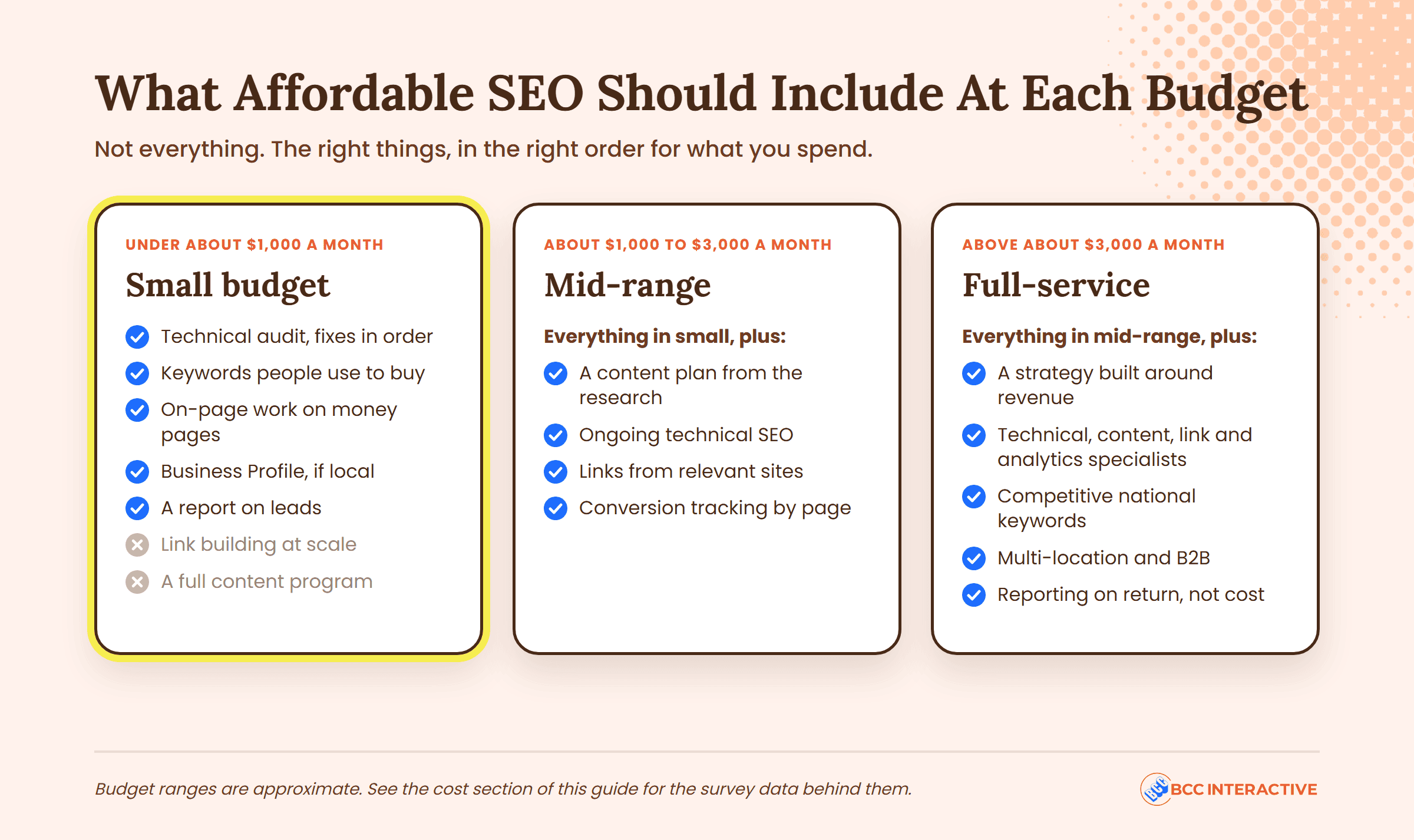
An affordable SEO plan doesn’t do everything. It does the right things in the right order, and the order changes with your budget.
Most affordable SEO packages come in tiers, with a keyword count or a number of blog posts attached to each. Tiers are fine as a starting point. The test is whether the provider adjusts the package after looking at your site, or sells you the tier as printed. A good package lists what’s in, what’s out, and why that order fits your budget.
On A Small Budget: What Low-Cost SEO Should Cover
At the low end, under roughly $1,000 a month, low-cost SEO only works if it’s narrow and specific. Good budget SEO services at this level should include:
- A technical SEO audit up front. A crawl that finds what’s blocking Google: broken pages, slow load times, missing titles, pages that can’t be indexed. Then fixes in priority order.
- Keyword research with intent. A short list of searches your customers use when they’re ready to buy, not a 500-row spreadsheet.
- On-page SEO for your money pages. Titles, headings, copy and internal links on the pages that sell.
- Google Business Profile work if you serve a local area. For most local businesses this is where the fastest wins are, and our local SEO services page explains what that work involves.
- A monthly report that shows traffic and leads, not just rankings.
What’s usually not included at this level: link building at scale, a full content program, or ongoing technical work. A plan that says “we’re not doing links yet” is being honest about scope.
On A Mid-Range Budget
Between roughly $1,000 and $3,000 a month, the scope widens to the work that compounds: a content plan built from the keyword research, ongoing technical SEO, link earning from relevant sites in your industry or region, and conversion tracking so the report shows leads by page, not just visits.
At A Full-Service Budget
Above that, you’re paying for strategy and several specialists: technical, content, links, analytics. This is where competitive national keywords, multi-location businesses and B2B companies with long sales cycles usually land. It’s also where “affordable” stops being the right word. The question becomes return, not cost.
Whatever the tier, the plan should start from your business goals, the provider should be able to explain every line item in plain English, and the report should tie the work to a number you care about.
What A Small Business Can Do Itself First
Before you pay anyone, do the free work. It’s not a substitute for professional SEO, but it tells you where you stand, and a provider who starts from a clean baseline can spend your money on the parts that need expertise.
Claim and fill out your Google Business Profile. It’s free. Add your real categories, hours, services, photos and a description written for customers. For a local business, this profile is what shows up in the map results, and it’s the single biggest free lever you have. If you’re a small business owner working through local search on your own, our local SEO for small business guide walks through it in order.
Set up Google Search Console. Also free. It shows you which searches already bring you impressions and clicks, which pages Google has indexed, and which ones it can’t. Every SEO provider you ever hire will ask for access to it, so have it running now.
Run a basic site check. Our free SEO tools post lists what’s still free and what each one is for. At minimum, find out whether your pages load fast on a phone, whether every page has a unique title, and whether anything important returns an error.
Fix the obvious. Pages with no title. Services you offer that have no page. Your phone number and address written three different ways across the web. None of this needs an expert.
Check how AI describes you. More buyers now ask ChatGPT or Google’s AI Overviews for recommendations before they search. Our free AI Visibility Playbook is a 15-minute check of what those tools say about your business and who they compare you to. It’s a diagnostic, not a fix, but it’s a useful baseline before you hire anyone who promises AI visibility.
Once that’s done, you’ll know whether your problem is technical, content, authority or targeting. That knowledge alone changes what you should pay for.
What To Ask Before You Pay For Affordable SEO
Our guide on how to choose an SEO agency covers the full vetting process: who works on your account, how success is measured, what the first 90 days look like, who owns your content and data, and the red flags to walk away from. Read that before you sign anything.
For an affordable plan specifically, the questions narrow to one theme: what, exactly, does this price buy?
Ask These Before You Agree To Any SEO Price
- How many hours of work does this price cover each month, and who does them?
- What is in scope, and what is deliberately out of scope at this budget?
- Where will the links come from, and can I see examples from another client?
- What will the monthly report measure beyond rankings?
- What would you expect to change in 90 days, and what would make you change the plan?
Cheap providers answer these with packages and promises. Affordable providers answer with specifics, and the specifics are what you're buying.
Google’s hiring guide (updated June 2026) adds two more worth borrowing. Ask for references, and ask those past clients whether the provider “produced positive results” and was easy to work with. And treat any audit as a source of “realistic estimates of improvement,” in Google’s words, not a guarantee. The same guide suggests giving a prospective provider read-only access to Search Console while they look, not write access.
One more thing on contracts. A provider who scopes honestly will usually explain what happens at the end of the first quarter: continue, change the plan, or stop. If the only answer is “twelve months minimum,” ask why a plan that works needs a contract to keep you.
When Paying For SEO Is Worth It, And When It Isn't
SEO is worth paying for when three things line up: your customers search for what you sell, you can handle more of them, and you can fund the work long enough for it to compound.
Timing depends on where you start, and no honest provider gives one number. An established site with targeting or content gaps can move in about 60 to 90 days. A site that needs bigger fixes, or a crowded market, often takes three to six months. A new site, or national keywords against big brands, is a six-to-twelve-month project or longer. Our post on how long SEO takes breaks down each case.
It’s usually not worth paying for yet when:
- Your site can’t convert. If visitors can’t find your phone number or the checkout breaks on a phone, more traffic is more waste.
- You need customers this month. Paid search is the channel for that, and a good provider will say so.
- You can only fund two months. The work won’t have time to compound.
- You haven’t done the free work above.
It is worth paying for when the free work is done, there’s a clear gap between what you offer and what your site ranks for, and you can fund a scoped plan for a year. Local businesses with a few core services, e-commerce sites with product pages that already convert, and B2B companies whose buyers research before they call tend to see the clearest returns.
"He did such an incredible job helping propel our content to the top-page results that I hired him again when my mother and I opened an insurance agency last year."
Affordable Means Scoped, Not Stripped
Affordable SEO services are real. They’re just not what the $99 ads are selling.
The affordable version starts with your business goals and your market, picks the work that will move your numbers, and leaves the rest for later. It costs more than the cheapest option, and it costs less than the full-service retainer you don’t need yet.
The cheap version does less of everything for everyone, and the part it cuts is the part that was supposed to work.
If you’re trying to figure out which tier your business actually needs, that’s a scoping conversation, not a sales call. We build custom solutions around goals, not packages, and the first step is finding out what SEO should cost in your market before anyone talks about a plan. Our SEO agency page covers how that work runs.
Frequently Asked Questions
It depends on who’s doing the work and for whom. Ahrefs’ survey of 439 providers found an average retainer of $2,917 a month. Backlinko’s survey of more than 300 SEO professionals puts the typical monthly cost at $1,000 to $2,500. SE Ranking’s survey of 260 agencies found 64% charge under $1,000 a month. For a small business, the right number is the smallest scope that can move your leads, funded for at least a year.
Usually not at $99 to $199 a month. That price only works with automation, templates or link schemes, and Google’s spam policies say sites that use link schemes, keyword stuffing or scaled content may rank lower or disappear from results. Recovering from that costs more than the SEO did. A low price with a narrow, honest scope is a different thing. Plenty of small agencies charge under $1,000 a month and do real work for local businesses, and that can be worth it.
They can be, if the package is a scope and not a template. Look for one that lists the hours, the work included, what’s deliberately left out at that budget, and what the report measures. Skip any package that promises a set number of backlinks, guaranteed rankings, or the same deliverables for every business regardless of market.
It depends on how many problems you have. A freelancer suits one clear job, such as a site audit or content for a set of pages, and costs less: Ahrefs puts the average freelancer retainer at $1,348.63 a month against $3,209 for agencies. An agency suits a business that needs technical, content and link work at the same time, or a market where one part-time person can’t keep up.
You can do the basics for free: claim your Google Business Profile, set up Google Search Console, fix missing titles and broken pages, and give every service you sell its own page. Keyword strategy, technical fixes, content that competes and link earning usually need experience, and that’s where a scoped provider earns the fee.
Yes, if the scope matches the budget. SE Ranking found that 94% of the agencies it surveyed focus on small or local businesses, and most charge under $1,000 a month. A small-budget plan should do two or three things well, such as a technical audit, on-page work for your money pages and Google Business Profile optimization.
No. Google’s own guide on hiring an SEO says no one can guarantee a #1 ranking, and tells you to find someone else if a provider promises first place. The same applies to guarantees of appearing in AI answers. What a good provider can give you is a realistic estimate of improvement, a scope, and a report that shows whether it’s working.
Find Out What SEO Should Cost In Your Market Before You Pay For It
- What SEO should actually cost for a business like yours, in your market
- Where your leads are leaking today, and which fixes are free
- A 90-day plan you can run with or without us
