
If you run a dispensary, you already know the game is rigged against you in one major way: you can’t run paid ads on Google, Facebook, or most of the platforms your competitors in other industries rely on. Paid advertising is largely off the table for cannabis businesses, which means SEO isn’t just a nice-to-have…
The good news? That restriction actually creates an opportunity. Most dispensary owners haven’t invested seriously in SEO, which means the local search results in your market are still very winnable. You just need to know how to play.
This guide breaks down cannabis dispensary SEO the right way, no fluff, no jargon, just what actually moves the needle.
Not sure where your dispensary stands in local search?
Why SEO Hits Different for Cannabis Retailers
SEO is the process of optimizing your website and online presence so that search engines rank you higher when potential customers go looking for what you sell. For a dispensary, that means showing up when someone in your city types “dispensary near me,” “cannabis store in [city],” or “best edibles in [neighborhood].”
The importance of SEO for dispensaries comes down to one problem: if you can’t pay to be seen, you have to earn it. And the dispensaries that earn it through strong local search rankings, a well-optimized website, and a dominant Google Business Profile are the ones pulling in consistent foot traffic without writing a monthly check to Google.
SEO is also one of the few marketing channels where your investment compounds over time. Unlike paid advertising, where traffic stops the moment you stop spending, organic traffic keeps coming in as long as you maintain your rankings.
Why Dispensaries Can't Afford to Ignore Local Search
The cannabis industry is growing fast, and so is the competition. Every market that’s legalized recreational or medical cannabis has seen a wave of new dispensary openings. Being a great dispensary isn’t enough anymore; local customers have to be able to find you first.
Here’s what’s working against most dispensary owners: local search results don’t just show a list of locations. They surface your reviews, hours, photos, and reputation right on the results page. A potential customer who is comparison-shopping among three dispensaries in their area is deciding before they ever visit your website.
Local SEO for dispensaries isn’t just about ranking high; it’s about owning that first impression.
| Local SEO Factor | Why It Matters for Dispensaries |
|---|---|
| Google Business Profile | Controls how you appear in Maps and the local 3-pack |
| Customer Reviews | Major ranking signal and trust driver for new customers |
| Local Keywords | Connects your pages to what buyers are actually searching |
| Citations & Directories | Builds authority and confirms your location information |
| On-Page SEO | Tells search engines what your dispensary offers and where |
Local SEO vs. National SEO: Know the Difference
National SEO is about ranking keywords across the country, relevant if you’re selling cannabis ecommerce products or informational content at scale. For most dispensaries, that’s not the goal.
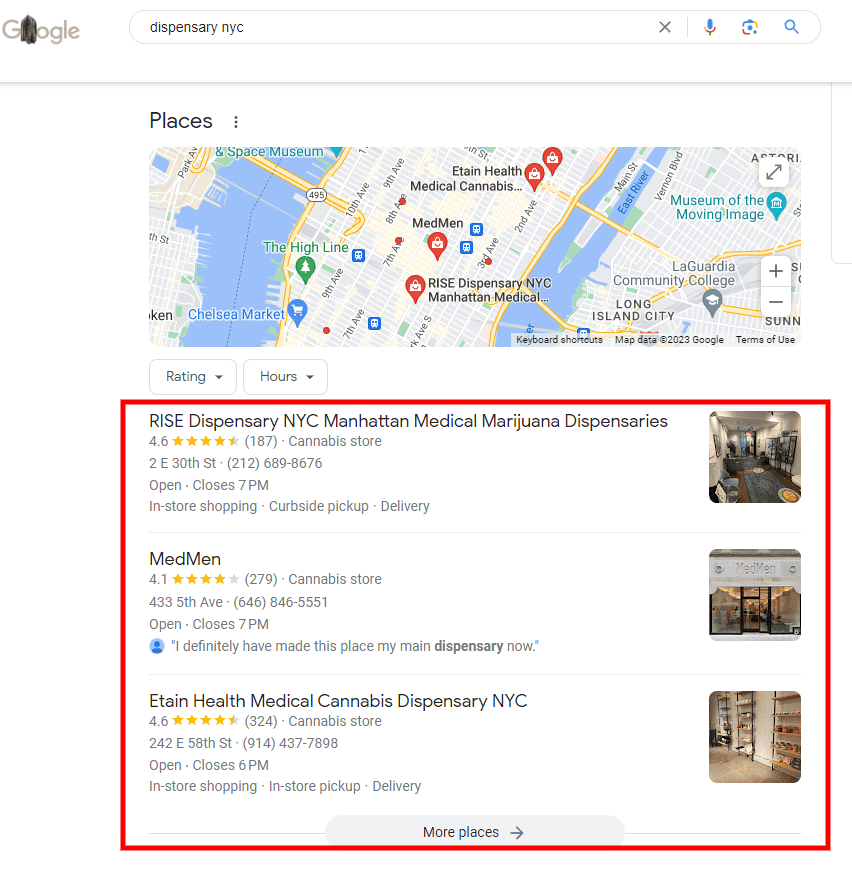
Local SEO targets buyers in your specific geographic area. It’s what gets you into the Google local 3-pack: those three map-pinned results that appear above the organic listings when someone searches for a dispensary in your city. Ranking there is the single highest-leverage move in local cannabis SEO because it puts you in front of high-intent buyers right when they’re ready to visit.
If you’re a dispensary with one or a few physical locations, local SEO is where 90% of your energy should go.
How to Optimize Your Dispensary for Search Engines
On-Page SEO: The Foundation
On-page SEO is exactly what it sounds like: optimizing the content and structure of your dispensary website so search engines can understand what you do, where you are, and who you serve.
For cannabis websites, this means:
Target the right keywords. Keyword research for a dispensary isn’t complicated, but it does require intention. You want to find the terms your local customers are actually searching for, like “cannabis store [city],” “THC edibles [neighborhood],” or “medical dispensary [county].” Don’t just optimize for broad terms. Local keywords that include your city, neighborhood, or region will drive the highest-quality traffic to your site.
Structure your pages properly. Each page on your dispensary website should target a specific keyword or topic. Your homepage, product category pages, and dispensary menus should all include keyword-optimized title tags, meta descriptions, headers, and body content. URLs and internal links should be clean, logical, and descriptive.
Create content that answers real questions. A blog that covers common questions your local cannabis market is searching for, strain guides, local regulations, and product comparisons, builds topical authority over time, and gives you more opportunities to rank higher in search results.
PRO TIP
Optimizing Your Google Business Profile
If you do nothing else on this list, do this: claim and fully optimize your Google Business Profile. It is the single most important asset for a dispensary’s local SEO.
Your Google Business Profile is what shows up in Google Maps and the local 3-pack. It displays your hours, photos, reviews, and contact information, and it’s often the first thing a potential customer sees before they even reach your website.
Optimizing your Google Business Profile means:
- Completing every field (hours, categories, description, services, attributes)
- Adding high-quality photos of your storefront and interior
- Choosing the right primary and secondary business categories
- Posting updates regularly to signal that the profile is active
- Actively requesting and responding to customer reviews
That last point matters more than most dispensary owners realize. Customer reviews are both a direct ranking signal and a conversion tool. A dispensary with 200 reviews and a 4.6 rating is going to win the click over a competitor with 18 reviews every time.
Technical SEO: The Stuff You Can't See (But Google Can)
Technical SEO is the behind-the-scenes work that makes your dispensary website easy for search engines to crawl, index, and rank. It’s less glamorous than content, but it’s the infrastructure everything else runs on.
Key technical SEO priorities for cannabis websites include:
- Mobile-first design: Most local search happens on phones. If your dispensary website isn’t fast and responsive on mobile, you’re losing customers before they ever read a word of your content.
- Site speed: Slow-loading pages hurt both user experience and SEO rankings. Image compression, lazy loading, and caching should be baseline standards.
- Schema markup: Adding local business schema to your site helps search engines better understand your location, hours, and services — which can improve how you appear in local search results.
- Age verification compliance: A compliant dispensary website isn’t just a legal requirement — it also signals legitimacy to search engines and builds trust with potential customers who land on your site.
PRO TIP
Build a Strong Backlink Profile
Backlinks, links from other websites pointing to yours, are one of the most powerful ranking signals search engines use. Building backlinks for a cannabis dispensary takes more strategy than other industries because of the restrictions around the cannabis niche, but it’s absolutely doable.
Where to focus for building backlinks in the cannabis market:
- Local directories: Getting listed in local directories like Yelp, Weedmaps, Leafly, and local business associations sends strong local relevance signals to search engines. These aren’t glamorous, but they work.
- Local press and community coverage: Local news sites, neighborhood blogs, and community organizations are gold for local dispensaries. If you host events, sponsor local causes, or have a unique story, pitch it.
- Cannabis industry publications: There’s a growing ecosystem of cannabis-focused blogs, magazines, and trade publications that accept contributions or cover local businesses. A mention or link from a relevant source in the cannabis industry carries real weight.
- Supplier and partner websites: If you carry specific brands or partner with local organizations, ask for a link from their site. These are often the easiest wins with the highest relevance.
Build a strong backlink profile slowly and legitimately. Shortcuts and spammy link schemes can tank your SEO rankings, and in a heavily regulated industry, that’s a hole you don’t want to dig yourself out of.
Dispensary SEO in the Age of AI Search
Here’s something most dispensary owners haven’t thought about yet: search isn’t just happening on Google anymore. A growing number of your potential customers are asking ChatGPT, Perplexity, Google’s AI Overviews, and other AI-powered tools questions like “what’s the best dispensary near me?” or “where can I find cannabis edibles in [city]?”, and those tools are pulling answers from somewhere. That somewhere is your online presence. Or it isn’t. And right now, most dispensaries aren’t showing up at all.
This is where Answer Engine Optimization (AEO) comes in. While traditional SEO focuses on ranking in search engine results pages, AEO is about making sure AI tools can find, understand, and confidently recommend your dispensary when someone asks a relevant question. It’s a newer discipline, but it’s becoming a real part of how local businesses get discovered, and the dispensaries that pay attention now will have a significant head start.
What actually influences AI visibility for a dispensary?
The good news is that a lot of it overlaps with what you’re already doing (or should be doing) for local SEO:
- Consistent, accurate business information across the web. AI tools pull from multiple sources — your website, your Google Business Profile, directories, review platforms like Weedmaps and Leafly, and local press mentions. If your name, address, phone number, and hours are inconsistent across those sources, AI tools can’t confidently surface you. Consistency builds the kind of authoritative signal that both search engines and AI platforms trust.
- Clear, structured content on your website. AI tools are looking for content that directly answers questions. If someone asks “what cannabis products does [your dispensary] carry?” the AI needs to find that answer somewhere on your site. Structured pages, clear service descriptions, and FAQ content all make your dispensary easier for AI to understand and recommend.
- Strong reviews and third-party mentions. AI tools don’t just look at your website- they look at what other sources say about you. A dispensary with hundreds of positive reviews across Google, Weedmaps, and Leafly, plus mentions in local news or cannabis publications, is the kind of business AI tools are more likely to recommend with confidence.
- Schema markup. This is the structured data layer on your website that explicitly tells search engines and AI tools what type of business you are, where you’re located, what you offer, and more. For a dispensary, a local business schema is a baseline, but a product schema for your cannabis products and an FAQ schema for your content pages can give AI tools even more to work with.
PRO TIP
The cannabis market is competitive enough as it is. As AI search grows, the dispensaries that optimize for it early will be the ones that own both traditional search results and AI-generated recommendations. That’s a compounding advantage most of your local competitors aren’t building yet.
Most dispensaries aren't showing up in AI search yet.
How to Measure Whether Your Dispensary SEO Is Working
You can’t improve your dispensary’s SEO if you’re not tracking what’s happening. Three tools every dispensary owner should be using:
- Google Search Console shows you which keywords people use to find your website, which pages are getting impressions, and where there are technical issues. It’s free, and it’s essential.
- Google Analytics: shows you what happens after people arrive on your site: which pages they visit, how long they stay, and what actions they take. This is how you connect your organic traffic to actual business outcomes.
- Google Business Profile Insights: shows you how customers are finding your profile, whether through branded searches or discovery searches, and what actions they’re taking (calls, direction requests, website clicks). Tracking this over time tells you whether your local SEO is moving in the right direction.
The Bottom Line on SEO for Dispensaries
The competitive cannabis market isn’t slowing down. New dispensaries are opening, regulations are evolving, and the online visibility game is only getting more important. SEO is one of the few channels where a well-run local dispensary can genuinely outcompete a bigger operator because rankings are earned, not bought.
Cannabis dispensary SEO isn’t a one-time project. It’s an ongoing investment in your dispensary’s online presence that compounds over time. Nail your Google Business Profile. Build your local keyword strategy. Fix your technical foundation. Earn backlinks the right way. And track everything so you know what’s working.
If you’d rather have a team handle it while you focus on running your business, that’s what we’re here for.
Ready to get your dispensary ranking where it belongs?
FAQs
Most major advertising platforms — Google, Facebook, Instagram — prohibit paid advertising for cannabis businesses. That’s not a loophole or a gray area; it’s a hard restriction. That’s exactly why cannabis dispensary SEO isn’t optional. Organic search is the primary traffic channel available to most dispensary owners.
Most dispensaries start seeing meaningful movement in local search results within 3 to 6 months of consistent SEO work. The timeline depends on how competitive your local market is, how well your site is currently optimized, and how aggressively you’re building authority. Local SEO generally shows results faster than national campaigns.
Your Google Business Profile — hands down. For local search results, especially the Google Maps 3-pack, a fully optimized profile with strong customer reviews is the highest-leverage thing you can do. After that, consistent local keyword targeting and building backlinks from local sources are what separate the top-ranked dispensaries from everyone else.
They can, but not on their own. Most menu platforms load content dynamically, which search engines often can’t read. The better play is to build dedicated product-category pages on your dispensary website with optimized content, and to use the menu as a functional tool, not as your SEO strategy.

