


Google search doesn’t look the way it did two years ago. Type in a question and there’s a good chance the answer is sitting at the top of the page before you’ve clicked a single link.
BrightEdge tracked AI Overview presence daily for twelve months and found it grew from roughly 30% of tracked queries to 48% by February 2026, a 58% increase.
Now flip that number over, because almost nobody does. About 52% of search queries still return no AI Overview. For most searches, organic results are still the entire experience.
Both things are true. Which one applies to your business depends on what people type to find you.
Key Takeaways
AI Overviews are common, not universal. BrightEdge found them on 48% of tracked queries by February 2026, so about 52% of searches still show none.
Ranking #1 and getting cited are different outcomes. BrightEdge found only about 17% of sources cited in AI Overviews also rank in the organic top 10.
Long questions trigger them most. Pew Research found question-based searches produced an AI summary 60% of the time, against 8% for one or two-word searches.
Intent decides your exposure. A Whitespark study found AI Overviews on about 15% of simple local searches but about 97% of hybrid ones like dental implant costs.
Clicks drop when a summary shows up. Pew found users clicked a traditional result in 8% of searches with an AI summary, compared with 15% without one.
Getting cited still beats getting skipped. Seer Interactive found cited brands earn roughly 120% more organic clicks per impression than uncited brands on the same page.
Normal SEO is the strategy. Ahrefs found 97% of llms.txt files got zero requests in May 2026, and Google says you don't need GEO tricks to appear.
What Are AI Overviews?
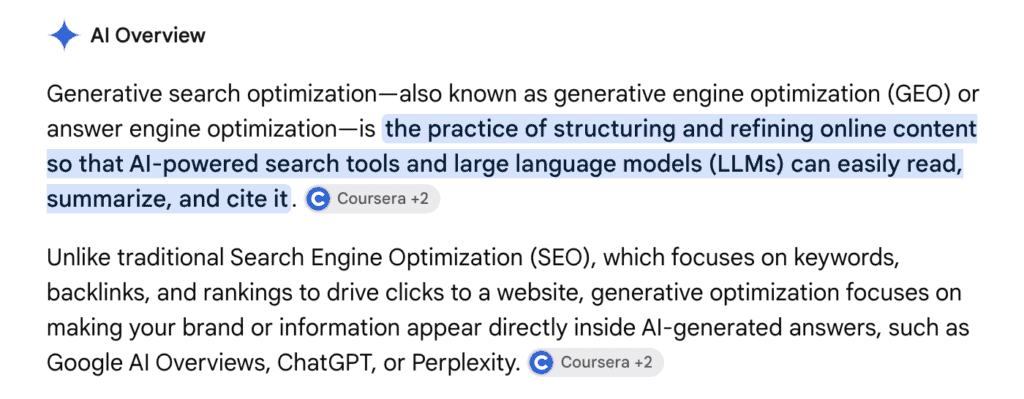
AI Overviews are automatically generated summaries that appear at the top of the results page for certain searches. Instead of scrolling through ten blue links, users get a written answer pulling information from multiple sources, with citations linked underneath. They’re Gemini-powered, generated using Google’s own large language models, and they’ve rolled out across more than 200 countries.
This is different from Google’s older Search Generative Experience (SGE), the experimental version tested before AI Overviews went mainstream. AI Overviews are the permanent replacement.
Google also has AI Mode, a conversational search experience that lets users ask follow-up questions the way they would with a chatbot. Different feature, same idea: answer the query directly instead of pointing you somewhere else.
AI Overviews also take up a lot of screen space. BrightEdge measured the average AI Overview at over 1,200 pixels tall against a standard desktop viewport of about 900. When one appears, the first organic result sits entirely below the fold. That’s before click-through rate enters the conversation. The listing is just gone from view.
How Do Google AI Overviews Work?
When someone runs a search, Google doesn’t summarize the top result. The process behind AI Overviews is called query fan-out: Google breaks the original query into related sub-questions, searches for answers to each, and stitches the findings into one summary.
This is why ranking #1 and getting cited are two different outcomes. BrightEdge found that only about 17% of sources cited in AI Overviews also rank in the organic top 10, and that number has been flat for months. Roughly five out of six citations come from content that isn’t on page one.
That cuts both ways. Strong search rankings don’t automatically get you cited. Not ranking on page one doesn’t lock you out.
It also varies enormously by industry. Healthcare has the highest overlap at 24%, which fits how cautious Google is with medical content. Finance sits at 11%, meaning nearly nine out of ten citations in that space come from somewhere other than page one.
Not Sure How AI Tools Describe Your Business Right Now?
The AI Visibility Playbook is a 15-minute check you run yourself in ChatGPT, Gemini and Perplexity. It shows you what AI says about your business and where it gets that from. It's a diagnostic: you see the gap before anyone sells you a fix.
Get the AI Visibility PlaybookWhat Types Of Questions Trigger AI Overviews?
Query length and phrasing matter more than most people realize.
The 2025 Pew Research Center study tracked the actual browsing behavior of 900 U.S. adults through March 2025. Short keyword strings are the least likely to trigger AI Overviews. Long, conversational questions are the most likely. If your content is built around the actual types of questions your customers ask, you’re writing directly into the queries where AI Overviews show up.
How often Pew saw an AI summary, by query type:
| Query Type | How Often An AI Summary Appeared |
|---|---|
| One or two-word searches | 8% |
| Full-sentence searches (noun and verb) | 36% |
| Ten or more words | 53% |
| Question-based ("who," "what," "why") | 60% |
Write for the exact question your customer types, not the head keyword. Query fan-out rewards a page that answers one thing thoroughly, which is how a narrow page gets cited without a top-10 ranking.
- Full sentences
- Ten or more words
- Who, what, why
Whether AI Overviews Matter Depends On What People Search

Most articles on this topic fall apart here. They quote one blended average and let you assume it applies to you.
Local search is the clearest example. A Whitespark study covered in Search Engine Land’s guide to AI and local search found AI Overviews appearing on 68% of local searches overall. Scary number in isolation. The breakdown by intent (table below) is what actually matters.
That same study found local packs appearing for more than 90% of simple local queries and 39% of queries overall.
So if you’re a plumber ranking for “plumber philadelphia,” your exposure is small, and your budget belongs in the local pack and your service pages. If you’re a dental practice creating content about implant costs, or a healthcare practice answering procedure questions, you’re in the 92% to 97% range, and this is urgent.
Same SERP feature, opposite strategy. Anyone selling you an AI search package without asking which of those you are isn’t paying attention.
| Query Type | Example | AI Overview Appears |
|---|---|---|
| Simple local intent | "tacos san francisco" | ~15% |
| Informational local | "how long does an eye exam take near me?" | ~92% |
| Hybrid intent | "average cost of dental implants in phoenix" | ~97% |
The Click Problem And What Cited Sources Actually Get
AI Overviews are cutting into website traffic. That worries brands and marketers alike, and the Pew data is blunt.
Users clicked a traditional result in just 8% of searches with an AI summary, compared with 15% on pages without one. Clicks on the cited sources inside the summary were rarer still, at 1% of visits. And 26% of users ended their browsing session entirely after a page with an AI summary, versus 16% without.
Zero-click searches aren’t new. Pew found roughly two-thirds of all Google searches end with the user browsing elsewhere on Google or leaving without clicking anything, with or without AI. AI Overviews made an existing problem worse; they didn’t invent it.
Seer Interactive’s numbers line up. They tracked 3,119 informational search terms across 42 organizations and found organic click-through rate on queries with an AI Overview fell 61%, from 1.76% down to 0.61%.
Their larger study of 53 brands across 5.47 million queries found brands cited within the AI Overview earn roughly 120% more organic clicks per impression than brands on the same page that don’t get cited.
That same study found cited brands still underperform a no-AI-Overview result by 38%, and that part rarely makes the headline. Getting cited is an advantage over everyone else on that page. It is not a return to what you had. Seer also says plainly that they can’t prove citations cause the lift, since brands with stronger authority and better baseline click-through rates are more likely to get cited in the first place.
The industry blurs two distinctions constantly.
A mention is not a citation. Being named in the summary text is different from being linked as a source. A mention with no link means the customer has to find you, which is friction you didn’t have before.
Citation position matters. Being the source the summary leans on is not the same as being the seventeenth link in the source tray. Being citation #17 is functionally the same as not being cited.
There’s also no accepted attribution model for any of this. Someone discovers you in an AI Overview and converts three weeks later through branded search. Your analytics credits direct. Anyone promising you clean AI search attribution is selling something.
Before You Panic: The Hype Is Ahead Of The Behavior
SparkToro’s August 2025 research, also covered in that Search Engine Land guide, found that only 20% of Americans use AI tools 10 or more times per month, while 95% still engage with traditional search engines monthly. Semrush found that when people adopt ChatGPT, their Google usage goes up, not down.
Rand Fishkin’s read on his own data: traditional search isn’t going anywhere even among heavy AI adopters, and the AI-versus-search narrative is largely manufactured by media and influencers chasing attention.
Plan for AI-driven search. Don’t abandon the channel still doing 95% of the work.
Want To Know Whether AI Overviews Are Costing You Traffic?
We'll pull your real numbers, not industry averages, and show you how we get brands cited instead of skipped.
See Our AEO ServicesWhat Google Says About How To Optimize For AI Overviews
There’s a lot of noise claiming you need a separate strategy to win at AI search. You don’t, and Google has said so directly.
Gary Illyes, speaking at Google’s Search Central Deep Dive event, said that to appear in AI Overviews, you use normal SEO practices and don’t need GEO, LLMO, or anything else. John Mueller made the same point on the terminology fight: what you call it doesn’t matter, but AI isn’t going away, so thinking about how your site’s value works in a world where AI exists is worth the time. Danny Sullivan’s version is shorter. Good SEO is good GEO.
Generative Engine Optimization (GEO) is SEO applied with an eye toward how AI systems pull and summarize information. It isn’t a separate discipline with its own ranking system. Google builds AI Overviews from the same index, crawl, and quality standards that power organic results.
That 17% top-10 overlap means organic ranking isn’t a gate you have to pass through to get cited. But the broader overlap, sources ranking anywhere in the top 100, sits around 53% and has been climbing. Being in Google’s index with real topical depth is still the entry ticket. It just isn’t the same race as fighting for position one.
| SEO Fundamental | Why It Also Helps With AI Overviews |
|---|---|
| Content that answers a specific question directly | Matches how query fan-out pulls sub-answers |
| Crawlable, indexable pages returning HTTP 200 | Google can't summarize what it can't fetch |
| Backlinks and mentions from reputable sources | Feeds the sources AI-generated answers cite most |
| On-page SEO basics like clear titles and meta descriptions | Improves how your page reads on the search results page |
| Fast, clean technical SEO across desktop and mobile devices | Baseline quality signals Google checks first |

Check your organic rankings before you spend a dollar on AI visibility work. Search Console or Semrush will show you where you stand. If you don't rank for the topics you want AI to cite you for, that's the actual problem, and it's where we'd start.
What Site Owners Can Skip When Optimizing For AI
A lot of what’s being sold as AI search essentials does nothing, according to the data.
llms.txt. Ahrefs analyzed 137,000 domains and found 28% publish an llms.txt file, and 97% of those files received zero requests in May 2026. Not zero AI traffic. Zero traffic. Nothing fetched them at all.
Of the 3% that did get read, AI retrieval bots (the ones that actually feed AI search answers) accounted for 1.1% of requests. Slackbot’s link-preview crawler fetched llms.txt files more often than PerplexityBot did. And when Ahrefs looked at 404s for llms.txt files that don’t exist, the AI bot share was zero. Nothing goes looking for one.
Google’s own AI optimization guide has a section titled “mythbusting” stating you don’t need machine-readable files, AI text files, markup, or Markdown to appear in generative AI search. Mueller called llms.txt a temporary crutch for AI coding tools parsing developer docs, and said flatly it’s “not done for search.”
If your customers are developers using coding agents, there’s a real use case. If you’re a dentist, skip it.
Publishing Markdown copies of your pages for bots. Martin Splitt has pointed out that Markdown strips the link structure and heading relationships that language models use to understand context. You’d be removing signal.
Turning every heading into a question and chopping paragraphs into “chunks.” Nobody has demonstrated this works. Readable beats over-engineered.
Schema markup as an AI play. Schema is fine. It’s table stakes for rich results and other SERP features, and it helps Google parse your entities. Nobody has proven it changes whether an AI engine cites you.
Skipping these isn’t laziness. It’s spending the same hours on things with evidence behind them.
5 Ways To Improve Your Chances Of Appearing In AI Overviews
| Step | What It Does |
|---|---|
| 1. Answer questions directly | Puts the answer up top, where Google can summarize it faster than a list of links |
| 2. Build topical depth, not volume | Signals expertise; mass publishing thin content can hurt the rankings you already have |
| 3. Earn backlinks and mentions from trusted sources | Feeds what AI repeats about you; if nobody credible says it, the AI won't either |
| 4. Keep technical SEO clean | Lets Googlebot fetch indexable pages that return HTTP 200 and load fast on mobile |
| 5. Change what you measure | Tracks leads, calls, form fills and revenue, not just sessions and snippet impressions |
- Answer questions directly. Get to the point instead of burying the answer three paragraphs down. Google shows a summary when it thinks it can help users faster than a list of links can.
- Build topical depth, not volume. A few strong pieces covering a subject properly signal expertise. Mass publishing thin content does not, and it can damage the rankings you already have.
- Earn backlinks and mentions from sources people trust. AI systems repeat what the web says about you. Third-party mentions on review sites, industry publications, and community platforms feed directly into AI Overviews. If nobody credible is saying it, the AI won’t either.
- Keep technical SEO clean. Google’s guidance for website owners is specific: don’t block Googlebot, make sure pages return HTTP 200, publish indexable content in supported formats. Make sure your site loads quickly on mobile devices. Add strong images and video, and keep Merchant Center listings current if you sell products.
- Change what you measure. Google says clicks arriving from pages with AI Overviews tend to be higher quality, with users spending more time on site. Take that with appropriate skepticism given who’s saying it, but the underlying advice holds: track metrics like leads, calls, form fills, and revenue, not just sessions and snippet impressions.
Showing up in Google AI Overviews also does not mean you’ll show up in ChatGPT, Perplexity, or Claude: different systems, different sources, different behavior. If AI visibility matters to your business, you need to check it platform by platform.
Hallucinations Are A Real Business Risk
AI Overviews misrepresent businesses regularly. They generate claims about brands that no cited source actually supports. GatherUp found that 67% of consumers aren’t rigorously fact-checking AI sources before choosing a local business.
So if an AI tool says your practice doesn’t take a certain insurance, or gets your service area wrong, or invents a problem you don’t have, two-thirds of the people reading it take it at face value. You lose the customer and never know it happened.
This is a reputation management problem wearing a search hat, and it’s the single most common reason clients come to us for an AI Visibility Analysis.
Where This Fits Into Your Digital Marketing Strategy
If you’re leaning on paid ads to generate leads right now, that’s not a mistake. Ads get you visibility today. They’re the short-term catalyst. SEO, and by extension GEO, is the long-term engine that keeps producing after the ad budget stops.
What’s changed is what showing up means. AI Overviews currently appear on roughly half of tracked queries, and on those queries, being cited is worth roughly twice as many clicks as not being cited. It’s the only version of position one that still exists there. On the other half, where no summary appears, nothing has changed.
That’s the gap BCC Interactive was built to close. We don’t treat SEO and AI visibility as two products bolted together. Same technical foundation, same content strategy, applied with an understanding of how AI systems pull and cite information. And we’ll tell you when your query mix means AI Overviews aren’t your problem, because plenty of the time they aren’t.
Frequently Asked Questions
AI-generated summaries at the top of the results page that answer the search with information pulled from several websites. They showed up on about 48% of BrightEdge’s tracked queries as of February 2026. How often you’ll see one depends on what you search and how long the search is.
Long, conversational questions. Pew Research found question-format searches produced a summary 60% of the time and searches of ten or more words 53% of the time. One or two-word searches did it just 8% of the time.
No. About 52% of tracked queries return no AI Overview at all. When one does show up, it pushes the organic listings below the fold, but they’re still there underneath, and rankings still matter.
Not automatically. Only about 17% of sources cited in AI Overviews also rank in the organic top 10. Ranking well helps, but they’re separate outcomes: roughly five out of six citations come from content that isn’t on page one.
Rarely. Pew Research found only 1% of visits to pages with an AI summary ended in a click on a cited source. People can still click the regular results below, but they do it far less often when a summary is on the page.
Not for Google. Google’s documentation says you don’t need machine-readable files, AI text files, markup or Markdown to appear in its generative AI features. Ahrefs found 97% of published llms.txt files got zero requests in a full month. It only has a real use if your customers work with AI coding agents.
Open Search Console and compare click-through rate on your informational queries against your commercial and branded queries over the last twelve months. If informational click-through rate dropped hard while impressions held or grew, that’s your answer. For the rest of your AI search numbers, see how to measure GEO performance.
Are AI Overviews Costing You Clicks? Let's Find Out.
- Which of your searches trigger AI Overviews, and whether you get cited or skipped
- Where your leads are leaking, from the search result to the form
- A 90-day plan for Google and AI search you can run with or without us
