


Most business owners we talk to have no idea if their brand shows up in ChatGPT or Gemini. They assume it either does or doesn’t, and they leave it at that. That’s a problem, because AI search is already influencing buying decisions, and guessing isn’t a strategy.
If you’re serious about generative engine optimization, you need real numbers, not a hunch. Let’s break down what to track and how.
Key Takeaways
Mentions aren't citations. Track them as two separate metrics, or your reporting will look better than it actually is.
Ranking doesn't mean getting cited. BrightEdge found only about 17% of sources cited in Google's AI Overviews also rank in the organic top 10.
Use a fixed prompt set. Run the same 15 to 25 prompts your buyers would ask every month across ChatGPT, Perplexity, Gemini and Google AI Overviews.
Search Console now shows AI impressions. Google's generative AI report reached every property on August 31, 2026, with AI Overview and AI Mode impressions but no clicks or CTR.
Segment citations by funnel stage. A handful of commercial citations is worth more than hundreds of informational ones, because that's where people decide what to buy.
AI referral traffic is still small. Semrush put it at 0.14% of total visits and Conductor at 1.08% of sessions, too small to carry a leadership report on its own.
Report brand and performance side by side. Share of voice, branded search lift and citation rank show the program working even when the click never happens.

Measuring GEO: Why It's Different From Traditional SEO
Rankings and click-through rates still matter; they always will. But generative search platforms no longer hand out a list of ten blue links. They synthesize one answer and decide whether to mention your brand.
That means measuring GEO performance requires a different lens. You’re not just asking “did we rank?” You’re asking “did the AI cite us, mention us accurately, and put us in front of the right query?” Traditional organic traffic reports won’t catch any of that.
What changes with AI-driven search:
- Zero-click is the default, not the exception. A lot of AI answers satisfy the user right there. No click, no session in Google Analytics.
- Citation doesn’t equal ranking. A page can rank #1 in Google and still get skipped by ChatGPT or Perplexity when generating an answer. BrightEdge found that only about 17% of sources cited in Google’s AI Overviews also rank in the organic top 10, and that number has been flat for months.
- Framing matters as much as frequency. Getting mentioned isn’t the win. Getting mentioned accurately and favorably is.
- Visibility in one AI platform doesn’t transfer to another. ChatGPT, Perplexity, Gemini, and Google AI Overviews pull from different sources and behave differently. Showing up in one tells you almost nothing about the others.
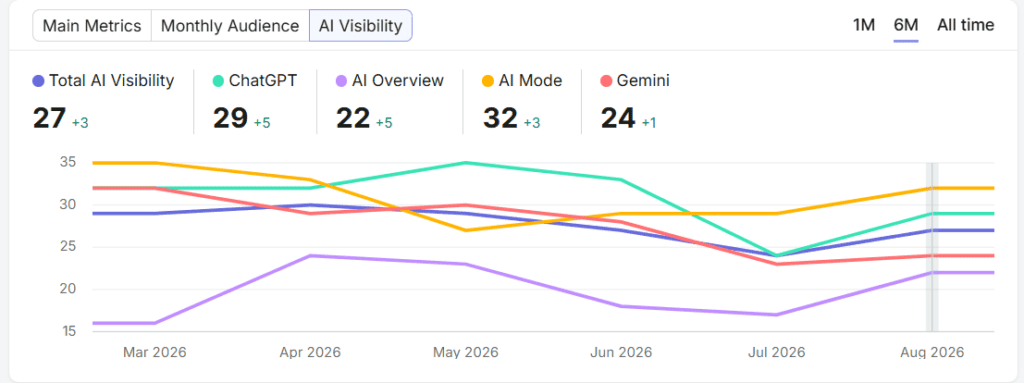

Track mentions and citations as two separate metrics. A brand can get name-dropped in an AI answer without a link back to your site or any credit as a source. Lump the two together and your reporting looks better than it actually is.
Core GEO KPIs: The Key Metrics Every Marketer Should Track
Skip the vanity dashboard. These are the core KPIs worth your time:
| Metric | What It Measures | Where to Find It |
|---|---|---|
| Share of voice | How often your brand shows up across a set of prompts vs. competitors | Semrush, manual prompt testing |
| Citation rate by funnel stage | How often AI platforms cite your pages, split by informational vs. commercial queries | AI visibility tools, manual audits |
| Citation rank | Where you land among the cited sources in an answer | Manual review of AI answers |
| AI Overview and AI Mode impressions | How often your pages surface inside Google's AI answers | Google Search Console generative AI report (impressions only) |
| Copilot citations | How often Microsoft Copilot cites your pages, and the queries that triggered it | Bing Webmaster Tools AI Performance (Copilot and Bing only) |
| Brand mention accuracy | Whether AI describes your brand correctly | Manual prompt audits, quarterly review |
| Third-party source sentiment | What the sites AI pulls from are saying about you | Brand monitoring tools, manual review |
| AI referral traffic | Sessions arriving from AI platforms | Google Analytics (GA4) only |
| Branded search volume | Whether AI exposure is driving people to search your name | Google Search Console, Semrush |
| Organic rankings | Your guardrail metric, covered below | Google Search Console, rank tracker |
| Query coverage | How many relevant prompts you show up for at all | Prompt tracking spreadsheet or dashboard tool |
Three notes on that table before you build anything from it.
Google Search Console does not report AI referral traffic. GSC covers Google Search performance. Sessions from ChatGPT, Perplexity, and Claude land in GA4 as referral traffic and nowhere else. If someone tells you to pull AI referrals out of Search Console, they haven’t done it.
Google Search Console does now report AI Overview and AI Mode impressions. This is new since we first published this piece. Google finished rolling the generative AI performance report out to every property worldwide on August 31, 2026. You get impressions across AI Overviews, AI Mode, and generative AI in Discover, broken out by page, country, device, and date. It’s free, it’s already sitting in your account, and most teams still haven’t opened it. If yours reads zero, that’s a finding, not an absence of data.
It still doesn’t give you AI Overview click-through rates. The generative AI report is impressions only. No queries, no clicks, no CTR, no average position. Any GEO report that promises “AI Overview CTR from GSC” is still promising a number that doesn’t exist as a separate line item.
Citation Rank: The Metric Most GEO Dashboards Miss
Citation rank sits separately from citation rate on that list. That’s intentional.
Getting cited matters. But if you’re buried at the bottom of a long list of sources an AI pulled from, that citation is doing almost nothing for your brand. Being the seventeenth citation is like being on page six of Google. Nobody’s getting there.
Rank inside the citation is a legit KPI, not a footnote.
The related trap is aggregate citation rate. Track it as one number, and a single top-of-funnel explainer page can rack up hundreds of citations across “what is X,” “why does X happen,” and “explain X simply.” Meanwhile, your bottom-of-funnel page targeting “best X software for Y” pulls a handful.
On a flat dashboard, the blog post looks like a superstar and the product or service page looks like a failure. It’s backward. The handful of commercial citations are worth more than the hundreds of informational ones, because those are the queries where someone is actually deciding what to buy.
Segment your citation rate by funnel stage, or the number will lie to you.
AI Visibility And Citation Tracking
Citation tracking isn’t sexy work, but it’s the reporting layer of any credible GEO strategy. We run it with clients in five steps:
- Build a fixed list of 15 to 25 prompts your buyers would realistically ask.
- Run those prompts monthly across ChatGPT, Perplexity, Gemini, and Google AI Overviews.
- Log whether your brand appears, whether it’s cited with a link, and where in the response.
- Tag each prompt as informational or commercial so you can segment the results.
- Compare month over month. Don’t overwrite old data. You need the trend line, not just a snapshot.
Why cap it at 25 prompts? Because the prompt space is functionally infinite. You can be mentioned and cited across an unlimited number of query variations, and you cannot optimize for each one individually. A fixed prompt set is a sample, not a census. Anyone selling you exhaustive prompt coverage is selling you a number that means nothing.
You also don’t need a tool to start. Open ChatGPT, ask it five questions your customers would ask, and write down what it says about you. That’s a benchmark. It costs nothing, and it’s more than most of your competitors have.
Two free reports now cover part of this for you. Search Console’s generative AI report tells you how often your pages surface in Google’s AI answers, and Bing Webmaster Tools’ AI Performance report gives you actual Copilot citation counts per page, plus the queries that triggered them. Neither one touches ChatGPT or Perplexity, which is exactly the gap your prompt set exists to fill. Pull the free data first, then spend your manual effort where nobody reports it for you.
Before You Build the Dashboard, Run the 15-Minute Check
The AI Visibility Playbook is a 15-minute check you run yourself in ChatGPT, Gemini and Perplexity. It shows you what AI says about your business and where it gets that from, so you know what to fix before anyone sells you a fix.
Get the AI Visibility PlaybookBuilding A GEO Dashboard For Tracking Performance
A GEO dashboard doesn’t need to be complicated. It needs to be consistent. At minimum, yours should include:
- Share of voice by AI platform (ChatGPT, Perplexity, Gemini, Google AI Overviews)
- Citation rate and citation rank, tracked separately and split by funnel stage
- AI Overviews and AI Mode impressions from Search Console’s generative AI report, remembering it’s impressions only
- Copilot citations per page from Bing Webmaster Tools, which covers Copilot and Bing but not ChatGPT or Perplexity
- AI referral traffic pulled from Google Analytics
- Branded search volume, since AI exposure often drives people to search your name directly afterward
- Third-party mention sentiment on the sites AI actually pulls from
- Your existing organic rankings, as a guardrail
- A rolling log of your prompt set results, updated monthly
That guardrail line matters more than it looks. If your citation rate climbs while your organic rankings slide, that’s not a win. Recovering lost Google rankings can take two or three years. No amount of AI visibility is worth trading your organic search foundation for, and a dashboard that doesn’t show you both won’t catch it happening.
The third-party sentiment row matters for a different reason. AI is a parrot. It repeats what the web says about you, which means the inputs to your AI visibility live mostly outside your website. Reviews, industry publications, community threads, and press coverage all feed what an AI says about your brand. A dashboard that tracks only your own citations watches the output and ignores the source.
Keep your prompt set the same for at least a quarter. AI answers shift constantly, and if your test questions change every month too, you can't tell a real drop from noise.
- 15 to 25 prompts
- Run monthly
- Hold for a quarter
GEO Measurement Mistakes That Wreck A GEO Strategy
There’s a lot of noise in this space right now, and some of it will waste your time.
Schema markup as a guaranteed GEO lever. It’s good practice for structured data generally, but there’s no solid evidence yet that adding schema directly improves how often LLMs cite you.
Q&A-formatted headings as an “AI-friendly” trick. Clear, well-organized content helps. A specific Q&A heading structure isn’t proven to outperform clean, direct writing.
Treating llms.txt as the whole answer. The file itself is cheap and harmless. Believing it’s what’s standing between you and AI visibility is the real problem. Ahrefs analyzed 137,000 domains and found 97% of published llms.txt files received zero requests in a full month. Of the small share that did get read, AI retrieval bots (the ones feeding AI search answers) accounted for 1.1% of requests. Slackbot’s link preview crawler fetched them more often than PerplexityBot did. If your customers use AI coding agents, there’s a real use case. If they don’t, it’s not the lever.
Expecting fast movement after content changes. LLM training data doesn’t refresh in a week. Real shifts in how a model represents your brand can take months, sometimes longer.
Treating AI referral traffic as your headline number. More on that below, because it’s the mistake most likely to sink a budget conversation.
Reporting GEO Results To Leadership
If you’re a marketer reporting up, this section decides whether your program survives the next budget cycle.
Start with the scale problem. Semrush analyzed billions of visits across more than 50,000 websites and 17 industries and found AI traffic grew 66% in 2025 while still accounting for just 0.14% of total visits. Conductor’s benchmark across 13,770 domains put it at 1.08% of sessions. Both numbers are growing fast. Neither is a number you want to build a leadership presentation around.
The conversion premium is shakier than the headlines suggest, too. You’ve probably seen claims that AI traffic converts 4x or even 23x better than organic. Amsive ran the test those studies skipped: a paired analysis of 54 websites with six months of validated GA4 conversion data. Organic converted at 4.60%, LLM referrals at 4.87%, and the difference failed statistical significance at p = 0.794. Filtering to the 33 highest-volume sites widened the gap, and it still didn’t hold. B2B sites did show a real edge at 2.17% versus 1.16%, suggesting the premium is tied to considered, research-heavy purchases rather than AI traffic as a category.
Then there’s the attribution problem. No universally accepted attribution model exists for AI search. Someone can discover your brand in an AI answer, sit on it for three weeks, and convert through branded search or direct traffic. Your analytics credit direct. If you report GEO purely on attributed pipeline, you’re reporting a fraction of the actual impact and setting yourself up to lose the argument.
So report both sides:
Brand side. Share of voice against competitors, branded search lift after a GEO push, citation rank on your highest-value commercial queries, and mention accuracy. These numbers show the program is working even when the click never happens.
Performance side. AI referral traffic month over month in Google Analytics, and any tracked conversions you can trace to an AI referral source.
Then say the quiet part out loud in the deck: these two don’t reconcile, and that’s a known limitation of the channel, not a gap in your reporting. AI search is both a brand channel and a performance channel. Leadership handles that fine when you tell them upfront. They handle it badly when they find out later.
Frame the report around business impact first, metric second. That’s the version that gets your budget renewed.
Foundational GEO: Generative Search Still Runs On SEO
Something we tell every client: generative search engines pull heavily from content that’s already established, crawlable, and trusted in traditional search. If your technical SEO is a mess, your GEO numbers will reflect it. Strong SEO is the foundation. GEO measurement shows whether the AI visibility layer on top of it is working.
That same Semrush study found organic search declined across 13 of the 17 industries they analyzed. That’s the real backdrop here. Organic isn’t collapsing, but it’s compressing, and businesses treating AI visibility as an add-on to a strong SEO program are handling it much better than those treating it as a replacement.
That’s the whole philosophy behind how we approach this. Paid ads get you leads today. SEO builds the engine that keeps generating leads for years. GEO measurement tells you whether that engine is also showing up in the new places your buyers are asking questions.
Want Someone To Run This Measurement For You?
We run AEO (answer engine optimization, also called GEO) alongside SEO: the prompt tracking, citation work and reporting in this guide, built on top of your search rankings instead of in place of them.
See How We Do AEOFrequently Asked Questions
Track all of them. ChatGPT gets most of the attention, but Claude, Gemini and Perplexity pull from different sources and serve different audiences. Visibility in one doesn’t carry over to the others, so if you only benchmark ChatGPT, you’ll miss whole segments of buyers.
Start with query coverage and citation rate on your commercial prompts. Those tell you whether you show up in AI answers at all on the queries where someone is deciding what to buy. Everything else is refinement.
No. AI referral traffic is somewhere between 0.14% and 1.08% of total sessions, depending on whose benchmark you use. It’s growing fast and worth tracking, but it’s too small right now to carry a report on its own. Pair it with brand-side metrics like share of voice and citation rank.
Partly. Search Console’s generative AI report shows impressions across AI Overviews, AI Mode and generative AI in Discover, by page, country, device and date. It doesn’t show queries, clicks, CTR or average position, and it doesn’t report AI referral traffic from ChatGPT or Perplexity. That lives in Google Analytics.
Yes, keep both. Rankings and click-through rates in regular search results still drive real traffic, and your organic rankings double as a guardrail. If GEO work is costing you rankings, no citation rate makes up for it.
Ask ChatGPT five questions your customers would ask and write down what it says about your brand. Do it again next month. It costs nothing, it’s measurable, and it’s more than most of your competitors have.
Stop Guessing At Your AI Visibility. Let's Measure It.
- What AEO and SEO should cost for a business your size in your market
- Where AI answers and search results are sending your buyers somewhere else
- A 90-day plan to track and grow your AI visibility, with or without us
