


Google now answers a lot of searches before anyone scrolls to a link.
That answer box is called an AI Overview: a summary Google’s AI writes at the top of the search engine results page (SERP). And since October 2024, your Google Ads can show up right next to it, and sometimes inside it.
So the question isn’t whether AI Overview ads exist. It’s whether your campaigns are set up to appear there, what it costs you to get in, and what you can actually see in your reports.
Honestly, most accounts we look at can’t answer any of those three.
Key Takeaways
Three placements Ads can show above, below or inside an AI Overview, and Google picks the spot, so you can't target or opt out of the inside placement.
Inside needs broad intent Only text and Shopping ads from Search, Shopping and Performance Max campaigns can appear inside, and the Search keywords have to be broad match or keywordless.
AI Max is optional Google's Ads Liaison said in June 2026 that broad match Search campaigns stay eligible without AI Max, which mostly widens how far your keywords reach.
AI Mode is still a test Standard ads in AI Mode are a US test, and the new formats from Google Marketing Live 2026 were announced as tests or "coming months."
No placement report Google reports these ads as Top Ads with no separate segment, so you can't isolate AI Overview performance in Google Ads.
Paid clicks get harder to win Seer Interactive found paid click-through rate fell from 19.7% to 6.34% on queries with an AI Overview.
What Are AI Overview Ads?
AI Overview ads are regular Google Search and Shopping ads that appear with, or inside, the AI-generated summary at the top of a search.
They aren’t a new campaign type. There’s no “AI Overview campaign” to set up.
Google first made ads in AI Overviews available to mobile users in the US on October 3, 2024, using existing Search, Shopping and Performance Max (PMax) campaigns with no extra setup, according to Google’s Ads & Commerce blog. In May 2025, Google expanded them to desktop in the US and announced English-language expansion to more countries.
What changed is the page. When an AI Overview loads, it pushes the organic results and the list of links down, along with the ads that used to sit at the top.
The Three Places Your Ad Can Show
Google’s help page “About ads and AI Overviews” lays out three possible placements. Your ad still goes through the normal auction. Google then decides where it shows.
| Placement | What can show there | Campaign types | Where it runs |
|---|---|---|---|
| Above the AI Overview | Text, Shopping, local and app ads | Search, Shopping, Performance Max, App | Every market where AI Overviews exist |
| Below the AI Overview | Text, Shopping, local and app ads | Search, Shopping, Performance Max, App | Every market where AI Overviews exist |
| Inside the AI Overview | Text and Shopping ads only | Search, Shopping, Performance Max | 12 countries, English only |
Inside is the placement everyone wants. To show there, your ad has to win the auction and be relevant to both the user’s query and the content of the AI Overview itself.
Inside placements run in English, on mobile and desktop, in 12 countries including the US: Australia, Canada, India, Indonesia, Kenya, Malaysia, New Zealand, Nigeria, Pakistan, the Philippines and Singapore. Google also keeps sensitive categories such as alcohol, gambling, finance, healthcare and politics out of AI Overviews, so check its current list if you’re in one.
The other rules that matter:
- You can’t target the placement. There’s no setting for “show me inside AI Overviews.”
- You can’t opt out. If your campaign is eligible, Google can place you there.
- One spot per auction. Google’s Ads Liaison, Ginny Marvin, said in May 2025 that an ad can show above or below the AI Overview, or inside it, but not both in the same auction, per Search Engine Roundtable.
Which Campaigns And Match Types Are Eligible
Advertisers don’t pick ads within the summary by keyword. Google’s help page says it requires “AI-powered targeting” to match ads inside AI Overviews: broad match on Search, or the keywordless targeting in AI Max for Search, Performance Max, Shopping campaigns or Dynamic Search Ads.
| Your setup | Above or below the AI Overview | Inside the AI Overview |
|---|---|---|
| Search, exact match keywords | Eligible | Not eligible |
| Search, phrase match keywords | Eligible | Not eligible |
| Search, broad match keywords | Eligible | Eligible |
| Search with AI Max turned on | Eligible | Eligible |
| Performance Max | Eligible | Eligible |
| Shopping | Eligible | Eligible |
| App campaigns | Eligible | Not eligible |
The exact match row comes from Marvin herself. In December 2025 she said “the exact match keyword is not eligible to show Ads in AI Overviews,” which is why an exact keyword no longer blocks a broad keyword from serving there, per Search Engine Roundtable. That same article’s author wrote that exact match “is now eligible.” His line contradicts her quote and Google’s help page, so we’re going with Google. A standard Search campaign on exact and phrase can still serve ads above and below the summary.
Do You Need AI Max To Show In AI Overviews?
No.
A lot of agencies have told advertisers AI Max is required to show up in AI answers. In a PPC Chat Q&A after Google Marketing Live 2026, Marvin said campaigns using broad match keywords remain eligible for ads in AI Overviews and AI Mode, as Search Engine Land reported in June 2026.
AI Max widens eligibility. It applies broad match behavior to your phrase and exact keywords and adds keywordless matching, so more of your campaign becomes eligible.
AI Mode’s newer formats are a different story. Google’s Google Marketing Live 2026 post told advertisers to build on AI Max for Search, AI Max for Shopping and Performance Max to use what’s coming. And the new Direct Offers asset only serves on campaigns using AI Max or text customization, per Search Engine Land. So AI Max isn’t required for ads in AI Overviews today, but Google is tying its newest AI Mode features to it.
How Ads Work In Google AI Mode
AI Mode is Google’s chat-style, AI-powered search. You ask a question, get a full AI-generated answer and keep asking follow-ups in the same thread.
Ads in AI Mode are still a test. Google started testing them in May 2025, with ads “below and integrated into AI Mode responses,” and Google’s own year-end Google Ads recap in December 2025 still said “We’re testing ads in AI Mode in the US.” We couldn’t find a Google announcement that it’s open to every advertiser.
Eligibility for those standard ads follows the same rule as AI Overviews. Google’s May 2025 announcement named Performance Max, Shopping and Search with broad match, including AI Max for Search, as eligible to serve.
One change to watch: in September 2026, Marvin confirmed “a small experiment” where exact and phrase keywords can serve text ads in AI Mode, “limited to cases where there is explicit and direct user intent,” per Search Engine Roundtable. That’s AI Mode only. It doesn’t change the AI Overview rules.
What Google Announced At Google Marketing Live 2026
Google Marketing Live is Google’s yearly ads event. On May 20, 2026, Google announced a batch of AI Mode ad features, and most were tests when announced:
| Feature | What it does | Status when announced |
|---|---|---|
| Conversational Discovery ads | Your ad answers a person's specific question in AI Mode | Testing |
| Highlighted Answers | Ads can appear in a list of recommendations AI Mode gives | Testing |
| AI-powered Shopping ads | Real-time product advice on Search | "In the coming months" |
| Direct Offers | Deals inside AI Mode, shown as a "Claim one-time code" under a sponsored result | Pilot since January 2026; asset in beta in early October 2026, AI Max or text customization only (Search Engine Land) |
| AI Max for Shopping and Travel | AI Max features for Shopping and travel campaigns | Closed beta, per AdExchanger (April 30, 2026) |
| AI Brief | Plain-language instructions to steer AI Max, including what to avoid | Rolling out to AI Max for Search in English first |
If ChatGPT is also on your radar, ads there work very differently. We break that down in our guide to ChatGPT ads.
Where AI Max For Search Fits
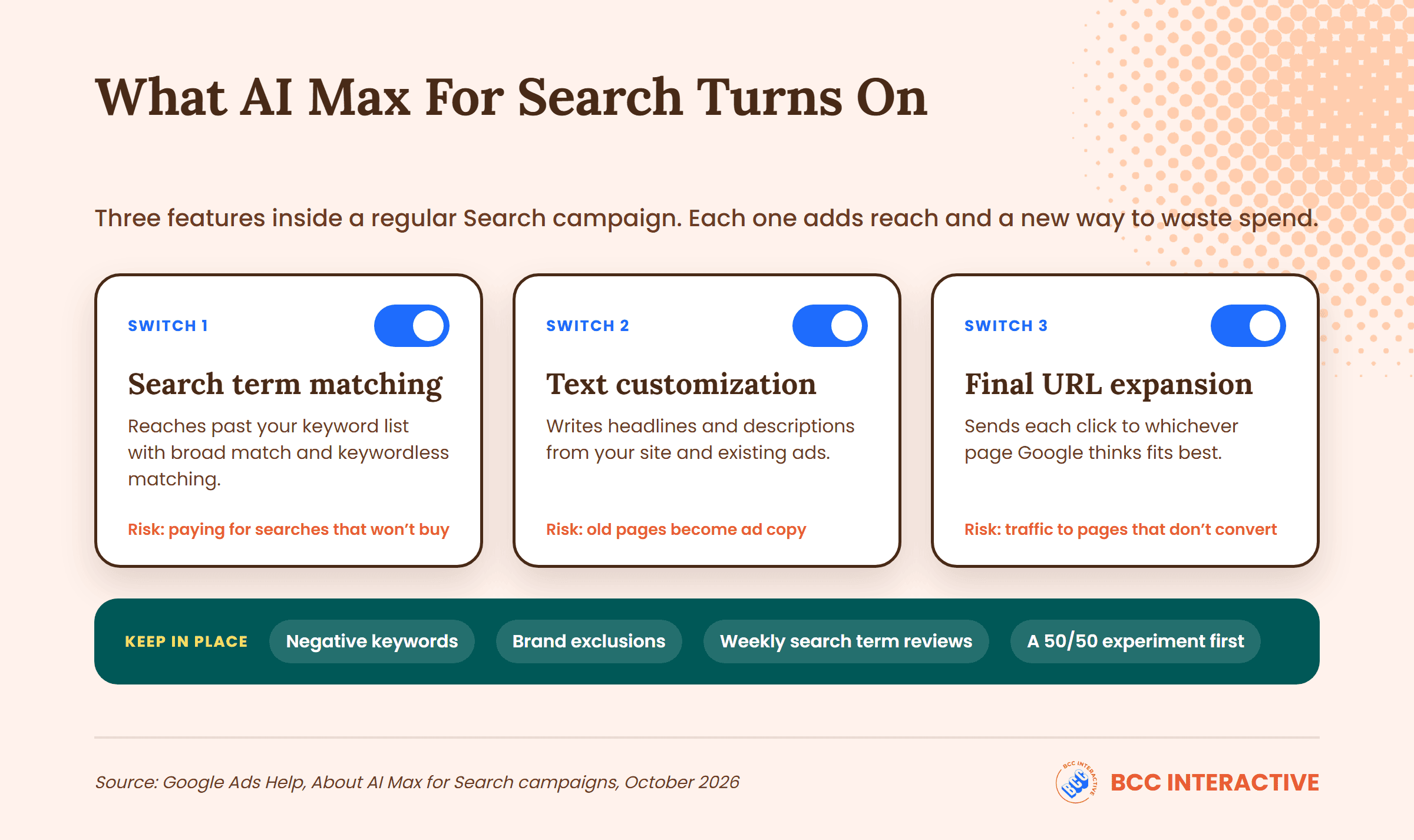
AI Max for Search is a setting you turn on inside a regular Search campaign. It isn’t a separate campaign type.
It does three things, per Google’s help page:
- Search term matching: Finds long-tail searches beyond your keyword list, using broad match and keywordless matching.
- Text customization: Writes headlines and descriptions from your site and existing ads.
- Final URL expansion: Sends people to the landing page on your site Google thinks fits best.
Google says advertisers who turn on AI Max typically see 14% more conversions or conversion value at a similar cost per acquisition (CPA) or return on ad spend (ROAS). That’s Google’s internal 2025 data, for non-retail advertisers.
Smarter Ecommerce found something different. It analyzed more than 250 Search campaigns with AI Max in March 2026 and found the extra conversions cost a median 16% more than the rest of the campaign. Marvin’s explanation, quoted in that report: “This often comes down to the cost of incrementality.”
Both can be true. You may get more conversions. Each extra one may cost more.
When To Turn AI Max On
AI Max makes sense when:
- Your conversion tracking is clean. AI Max learns from your conversions. Bad tracking teaches it the wrong thing.
- You’re on Smart Bidding. Google’s AI Max FAQ says search term matching won’t work with Manual CPC (cost per click). It needs a conversion-based strategy like Maximize Conversions.
- Your site says what you actually sell. Text customization and final URL expansion pull from your pages. Old service pages become ad copy.
- You’re mostly on exact and phrase today. Google says those campaigns see an even bigger lift: 27%.
The Broad Match Waste Risk
Broad match reaches more searches. Some of them won’t be your customers.
That’s the real cost of chasing AI Overview placements. You loosen keywords to get inside the summary, and you pay for searches that were never going to buy. What keeps it in check:
- Negative keywords. Google’s FAQ confirms AI Max honors them.
- Brand exclusions. They’re part of AI Max, so turning AI Max off turns them off too.
- Weekly search term reviews. Not monthly. Weekly, for the first 60 days.
- A test before a switch. Google offers a one-click 50/50 AI Max experiment. Use it instead of flipping your best campaign.

We'd test AI Max on one campaign with clean conversion tracking before touching the rest of the account. Run the 50/50 experiment, review search terms every week, and judge it on cost per qualified lead, not conversion volume. More conversions at a higher cost is only a win if your margins say so.
What You Can And Can't Measure
Google doesn’t give you a report for AI Overview placements.
Google’s help page says ads in AI Overviews are reported as Top Ads, with no segmented reporting for ads inside AI Overviews. In June 2026, Marvin confirmed AI Overview and AI Mode ads are reported with other top-of-page ads, with no separate breakdown, and that Google is still deciding what reporting should look like.
| Question | Can you answer it in Google Ads? |
|---|---|
| Did my ad show inside an AI Overview? | No. There's no placement segment |
| How many clicks came from AI Overviews? | No. They're counted with Top Ads |
| Which search terms triggered my ads? | Yes. Check the search terms report |
| Did broad match or AI Max bring in junk? | Yes. Search terms plus conversion quality |
| Is my top-of-page performance changing? | Yes. Top impression rate, clicks and CPA trends |
If you’re a marketer whose boss wants an AI Overview number, Google doesn’t have one to give you. So you measure around the gap. Track top-of-page trends, watch search terms closely and judge the account on leads and revenue, not impressions.
What AI Overviews Do To Your Click-Through Rate
Seer Interactive tracked 3,119 informational queries across 42 organizations from June 2024 to September 2025. On queries with an AI Overview, paid click-through rate (CTR) fell from 19.7% to 6.34%.
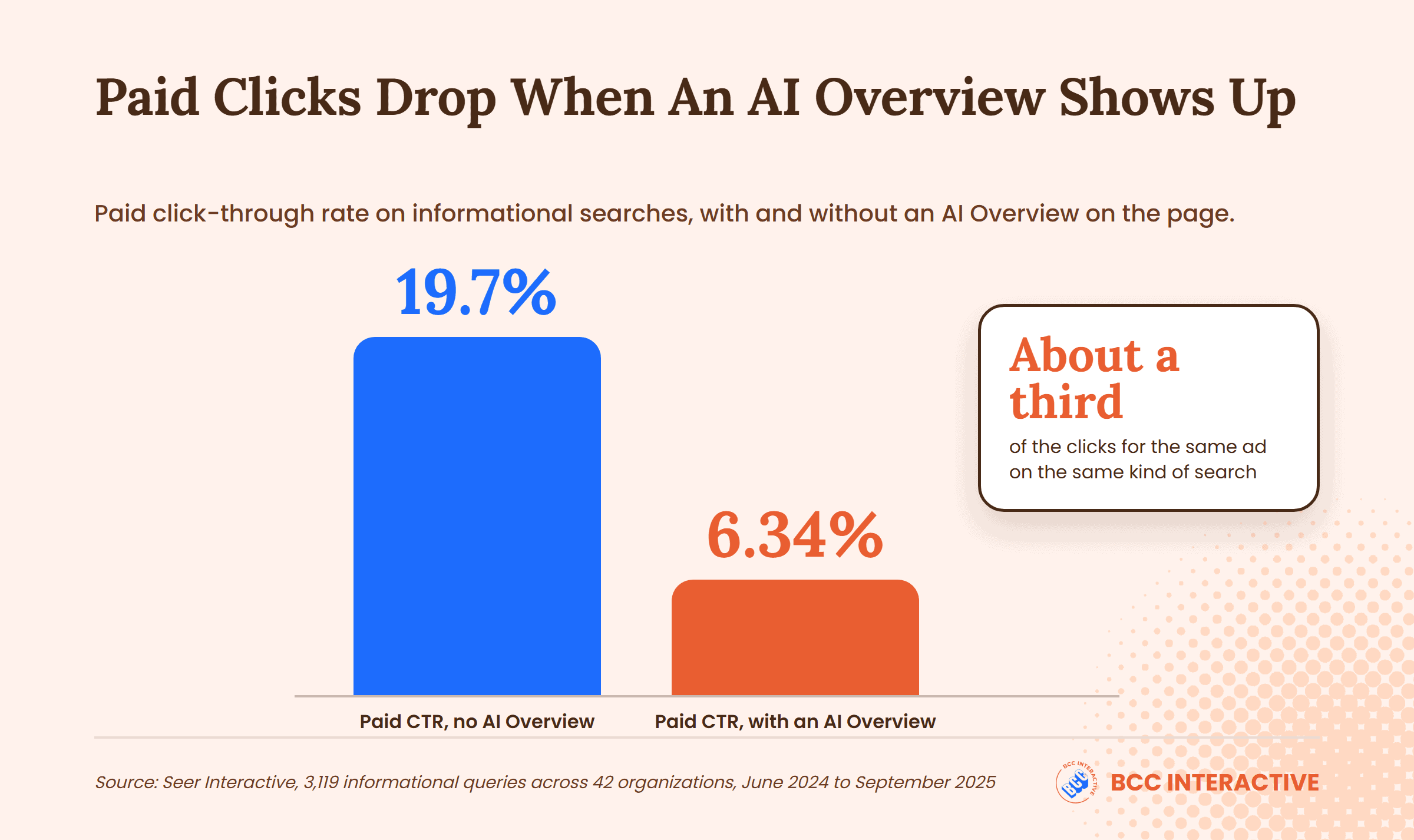
Same ad, same keyword, roughly a third of the clicks. If your question-style keywords were already borderline, an AI Overview can stop them paying for themselves.
What To Do In Your Google Ads Account This Quarter
- Audit eligibility. Exact and phrase only means above and below AI Overviews, never inside.
- Pick one test campaign with solid conversion tracking and Smart Bidding. Add broad match or run the AI Max experiment there.
- Build negatives first. Negative keywords and brand exclusions go in before the test, not after the waste.
- Fix the pages your ads point to. If AI Max writes copy from your site, your site is your ad copy.
- Watch CTR on question-style keywords. That’s where Seer measured the drop. If those keywords stopped converting, bid them down or cut them.
The question to ask about AI Overview ads
If they can't answer the first part, they haven't checked. If they can't answer the second, broad match is spending without supervision.
If you’d rather have someone run this for you, that’s what our paid search management team does every week.
AI Overview Ads Are Your Existing Campaigns On A New Page
AI Overview ads aren’t a separate channel. They’re your existing campaigns competing on a page with an AI summary at the top.
That page gives fewer clicks to every ad on it. The accounts that still win there have clean conversion tracking, broad match under supervision and a negative keyword list that keeps growing. None of that is new. AI Overviews just make skipping it more expensive.
Frequently Asked Questions
Yes. Google has shown ads in AI Overviews since October 2024 in the US. Ads can appear above, below or inside the AI Overview, and they’re labeled “Sponsored.”
Run Search campaigns with broad match keywords, or use Performance Max, Shopping or AI Max for Search. Exact and phrase keywords can only show above or below the summary. You can’t target the inside placement directly.
No. Google’s Ads Liaison said in June 2026 that broad match Search campaigns remain eligible for AI Overviews and AI Mode without AI Max. AI Max widens eligibility by applying broad match behavior to your exact and phrase keywords.
Not separately. Google reports these ads as Top Ads and doesn’t offer a segment for AI Overview or AI Mode placements yet. Use search terms, top-of-page trends and lead quality instead.
Not yet. Google still describes ads in AI Mode as a US test.
They can be, if your conversion tracking is clean and you watch search terms closely. Broad match brings reach and waste. Judge it on cost per qualified lead.
Find Out Which Of Your Campaigns Can Show Up In AI Answers
- Which of your campaigns can show inside AI Overviews today
- Where broad match or AI Max would add reach, and where it would add waste
- Where your current spend is going to searches that will never convert
