


Google wants to run your ads for you.
Smart Bidding sets your bids. Performance Max picks your channels. AI Max writes your headlines and chooses your searches. And since September 2026, Google has been moving Search campaigns that use automatically created assets or campaign-level broad match into AI Max on its own, according to its Ads & Commerce blog.
So can AI manage your Google Ads?
Honestly, it can manage a lot of it. What it can’t do is decide what your business actually counts as a win. The algorithm optimizes toward whatever your conversion tracking tells it to. Feed it the wrong signal and it gets very efficient at buying the wrong thing.
Key Takeaways
Smart Bidding is the part to trust. It sets a bid for every auction, and Google says it needs conversion tracking to work at all.
Your conversion data decides everything. If Google Ads reports more conversions than you have customers, bidding has been chasing the wrong goal.
Google's AI Max numbers are Google's numbers. Google claims 14% more conversions at a similar cost on its own 2025 data, excluding retail. Smarter Ecommerce found about 35% lower ROAS than broad match in 271 retail campaigns.
Performance Max can take credit for your brand. Brand exclusions exist for a reason.
Auto-applied recommendations change your account without asking. That includes adding broad match keywords and changing bid targets.
A human still owns goals, data, guardrails and negatives. Let the machine bid. Keep a senior person in charge of what it's bidding toward.
What AI PPC Management Actually Means
PPC is pay-per-click advertising: ads where you pay each time someone clicks. AI PPC management is the use of artificial intelligence to run parts of a PPC campaign, mostly bids, targeting, budgets and ad copy. The term covers three things:
- Google’s built-in automation. Smart Bidding, broad match, Performance Max, AI Max and the new Gemini tools. Most of the AI in PPC lives here.
- Third-party AI PPC tools. PPC management software that asks you to connect your ad accounts, then automates bid adjustments, sends an alert when something breaks or writes ad copy.
- Agencies selling AI-powered PPC management. Some are senior people using automation well. Some are a tool with a login and an invoice.
This post covers Google Ads. Amazon PPC and Microsoft Advertising each have their own ad platform and their own automation, but the same rule applies to all of it. AI for Google Ads is only as smart as the goal and the data you hand it.
What Google's Automation Gets Right
Look, some of Google Ads automation is genuinely better than a human. Pretending otherwise is a losing game.
Smart Bidding
Smart Bidding is Google’s group of automated bid strategies: Target CPA (cost per acquisition), Target ROAS (return on ad spend), Maximize Conversions and Maximize Conversion Value. Google describes them as strategies that use its AI to optimize for conversions or conversion value “in every auction.”
This is the core of PPC optimization in Google Ads now, and no human can match it. A person sets one bid for a keyword. Smart Bidding sets a different bid for every search, using signals like device, location, time of day, remarketing lists and the exact words typed.
The catch, per Google’s Help Center: you need conversion tracking turned on to use it. Google’s guidance also talks in terms of at least 30 conversions (50 for Target ROAS) when you judge performance.
Broad Match Paired With Smart Bidding
Broad match lets Google show your ad on searches it decides are related to your keyword, not just the words you entered. Google’s best practices are blunt about the pairing. Its keyword help page says “It’s critical to use Smart Bidding with broad match.”
Broad match finds searches you’d never think to add. Smart Bidding is supposed to bid down the ones that don’t convert. With clean conversion data, that combination can find real buyers you were missing.
Performance Max
Performance Max (PMax) is Google’s goal-based campaign type. One campaign can serve across YouTube, Display, Search, Discover, Gmail and Maps, according to Google Ads Help.
For years you couldn’t see what it bought. That changed in 2025. Google now offers search terms reporting for all Performance Max campaigns, campaign-level negative keywords and negative keyword lists, so you can see and block the searches it buys.
AI Max For Search
AI Max for Search is a set of features you switch on inside a regular Search campaign. Google announced it on May 6, 2025. It does three main things:
- Search term matching. It reaches past your keywords using broad match and “keywordless” matching built from your ads, keywords and landing pages.
- Text customization. It writes new headlines and descriptions from your website and existing ads. This used to be called automatically created assets.
- Final URL expansion. It sends people to whichever page on your site it thinks fits the search best.
Google says advertisers who turn on AI Max “will typically see 14% more conversions or conversion value at a similar CPA/ROAS,” and 27% for campaigns that mostly run exact and phrase match keywords. Read the footnote: that’s Google internal data from 2025, and it excludes retail advertisers.
Independent data points the other way. Mike Ryan at Smarter Ecommerce reviewed 271 retail campaigns with AI Max on and reported, on the company’s podcast in November 2025, that AI Max averaged about 35% lower ROAS than broad match (2.6 vs 4.0) at roughly 20% higher cost per conversion. Retail is the category Google left out of its claim, so neither number cancels the other. AI Max results vary a lot by account. Test it against a control instead of trusting anyone’s average.
The Gemini Tools From Google Marketing Live 2026
At Google Marketing Live on May 20, 2026, Google announced new Gemini-powered tools. Three matter for Google Ads:
- Ask Advisor. An AI agent across Google Ads, Google Analytics, Merchant Center and Google Marketing Platform. It makes recommendations, explains campaign performance using Google Ads and Google Analytics data, and can build a campaign from a plain-language request. Google says it’s in beta for English-language accounts.
- AI Brief. Plain-language instructions for AI Max for Search: what your ads should and shouldn’t say, which searches to avoid and who to reach. Google says Performance Max and AI Max for Shopping will follow.
- Asset Studio updates. Google’s creative hub, now connecting to Gemini models so it can turn brand guidelines into ad creative.
These roll out in stages, so check what’s actually live in your account before you plan around any of them.
Where Google Ads Automation Burns Money
These features do exactly what they’re told. Most accounts are telling them the wrong thing.
It Optimizes Toward Whatever You Count
Smart Bidding doesn’t know what a customer is. It knows what a conversion is, and a conversion is whatever your tracking says it is.
If your tracking counts a page view as a lead, or counts one form fill twice, or counts a PDF download as a sale, the algorithm will go find more of those. Cheaply. At scale. And it’ll report a beautiful cost per conversion while your sales team wonders where the leads went.
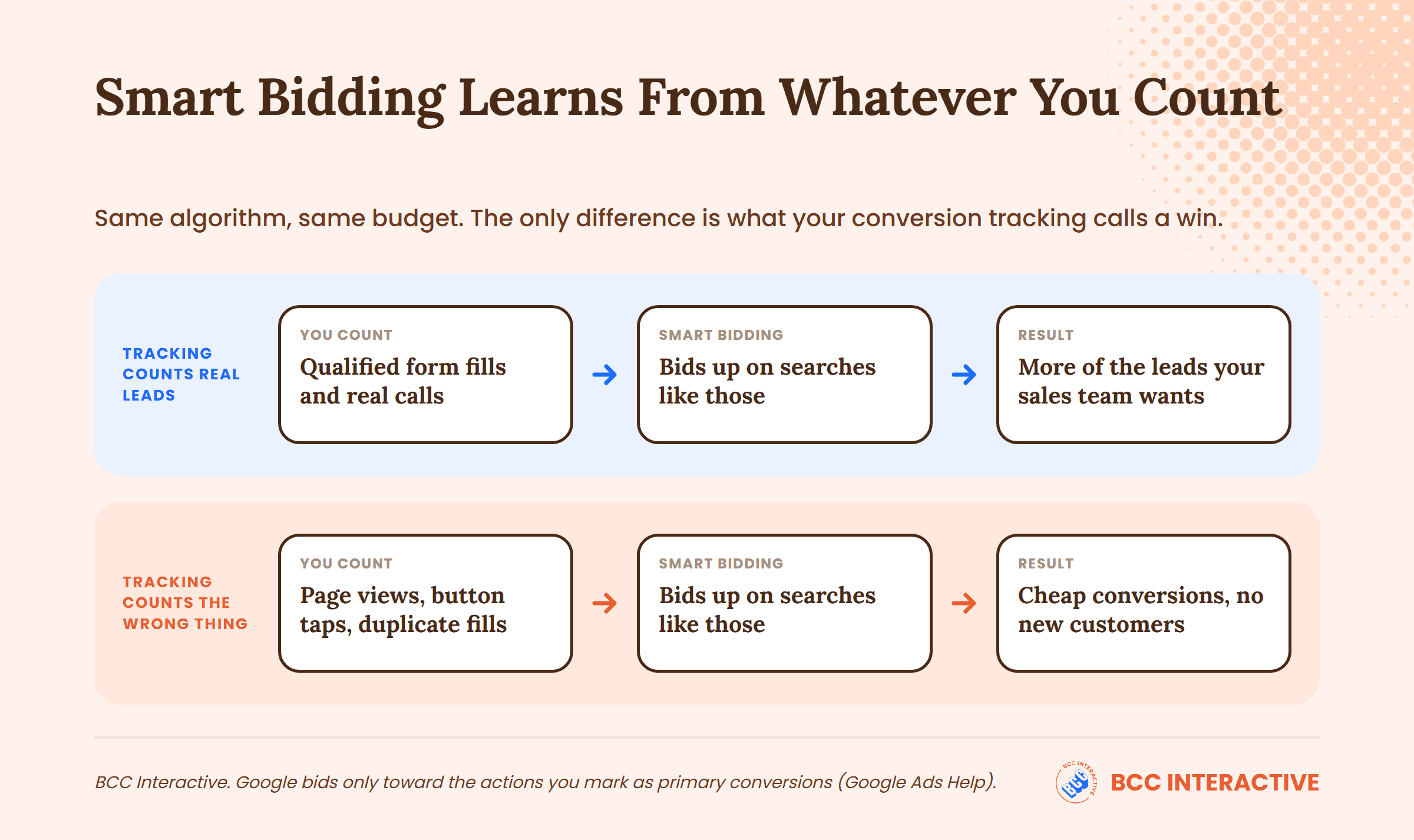
Google only bids toward your primary conversion actions (secondary actions are observation-only unless they sit in a custom goal). So which actions you mark as primary is one of the most important settings in the whole account.
You’re not just wasting money. You’re teaching the algorithm to waste more of it.
Check this yourself in two minutes. Open Google Ads, go to Goals, then Conversions. If Google shows more conversions than you have actual customers or qualified leads, your bidding has been optimizing toward the wrong thing.
- Goals > Conversions
- Primary vs secondary
- Compare to your CRM
Performance Max Taking Credit For Your Brand
People who search your company name were probably coming anyway. If Performance Max serves an ad on that search and counts the sale, its numbers look great and your new customer count doesn’t move.
Google built brand exclusions for this. They stop a campaign from serving on branded searches you choose, but for Performance Max they only apply to Search, Shopping and YouTube search inventory.
The data on how much this costs you is mixed. Optmyzr looked at February 2025 search term data across 503 accounts and found Performance Max and Search campaigns overlapped on the same searches in 91% of them, even on exact match keywords that Google says should take priority. But in about 75% of those overlaps, conversion rates showed no meaningful difference, and the study didn’t separate out brand searches.
So the overlap is nearly universal. Whether it’s costing you is an account-by-account question. Turn on brand exclusions, watch what happens to total sales (not PMax’s reported conversions), and let your numbers answer it.
Broad Match Drift
Broad match plus Smart Bidding works when the bidding has good data. Without it, broad match drifts. “Commercial roof repair” starts matching “how to fix a shingle” and “roofing jobs near me,” and you pay full price for every click.
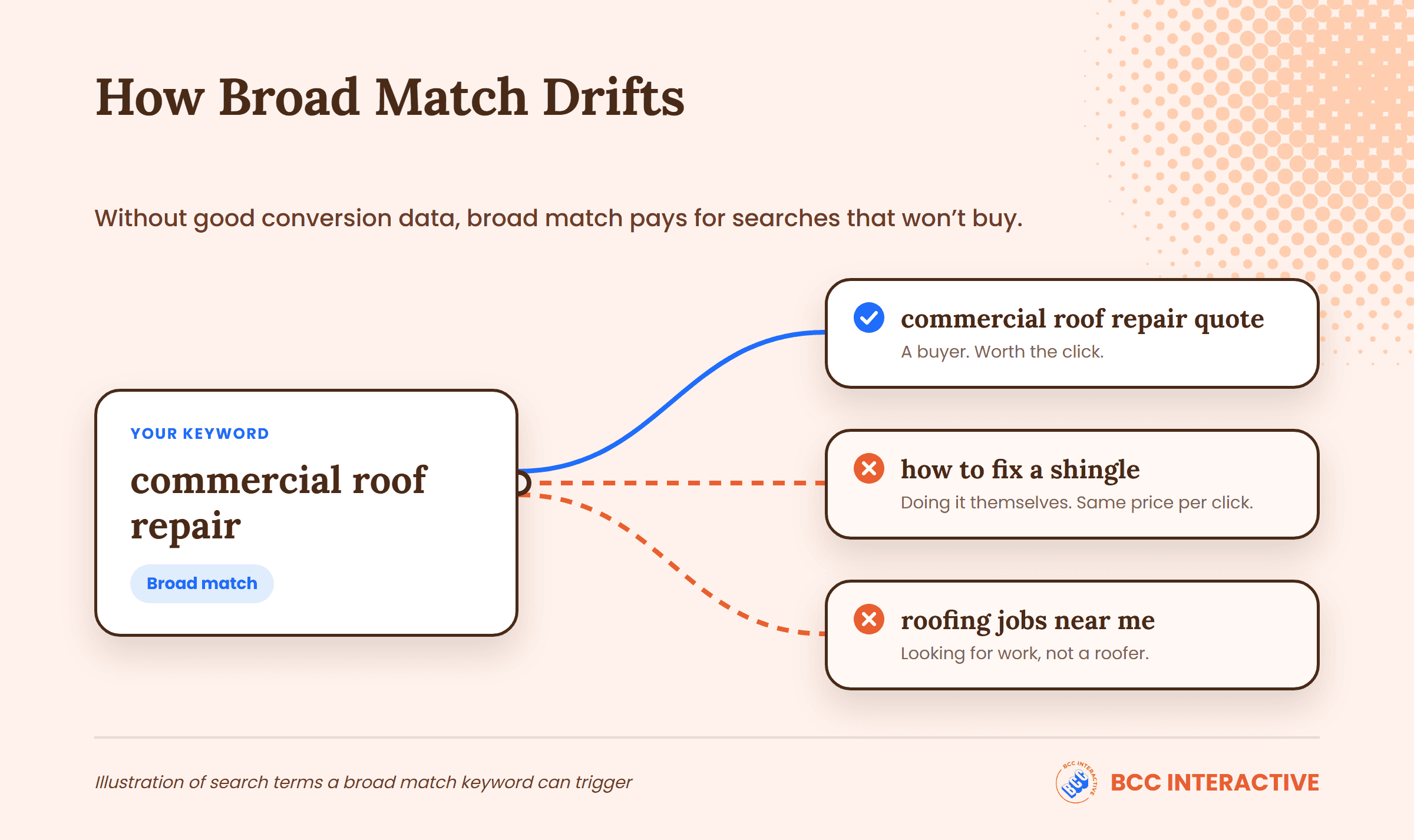
We saw this firsthand. In early 2025, Google’s shift toward broader keyword matching hit Ascend Wellness Holdings’ paid search account, and cost per click in Chicago jumped from about $1 to about $11 (Google Ads). Nothing in the account had changed. The account was still on manual CPC bidding, so nothing was reining in the new, looser matches. We moved it to Target CPA under $20 in late April 2025 and rebuilt it in May 2025, with campaigns consolidated by market.
The fix wasn’t turning the AI off, and it wasn’t going back to manual bids. It was a human rebuilding the structure so the AI had the right goal and the right guardrails.
"Thank you for being a strong partner and for helping us trailblaze the SEO/SEM journey in cannabis."
Auto-Applied Recommendations
Google Ads has a setting called “Automatically apply recommendations.” Turn it on and Google applies eligible recommendations on a regular schedule, according to its Help Center.
The eligible list includes adding broad match keywords, setting a target ROAS, switching to Maximize Conversion Value and removing keywords that aren’t serving. Those aren’t cosmetic. They change what you buy and how you bid.
You can turn it off at any time, and every applied change shows up in the History tab and Change History. If nobody on your side reads those, Google is making changes nobody approved.
AI-Written Ads That Don't Sound Like You
Text customization writes headlines and descriptions using generative AI grounded in your landing page, your domain and your existing ads. Google’s own Help Center tells advertisers to monitor that ad content for accuracy and to make sure their website isn’t misleading or out of policy.
If the AI writes a claim you can’t back up, it’s still your ad.
AI Brief helps here, because you can tell it what never to say. But someone still has to read the ads. Off-brand copy, a discontinued offer pulled from an old page, a price you stopped charging. General AI tools like ChatGPT can draft ad copy in seconds too, and they have the same blind spot. A model won’t catch a wrong offer. A person who knows the business will.
What To Automate Vs What To Keep Human
This is how we split the work on the accounts we run.
| Task | Let AI handle it | Keep a human on it |
|---|---|---|
| Bids per auction | Yes. Smart Bidding beats manual bids at scale once tracking is clean | Choose the strategy and the target, and review it monthly |
| Conversion tracking | No | Decide what counts as a conversion, which actions are primary, and check it against real sales |
| Keyword expansion | Broad match and AI Max can find new searches | Read the search terms report weekly and add negative keywords |
| Brand protection | No | Set brand exclusions and test the impact on total sales |
| Ad copy | AI can draft headlines and test variations | Approve claims, offers and tone before they run |
| Recommendations | Use them as a to-do list | Keep auto-apply off for bidding and keyword changes |
| Budget pacing and alerts | Automation tools are good at daily budget pacing and flagging spend spikes | Decide where budget moves and why |
| Landing pages | No | Fix the page that's losing the conversion |
| Reporting | AI can summarize performance | Tie spend to revenue, not to platform-reported conversions |
The pattern is simple. AI is great at volume and speed inside a goal. Humans set the goal, the data and the limits.
Third-Party AI PPC Tools And Agencies: What To Ask First
The AI tools for PPC on the market today promise to automate your campaign management, whether you run PPC in-house or with an agency. Some help, with alerting, budget pacing, bid management across multiple platforms and catching broken ads before they spend. The question is how a tool fits your workflow and who checks its work.
But every one of them sits on top of the same thing Google’s AI does: your conversion data. A tool can’t fix tracking that counts the wrong thing. It’ll just optimize the wrong thing faster.
One more thing to watch: Meta and LinkedIn ads are social ads, not PPC. Nobody’s searching for you when they show up, so a tool that runs Google Ads and Meta from one dashboard is doing two very different jobs.
Ask any AI PPC tool or agency these five questions
- What conversion actions will your system optimize toward, and how do you check them against our actual sales or CRM data?
- Which changes does your tool make automatically, and which ones does a person approve?
- Who reads our search terms report, and how often?
- Will our Google Ads account stay in our name, on our billing, if we leave?
- Can you show me a change your system made that a human reversed, and why?
Question five separates real oversight from automation nobody watches. If they can't name one, nobody's checking.
Let The Machine Bid. Keep A Human In Charge.
AI is going to handle more of the media buying in your ad campaigns every year. Google is making that call for you.
That makes the PPC work left for humans more valuable, not less. Someone has to define the goal, clean the data, set the brand exclusions, write the negatives, read the search terms report and say no to a recommendation that looks smart and costs you money.
That’s what good Google Ads management looks like now. Not fighting the automation. Directing it.
Frequently Asked Questions
Not the part that matters most. You should use AI to optimize campaigns at auction speed, find new searches and draft PPC ads faster than any person could. It can’t decide what counts as a conversion, catch a wrong claim in an ad, or tell you a campaign shouldn’t exist. That judgment is the job.
Not always. Smart Bidding, Performance Max and AI Max already handle bidding and targeting. A third-party tool earns its fee when it adds oversight Google doesn’t, like alerts, budget pacing or rules that block bad changes. If it just adds more automation on the same data, skip it.
For bidding and keyword changes, we’d keep it off and review recommendations by hand. Google’s eligible list includes adding broad match keywords and changing bid targets, which can shift what you pay for overnight.
Maybe. Google’s own 2025 data says 14% more conversions at a similar cost for non-retail advertisers. Smarter Ecommerce found about 35% lower ROAS than broad match in retail. Run it as an experiment against a control, with clean conversion tracking in place, and judge it on revenue.
Go to Goals, then Conversions in Google Ads and compare the count to the customers or qualified leads you actually got in the same period. If Google’s number is higher, something is counting the wrong action or counting twice. Check which actions are marked primary, because those are the ones bidding uses.
Find Out What Your Automation Is Actually Optimizing For
- Whether your conversion tracking counts real customers or noise
- Where broad match, PMax or auto-applied changes are creating wasted spend
- A ranked list of fixes you can run with or without us
