


A year ago, almost nobody searched for “ChatGPT ads.” Now about 6,600 people a month do in the US alone, according to Semrush.
And the sales pitch is loud. OpenAI says ChatGPT reaches 1.2 billion people a week, and businesses in more than 60 countries can now buy ads inside it on their own.
So should you?
Maybe. It depends on what you sell, how you measure, and how much money you can afford to spend learning.
Key Takeaways
Only part of the audience sees ads. Ads show to Free and Go users; Plus, Pro, Business, Enterprise and Edu accounts stay ad-free, and so does anyone OpenAI identifies as under 18.
Self-serve is open. The pilot reportedly required about $200,000 to get in. Since OpenAI's self-serve Ads Manager opened on May 5, 2026, there's no published minimum.
You bid three ways. Pay per 1,000 views (CPM), per click (CPC), or let the system optimize for conversions while you still pay per click. OpenAI suggests a $3 to $5 starting bid per click.
There are no keywords. You give ChatGPT "context hints" about where your ad fits. OpenAI says they guide matching but don't guarantee delivery.
Results vary widely. Published tests show clicks costing anywhere from under $3 to around $13, and OpenAI says it has no performance benchmarks yet.
Paying doesn't get you into the answer. OpenAI says ads don't influence ChatGPT's responses, so being cited organically is a separate job.
What Are ChatGPT Ads?
ChatGPT ads are sponsored listings that appear inside conversations with OpenAI’s AI chatbot. OpenAI calls the program ChatGPT Ads and sells it through its Ads Manager at ads.openai.com, pitching marketers a way to reach people while they compare options and make decisions.
OpenAI began testing ads in ChatGPT in the US on February 9, 2026. Since then it has moved fast:
- February: A US test with a small group of advertisers, sold on a CPM (cost per 1,000 impressions) basis.
- March: OpenAI announced pilots in Canada, Australia and New Zealand.
- May 5: A beta self-serve Ads Manager opened, along with cost-per-click (CPC) bidding.
- August: Launches in the UK, Mexico, Brazil, Japan and South Korea, then 31 European markets, India, the Middle East and North Africa.
- September: OpenAI started testing Sponsored Agents and added HubSpot and Shopify integrations.
- October: OpenAI announced visual ads that appear during image generation.
On August 31, OpenAI said ChatGPT Ads hit a $1 billion annualized revenue run rate in under 200 days, with tens of thousands of advertisers. That’s OpenAI’s own projection. Still, this isn’t a side experiment.
How Do ChatGPT Ads Work?
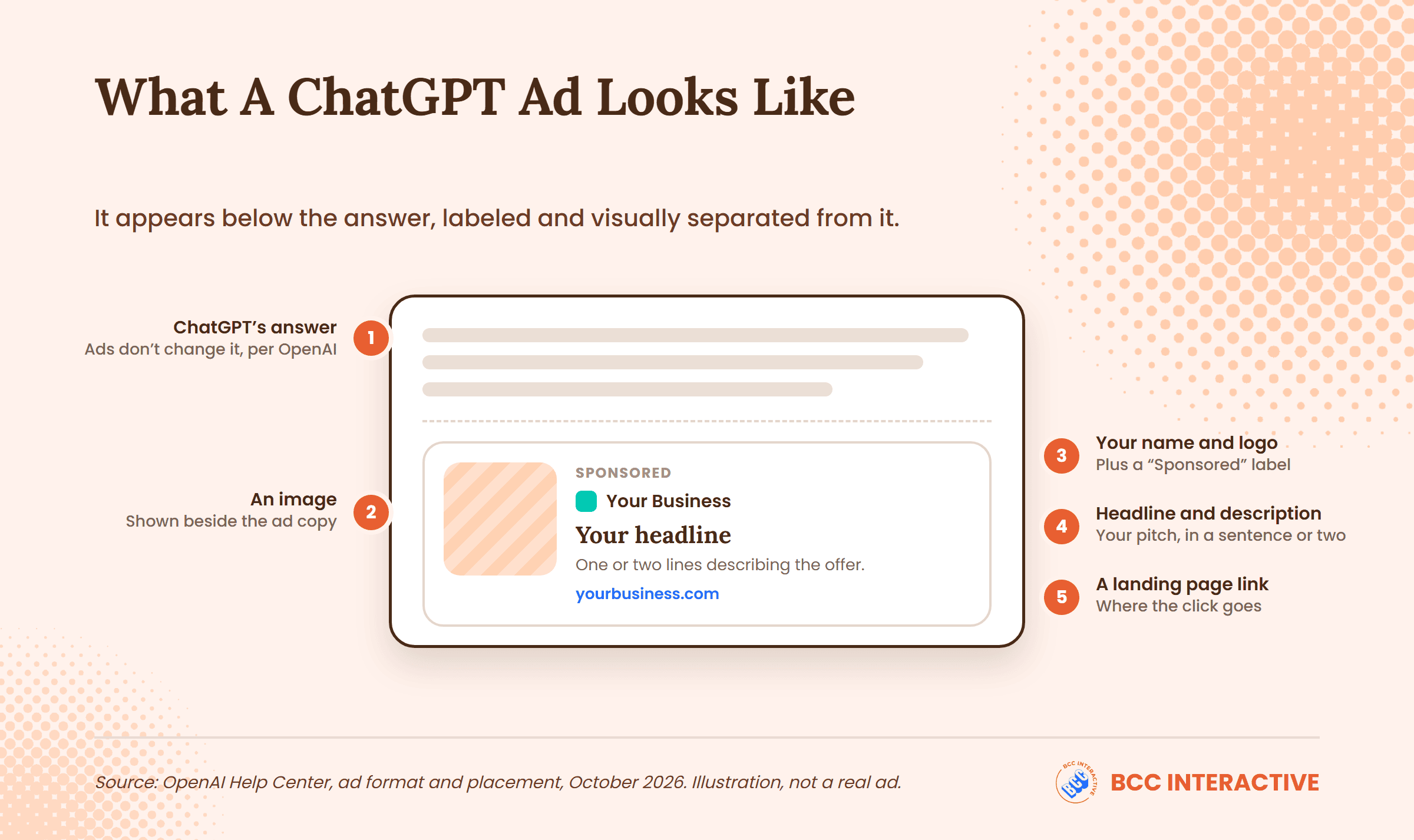
Someone asks ChatGPT a question. ChatGPT answers. If there’s a relevant match, an ad can appear below the end of the response, clearly labeled as sponsored and visually separated from the answer.
According to OpenAI’s help center, a standard ad includes:
- Advertiser name and favicon (your logo)
- A headline and a description
- A landing page link
- An image
How OpenAI Decides Which Ads Appear
This is the part that’s different from Google.
There are no keywords to bid on. At the ad group level, you write “context hints” that describe the conversations, topics or needs where your product or service makes sense. OpenAI’s help center says these hints guide matching but “are not exact-match keywords and do not guarantee delivery.”
The ads system then weighs:
- The context and intent of the current chat
- Your landing page, headline and copy
- Your context hints and targeting choices
- If the user lets ChatGPT personalize ads, signals from their past chats and memory
- Your bid
OpenAI runs what it calls a relevance-weighted, second-price auction. Relevance and bids both matter. Your bid alone won’t buy the spot.
Who Can See Ads In ChatGPT (And Who Can't)
Ads in ChatGPT show to users on the Free and Go plans. Go is OpenAI’s low-cost paid tier, so “ad-supported” doesn’t strictly mean “free users only.”
Users who won’t see ads:
- Plus, Pro, Business, Enterprise and Edu subscribers
- Accounts OpenAI identifies or predicts as belonging to someone under 18
- Free users who switch to Ads-Free, which trades ads for fewer daily messages and no access to tools like image generation or deep research
- Anyone in a Temporary Chat
OpenAI says ads are not eligible to appear near conversations about personal health, mental health and politics, and it doesn’t allow political advertising. Advertisers in regulated categories like health and financial services face stricter eligibility rules.
One wrinkle: OpenAI’s February post said the test was for logged-in adults. AdExchanger reported in April that ads had started showing to logged-out users, and OpenAI’s help center now confirms logged-out ads exist, limited to content suitable for all audiences.
Users who do see ads can turn off personalized ads, delete their ads data, hide or report an ad, or tap “Ask ChatGPT” to ask questions about it. OpenAI’s stated principle is that it puts user trust and user experience ahead of ad revenue.
The paid-tier exclusion matters for B2B and premium brands. Many of the decision-makers you want are likely paying for Plus, Pro or a Business plan, and those accounts see zero ads.
How Much Do ChatGPT Ads Cost?
There’s no fixed price. You bid in an auction, and what you pay depends on competition, relevance and your category.
What is documented:
| Buying option | You pay for | How the bid works | Best fit |
|---|---|---|---|
| Views (CPM) | Every 1,000 impressions | Set a max CPM bid per ad group | Awareness in a category you're new to |
| Clicks (CPC) | Each valid click | Set a max CPC bid; OpenAI suggests starting at $3 to $5 | Traffic to a page that already converts |
| Conversions (oCPC) | Each valid click | System optimizes toward a conversion event you track | Advertisers with the pixel or Conversions API live |
A few numbers to keep in perspective:
The early pilot was expensive. AdExchanger reported the program launched with a $200,000 minimum commitment and a $60 CPM, and that the minimum dropped to $50,000 in April. Adweek reported that some brands were pitched lower amounts. OpenAI’s VP of monetization told AdExchanger the minimum would go away as Ads Manager opened to everyone, and OpenAI’s current help docs don’t list one.
$3 to $5 is a starting bid, not an average. OpenAI recommends it as a starting maximum CPC. Search Engine Journal points out that OpenAI has published no cost benchmarks, and the tests advertisers have shared publicly show CPCs from under $3 to around $13.
There’s a promo running. At the time of writing, ads.openai.com offers new advertisers a $500 ad credit when they spend $500.

Budget for learning, not for scale. Pick an amount you'd be fine spending to get an answer, set a hard monthly cap, and decide up front what result would make you keep going. If you can't name that number before you launch, you're not ready to test.
How To Measure Conversions From ChatGPT Ads
This is where most early complaints live.
Ads Manager reporting covers impressions, clicks, spend, click-through rate (CTR, the share of people who saw the ad and clicked), average CPC, average CPM and conversions. OpenAI says impressions and clicks refresh about every 15 minutes, but spend data can lag 7 to 8 hours.
For conversion tracking and the post-click side of the story, you have:
- The OpenAI pixel, a tracking code on your site
- Conversions API (CAPI), which sends conversion data from your server or CRM straight to OpenAI
- UTM parameters, tags on your landing page URLs so traffic shows up correctly in Google Analytics
On October 5, OpenAI added integrations with Hightouch, Tealium and LiveRamp for sending conversion data, a list of attribution partners, and geo-based incrementality tests with Haus, Measured and WorkMagic. It’s also piloting brand safety checks with DoubleVerify and Integral Ad Science.
Advertisers only get aggregated performance data, never individual users. What’s still missing, per Search Engine Journal: no equivalent of Google’s Auction Insights, no impression share and no competitive reporting. When your CPC jumps, you won’t know whether it’s competition, relevance or the conversations you’re being matched to.
What Early Results Actually Look Like
OpenAI’s site features early advertisers like Newegg, Best Buy, Lowe’s and VistaPrint. Its October announcement also cited a partner finding that WeightWatchers’ attributed cost per acquisition on ChatGPT Ads was 15.3% lower than its blended paid search benchmark, according to DV Rockerbox. That’s a vendor-reported number, shared by OpenAI.
The reports from smaller advertisers are rougher:
- MediaPost reported that the agency Choice OMG spent about $415, got roughly a 0.6% CTR against about 2% on its search ads, and saw zero purchases.
- In the same piece, a B2B lead-gen founder said OpenAI reported 57 clicks while Google Analytics showed fewer than 20 visits.
- Search Engine Journal covered a B2B test where 336 paid clicks traced back to 146 companies, and only five matched the advertiser’s ideal customer profile.
Those tests ran in June, before OpenAI added geo-targeting, custom audiences and conversion optimization in August. Nobody has published a large, independent benchmark yet.
Paste This Into Your Test Plan Before You Spend A Dollar
- Is the OpenAI pixel or Conversions API firing on my real conversion event, not just page views?
- Do my landing page URLs carry UTM tags, so ChatGPT traffic doesn't land in Google Analytics as "direct"?
- What CPC and conversion rate would make this worth more than my next Google Ads dollar?
- What's my hard spend cap, and what date do I decide to keep going or stop?
Every published complaint about ChatGPT ads so far comes back to measurement. Answer these four first so your test ends in a clear keep-or-stop call.
How Are ChatGPT Ads Different From Google Search Ads?
Both put a paid listing in front of someone who’s looking for an answer. That’s roughly where the similarity ends.
| Google search ads | ChatGPT ads | |
|---|---|---|
| How you target | Keywords and match types | Context hints, targeting and audiences; no keywords |
| Where the ad shows | Search results page | Below a ChatGPT answer (and soon during image generation) |
| Who's eligible | Nearly everyone searching | Free and Go users; paid tiers excluded |
| Competitive data | Auction Insights, impression share | None yet |
| Benchmarks | Years of industry data | None published by OpenAI |
| Maturity | Decades | Launched February 2026 |
The upside is context. Someone typing “CRM” into Google gives you three letters. Someone in ChatGPT might explain their team size, budget and the tool they’re leaving.
The downside is control. You can’t pick the exact conversations you show up in, or see who you’re bidding against.
For most businesses, Google Ads is still where buyers with intent are easiest to reach and measure. If your Google account isn’t tight yet, fix that before you spread your paid media budget to a new channel. That’s most of what our PPC services focus on.
Where Are Ads In ChatGPT Available?
As of early October 2026, OpenAI’s help center lists 63 countries where businesses can use self-serve Ads Manager, including the US, Canada, the UK, most of Europe, India, Japan, Australia and Mexico. The legal entity that gets billed has to be based in one of them.
Expect that number to shift. Search Engine Journal counted 52 self-serve countries at the end of August, so check OpenAI’s Ads Manager availability page before you plan anything outside the US.
You can also buy through partners. OpenAI names agency partners including Dentsu, Omnicom, Publicis and WPP. And Marketing Dive reported on September 10 that Amazon is piloting ChatGPT ad buying through Amazon DSP (its programmatic ad platform) as a managed service for select US brands.
Getting Started With ChatGPT Ads Manager
You start by creating an account at ads.openai.com. From there, OpenAI’s May announcement says you can:
- Register as an advertiser and add payment information
- Create campaigns and pick a campaign objective (views, clicks or conversions)
- Set budgets, bids and pacing for each ad group
- Create ads in the tool or bulk upload them by CSV
- Launch, edit and track performance from the Ads Manager dashboard
Larger advertisers can request sales support instead. And if you run HubSpot or Shopify, you can create ads and track results from inside those tools.
What's New: Sponsored Agents, Visual Ads And AI-Powered Tools
Two newer formats are worth watching, though neither is something most businesses can buy today.
Sponsored Agents. Announced September 16. After clicking an ad, a user can start a labeled conversation with an AI agent the business sponsors, ask follow-up questions, then click through to the site. OpenAI says it’s being tested with select US advertisers.
Visual ads. Announced October 5. Image ads that appear while Free and Go users generate images in ChatGPT. TechCrunch’s headline said OpenAI “launches” them, but both TechCrunch and OpenAI say US testing starts later in October with an initial group of advertisers.
AI-powered tools for advertisers. Also in September, OpenAI added an Ads Manager plugin that lets you create and analyze campaigns directly in ChatGPT with plain-English prompts, AI-suggested copy and images based on your landing page and campaign objective, and an opt-in setting that adapts your headlines to each conversation. You can use AI to draft ads now, but review every suggestion before it runs.
Being Cited In ChatGPT Is A Different Problem
This is the part a lot of guides skip.
OpenAI says ads run on separate systems from the chat model and that advertisers “have no ability to shape, rank, or alter ChatGPT’s responses.” So buying ChatGPT ads puts a sponsored card under the answer. It doesn’t get your business mentioned in the answer.
That’s two separate jobs:
- Paid: You bid, you appear in a labeled ad slot, you stop appearing when you stop paying.
- Organic: ChatGPT names your business in its actual response because the sources it pulls from describe you clearly and credibly. That’s answer engine optimization (AEO), and it reaches Plus, Pro and Business users too, who never see ads.
Say a buyer asks ChatGPT for the best payroll software for a 40-person company. If the answer lists three competitors and your ad sits underneath, you paid to be the fourth option. If the answer names you, that click cost nothing.
The two can work together. But if you don’t know what ChatGPT says about you today, start there before you pay to sit under its answers.
Before You Pay For The Ad Slot, See What ChatGPT Already Says About You
Our free AI Visibility Playbook walks you through a 15-minute check of how ChatGPT, Gemini and Perplexity describe your business, who they compare you to, and where they get their information. It shows you where you stand. Fixing it is the work we do.
Get the free playbookShould You Advertise On ChatGPT? Who Should Test Now And Who Should Wait
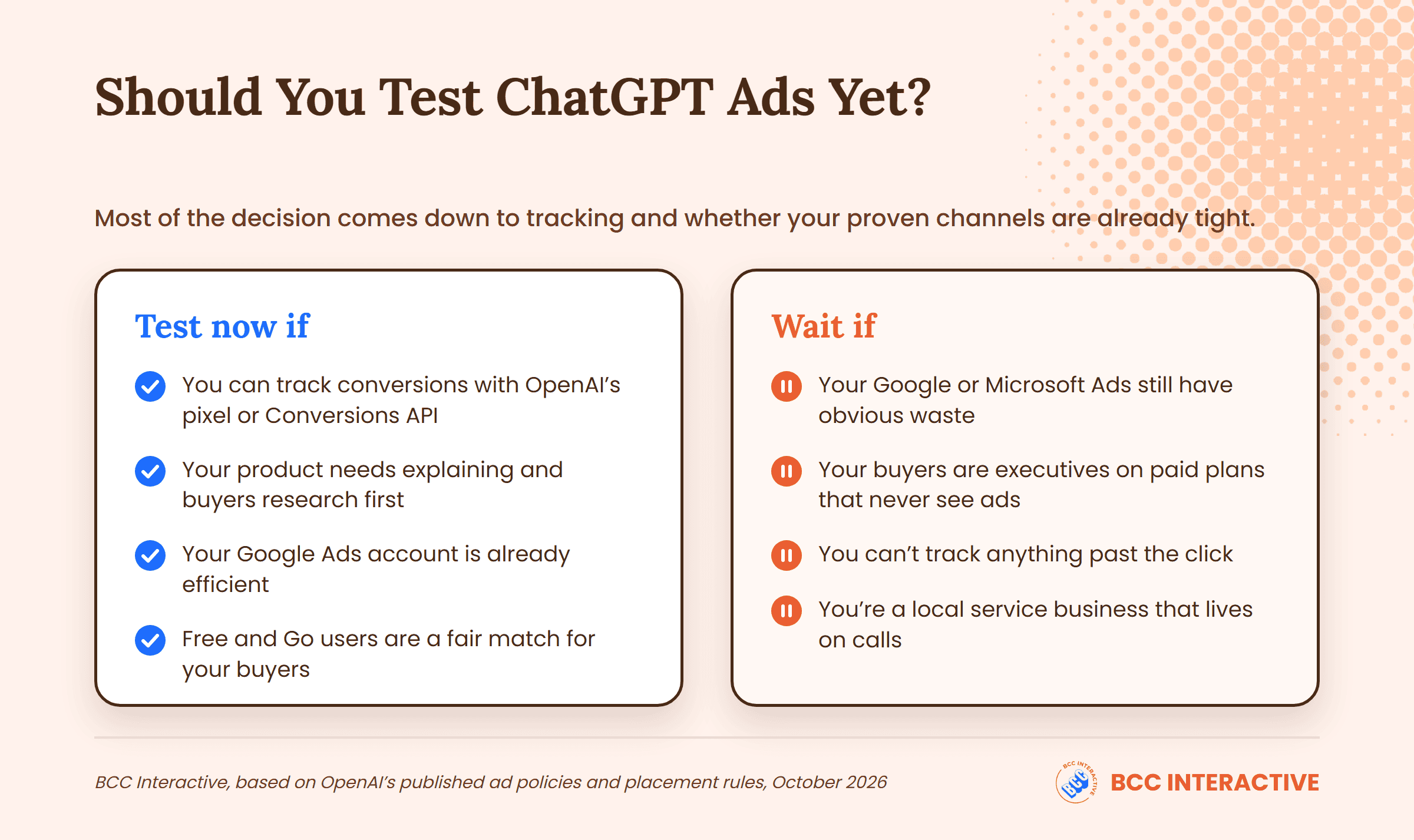
Test now if:
- You sell online and can get the pixel or Conversions API live before launch. Shopify merchants can start through OpenAI’s Shopify app.
- Your product needs explaining. ChatGPT’s format is built around people researching and comparing.
- Your Google Ads account is already efficient, and you have budget set aside for experiments.
- You’re in a consumer category where Free and Go users are a fair match for your buyers.
Wait if:
- Your Google Ads or Microsoft Ads accounts still have obvious waste. Fixing them will return more than a new channel.
- You sell to executives or enterprise buyers who are likely on paid ChatGPT plans that never show ads.
- You can’t track conversions beyond clicks. You’ll be paying for numbers you can’t check.
- You’re a local service business that lives on calls and map results. There’s little published data on local lead generation through ChatGPT ads.
- You’re in a regulated category like health or financial services. Eligibility is stricter, and ads stay away from sensitive conversations.
Skip it for now if your monthly ad budget is small enough that a $500 test would come out of the campaigns that already pay your bills.
The Smart Move Is A Small, Measured Test Or A Deliberate Wait
ChatGPT ads are a real, fast-growing paid channel. OpenAI has added self-serve buying, CPC bidding, conversion tracking and targeting in about eight months.
It’s also a channel without benchmarks, without competitive data and with an audience that leaves out every paying ChatGPT subscriber above the Go tier.
So run it as a test. Set a cap, set up tracking first, decide what success looks like before launch, and keep your proven channels funded. And if you want ChatGPT to mention you in its answers, that’s an organic job, not a paid one.
Frequently Asked Questions
Yes. OpenAI started testing ads in ChatGPT in the US on February 9, 2026, and has since expanded to dozens of countries. Ads appear for users on the Free and Go plans.
You’re on the Free or Go plan in a country where ads are live. OpenAI says ads help fund free and low-cost access. You can upgrade to Plus or Pro, or switch Free to Ads-Free in exchange for lower message limits and fewer tools.
It’s an auction, so there’s no set price. You can pay per 1,000 impressions, per click, or optimize for conversions while paying per click. OpenAI recommends starting with a maximum bid of $3 to $5 per click, and its help docs list no minimum spend.
OpenAI says no. Ads run on separate systems, are labeled as sponsored, and advertisers can’t shape or rank ChatGPT’s responses. Being mentioned in the answer itself comes from organic visibility, not ad spend.
No. According to OpenAI, advertisers don’t get access to chats, chat history, memories or personal details. They receive aggregated numbers like views and clicks.
Sign up at ads.openai.com, create an account in Ads Manager, then build a campaign, ad group and ad. Your billed business entity has to be in a supported country. You can also buy through agency partners or, for select US brands, Amazon DSP.
For some businesses, possibly. Published results range from vendor-reported wins to small tests with zero sales, and OpenAI hasn’t released benchmarks. If your tracking is solid and your core campaigns are already efficient, a capped test can tell you. If not, fix the basics first.
Not Sure Where ChatGPT Ads Fit In Your Budget?
- Whether a ChatGPT ads test makes sense for your business right now
- Where your current paid search budget is leaking
- A 90-day plan you can run with or without us
