


You signed with an SEO agency three months ago. Traffic is up a little, and leads aren’t. Now you’re wondering whether you got sold something.
I get some version of that question on almost every call. Search engine optimization (SEO) runs on a timeline, and you should know what each month looks like and when it’s fair to say it isn’t working.
Key Takeaways
There’s no single SEO timeline. Google’s SEO hiring guide said four months to a year for years. The version updated in June 2026 no longer gives a number.
It depends where you start. An established site with targeting or content gaps can see results in 60 to 90 days. Bigger fixes or tougher competition often take 3 to 6 months.
New sites take the longest. Plan on 6 to 12 months or more when Google has no history to go on.
Local SEO often moves faster. A complete Google Business Profile and steady reviews can move your Map Pack rankings in 60 to 90 days.
PPC fills the gap. Paid search can bring in leads in the first month while SEO builds.
Activity isn’t the same as progress. If you’re six months in and your target keywords haven’t moved in Google Search Console, ask hard questions.
How Long Does SEO Take To Work? It Depends Where You Start
For years, Google answered this itself. Its Search Central page, Do you need an SEO?, said SEO typically takes four months to a year from the time you begin making changes until you start to see the benefits. The current version of that page, updated in June 2026, no longer includes the line.
Honestly, dropping the number was the right call. There isn’t one SEO timeline. Aleyda Solis, an international SEO consultant, said it plainly in an interview with cognitiveSEO: “there’s no rule of thumb.” You have to look at your market and what you can actually get done. Kevin Indig, who writes the Growth Memo newsletter, notes that some SEO changes have “slow and broad impact over time” while others hit fast.
When Ahrefs polled 3,680 people on LinkedIn and X, the most common answer was three to six months. Then Ahrefs added the part that matters: it depends.
What it depends on most is where you’re starting from:
| Where you’re starting | What’s usually holding you back | When results can show up |
|---|---|---|
| Established site with targeting or content gaps | Pages stuck on page two, services with no page of their own, titles that don’t match how people search | Often 60 to 90 days |
| Established site that needs bigger fixes, or a competitive market | Indexing problems, thin content, few links, strong competitors | Often 3 to 6 months |
| New site, or national keywords against big brands | No history and no backlinks, so Google is still deciding how much to trust you | 6 to 12 months or more |
Those are ranges, not promises. Two examples from our own clients:
- An established site with weak targeting. A ghostwriting agency already had years of links pointing at its site. We refreshed existing pages to match how people actually search and added direct-answer FAQs. About two weeks after the refreshes went live, two tracked keywords jumped from position 34 to 1 and from 24 to 1.
- An established brand with too few pages. A multi-location pizza restaurant, open since 1956, relaunched its site in late May 2026 with a page for each location. From June to July, its Google Search Console clicks rose 37%, and clicks to its busiest location page rose 166%.
Fast results deserve a second look, though. Lily Ray, who leads SEO research at Amsive, pointed out on LinkedIn in March 2026 that something that “worked” over three months isn’t proof it will last. Her example was AI-generated sites that ranked within 36 days and were gone by month three. That’s why we report the pizza restaurant’s gains as search clicks, not sales. When something moves fast, check it again at month six before you call it a win.
What A New Site’s First Year Looks Like
If you’re starting from scratch, or going after national keywords against big brands, this is what a typical first year looks like, month by month:
| Timeline | What’s happening | What you should see |
|---|---|---|
| Months 1–2 | SEO audits, technical SEO fixes, on-page SEO (titles, content, internal links) | Errors cleared and more pages indexed in Google Search Console. Little change in traffic |
| Months 3–4 | New content goes live, and Google needs time to crawl and re-rank it | Impressions rise. Long-tail keywords start ranking on pages 2 and 3 |
| Months 4–6 | Content and links build on each other | The first noticeable results: page-one rankings in the search engine results page (SERP) for less competitive terms. Organic traffic starts climbing |
| Months 6–12 | The work adds up | Measurable results: steady growth in organic traffic, plus calls and form fills from search |
| Month 12+ | Going after competitive terms | You rank well for harder keywords, and SEO results keep growing without extra spend per click |
Why Does SEO Take So Long?
Google has to do several things in order. Its crawler (the bot that reads web pages) has to find your page, Google has to index it, and then its ranking algorithm has to decide where it belongs in search engine results. Each step takes time.
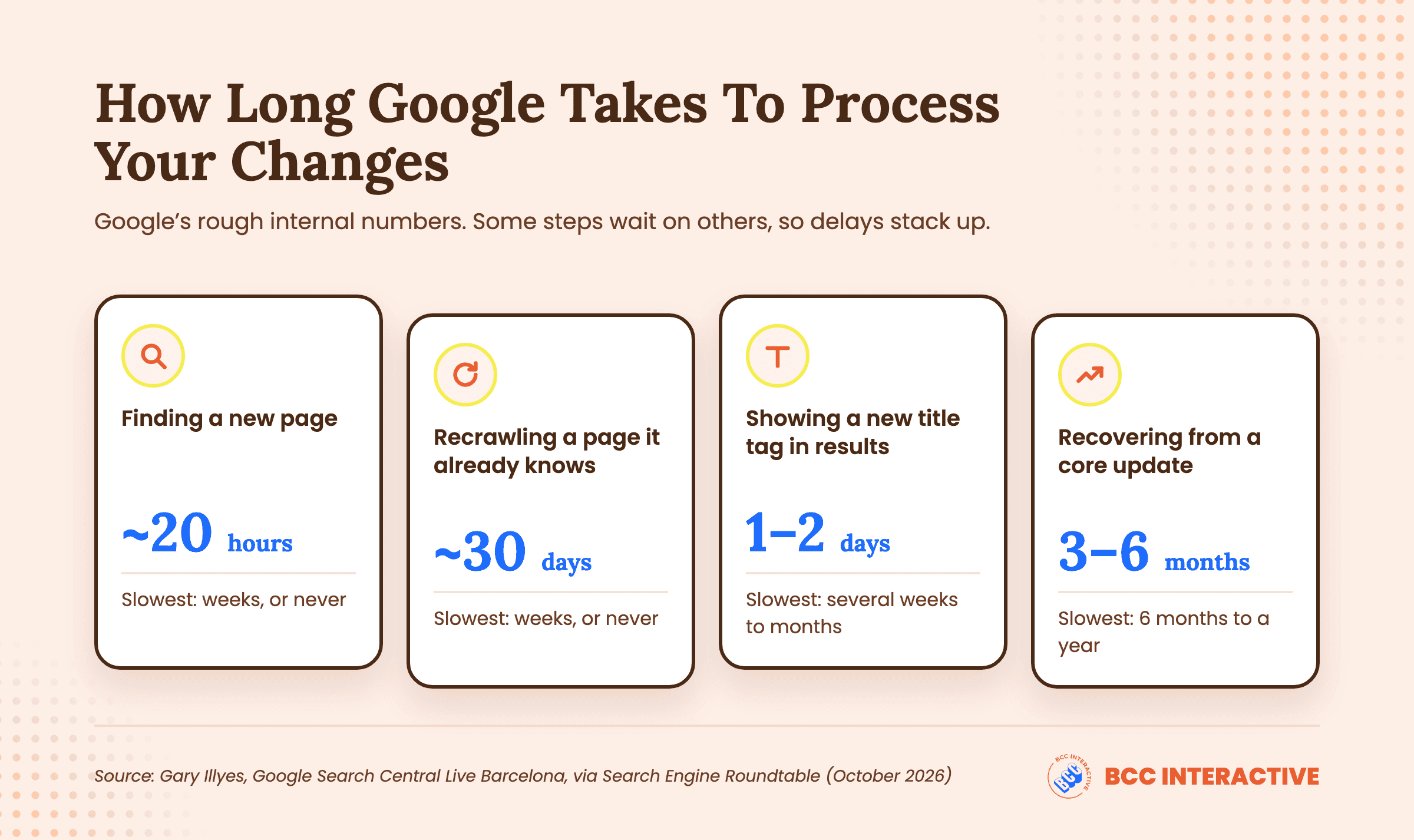
At Google Search Central Live in Barcelona in October 2026, Google’s Gary Illyes shared Google’s rough internal processing numbers:
- Finding a new page: about 20 hours typically. In the slowest cases, weeks or never.
- Recrawling a page Google already knows: about 30 days.
- Showing a new title tag in search results: 1 to 2 days typically, and several weeks to months in the slowest cases.
- Recovering from a core update: 3 to 6 months.
Those steps stack. A page can’t rank in search results until it’s crawled and indexed, and it can’t rank well until Google has enough signals that it deserves to. Even after that, climbing past established competitors can take months.
Competition adds more time. When Ahrefs updated its ranking study in 2025, it tracked 2 million new English pages created in October 2023 and found that only about 6% reached Google’s top 10 within a year.

We give a title tag change at least two weeks before we judge it, and an internal-linking change a full month. Google refreshes known pages about every 30 days, so an update that hasn’t moved after a week may not have been recrawled yet. Check the “last crawl” date in Google Search Console’s URL Inspection tool before you change anything else.
What Impacts How Long SEO Takes
Six things decide how fast SEO works for your business. Some speed it up. Some drag it out.
| SEO factor | Faster | Slower |
|---|---|---|
| Site history | Established site with years of content | New website with no backlinks |
| Competition | Local or niche keywords | National keywords against big brands |
| Technical SEO | Fast site Google can crawl easily | Indexing errors, slow pages, broken redirects |
| Content | Answers real buyer questions, found through keyword research, in depth | Thin pages that repeat what competitors say |
| Authority | Other trusted sites already link to you | Few or no backlinks (off-page SEO) |
| Execution speed | Changes go live within days | Recommendations sit in a Google Doc for months |
People rarely talk about that last row. Google’s hiring guide used to tell business owners to “be committed to implementing the recommended changes,” or not bother hiring an SEO. That’s true whether SEO is done in-house or by an agency. If your developer takes three months to publish the fixes, your SEO timeline just got three months longer.
Local SEO Usually Moves Faster
Local SEO can show results faster because you’re competing with businesses in a few zip codes, not the whole country. A complete Google Business Profile, consistent listings, and a steady flow of reviews can move your Map Pack rankings in 60 to 90 days.
Jessica Benhaim, owner of Lumos Yoga & Barre, ran a six-month campaign with us. In her words: “About halfway through the campaign, we started to see more traction in searches for us.”
"Higher search rankings, more leads, and most importantly, more patients."
How To See SEO Results Faster (And Get Leads Sooner)
There’s no SEO shortcut that holds up. Buying links or publishing hundreds of thin AI-written pages breaks Google’s spam policies, and Google’s spam updates hit in 1 to 2 days. What actually speeds it up:
- Fix technical SEO first. A page Google can’t crawl or index can’t rank, no matter how good it is.
- Go after long-tail keywords first. Longer, more specific searches (“water heater repair in [your town]” instead of “plumber”) have less competition and usually rank sooner. Our local keyword research guide shows how to find them.
- Improve pages already on page two. Google already shows them for your keywords, so making them better is usually faster than publishing something new.
- Link new pages from pages that already get traffic. Internal links (links between your own pages) help Google find new pages and understand which ones matter.
- Get changes live in days, not months.
None of these turn a 12-month SEO timeline into a 30-day one. They make sure the work isn’t sitting idle while you wait. If you need leads before SEO catches up, that’s what paid search is for.
Run PPC While SEO Builds
PPC (pay-per-click) ads, like Google Ads, show at the top of search results as soon as your campaign is approved and live. You pay each time someone clicks. That makes PPC the fastest way to get in front of people searching for what you sell, while your organic rankings are still months out.
PPC stops the day you stop paying. SEO is slower, but the rankings you earn keep bringing in traffic. That’s why we run them together, not as an either-or.
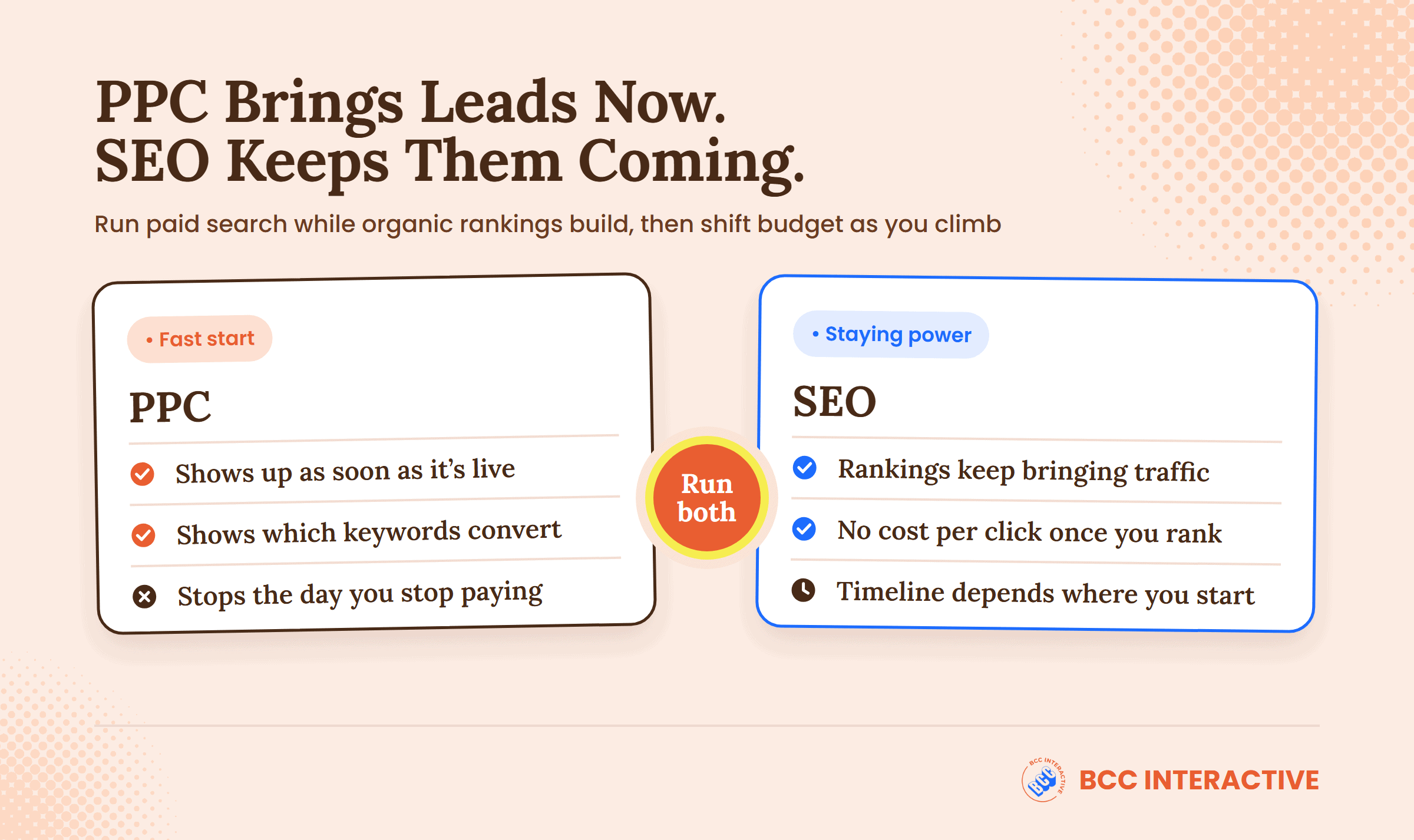
- PPC tells SEO which keywords to chase. Within a few weeks, your Google Ads search terms report shows which searches actually turn into calls and form fills. Those are the keywords worth building SEO pages for.
- PPC covers the keywords you don’t rank for yet. As your organic rankings climb for a keyword, you can lower the ad spend on it and move that budget to terms you haven’t earned yet.
- Better landing pages help both. A page that answers the buyer’s question converts paid clicks better and gives Google more reason to rank it.
See how we run PPC management alongside SEO.
Read more: SEO and PPC Working Together →
How To Measure SEO Progress Before The Leads Show Up
Leads are the real measure of SEO success, and they come last. So track the numbers that move before them. You don’t need expensive SEO tools for this. Free tools like Google Search Console and GA4 (Google Analytics 4) cover it, and each one answers a different question. In order:
- Indexed pages. In Google Search Console, go to Pages and check that your important pages are indexed.
- Average position on the keywords you’re targeting.
- Impressions on those same keywords. This is how often you show up in Google search results, even when nobody clicks. Check which searches the impressions come from. Since late 2025, AI answers and bot traffic can push sitewide impressions up on short, definition-style searches that never send a click, so a rising total on its own doesn’t prove anything.
- Clicks and organic traffic, in Google Search Console and GA4.
- Leads: calls, form fills, and bookings from organic search, tracked as conversions in GA4.
If numbers 1 to 3 are moving on your target keywords by month four, your SEO efforts are working, even if number 5 hasn’t caught up yet.
Get dates, not promises.
An experienced SEO will answer with a number and a date. If they can’t, you have your answer.
Common SEO Myths That Stretch Your Timeline
- “We guarantee page one in 30 days.” Some SEO agencies still promise this. Google says no one can guarantee a #1 ranking on Google. An agency that does is selling you something Google doesn’t sell. Here’s how to choose an SEO agency that won’t.
- “SEO is a one-time project.” SEO is an ongoing process. Competitors publish, Google updates, and rankings you stop maintaining start slipping.
- “More content means faster results.” Ten thin posts lose to one page that actually answers the question.
- “SEO is dead now that AI answers everything.” SEO isn’t dead. It’s evolving. Google says a page has to be indexed and eligible to show in Search to appear as a link in its AI Overviews, so the same work that gets you ranked is what gets you cited. More on that in GEO vs. SEO.
- “No leads in 60 days means it failed.” At 60 days, the right question is whether your important pages are indexed and moving up for the keywords you care about.
How Long Will SEO Take For You?
A plumber in one city and a national B2B software company are on very different SEO timelines. Pick the one closest to you and we’ll walk you through a realistic timeline for your market.
SEO Takes Time. Pick A Partner Who Tells You How Much.
The reason to invest in SEO is what happens once your rankings take hold. Paid search stops the day you stop paying. Organic rankings you’ve earned keep bringing in leads. That’s the payoff.
Getting there takes patience, and it takes an agency that tells you up front what to expect and when. No guarantees it can’t keep, a plan built around your business and your goal, and monthly reports tied to numbers you can check yourself. That’s how we approach SEO at BCC Interactive: sustainable leads without the agency games. If you’re also weighing the budget, our SEO pricing guide covers what it should cost.
SEO Timeline FAQs
Plan on 6 to 12 months or more. A new website starts with no backlinks or history, so Google is slower to trust it, and results may take longer than the ranges above. If you’re launching a new site, use those first months to get the technical SEO right and publish pages that answer real customer questions.
Some fixes show up that fast. Google typically updates a title in search results within 1 to 2 days, and fixing an indexing error can get a page into Google within hours. Steady organic traffic and leads take longer, from about 60 days on an established site to a year or more on a brand-new one. If you need leads in the first month, run PPC alongside SEO.
According to Google’s Gary Illyes, Google typically finds a new URL in about 20 hours, and indexing it typically takes about an hour and a half after that. Some pages take weeks, and some never get indexed. If a page still isn’t indexed after a few weeks, it usually needs more internal links or better content.
Usually faster than national SEO. Many local businesses see Map Pack movement in 60 to 90 days if their Google Business Profile, reviews, and listings are in good shape. Our local SEO checklist covers each one.
Some movement is normal, especially in the first few months and during Google’s core updates, which take 2 to 4 weeks to roll out. Judge the trend over 4 to 8 weeks, not day by day.
If you’re six months in and indexed pages, average position, and impressions on your target keywords haven’t moved in Google Search Console, something is wrong. If you’re working with an SEO agency or consultant, ask them to show you exactly what changed on your site and when.
For most businesses whose customers search on Google before they buy, SEO is worth it. Once you’re ranking, SEO keeps bringing in traffic without a cost per click, which paid ads can’t do. More on that in why SEO is important for small businesses.
Want A Real SEO Timeline For Your Business?
- What SEO should cost in your market
- Where your leads are leaking today
- A 90-day plan you can run with or without us
