


Someone in your town just asked ChatGPT for “the best roofer near me.” It named three companies. You weren’t one of them.
That’s not a someday problem, it’s happening now. In BrightLocal’s 2026 Local Consumer Review Survey (1,002 US adults), 31% of consumers had used ChatGPT for business recommendations in the past year. And it’s picky: SOCi’s 2026 Local Visibility Index found ChatGPT recommended 1.2% of about 350,000 brand locations, vs. 35.9% appearing in Google’s local 3-pack.
So how do you rank on ChatGPT? Not the way you rank on Google. AI-powered search tools like ChatGPT give an answer, and you’re either in it or you’re not. Below is how that answer gets built, six steps that influence it, and what nobody can control.
Key Takeaways
There is no position one. SparkToro found less than a 1 in 100 chance that ChatGPT gives the same brand list twice for the same prompt. Track how often you appear, not where.
ChatGPT answers from training data or a live web search. Only the search side moves quickly when you make changes.
Allow OAI-SearchBot or you're out of search answers. That's OpenAI's own rule. Blocking GPTBot affects training, not search.
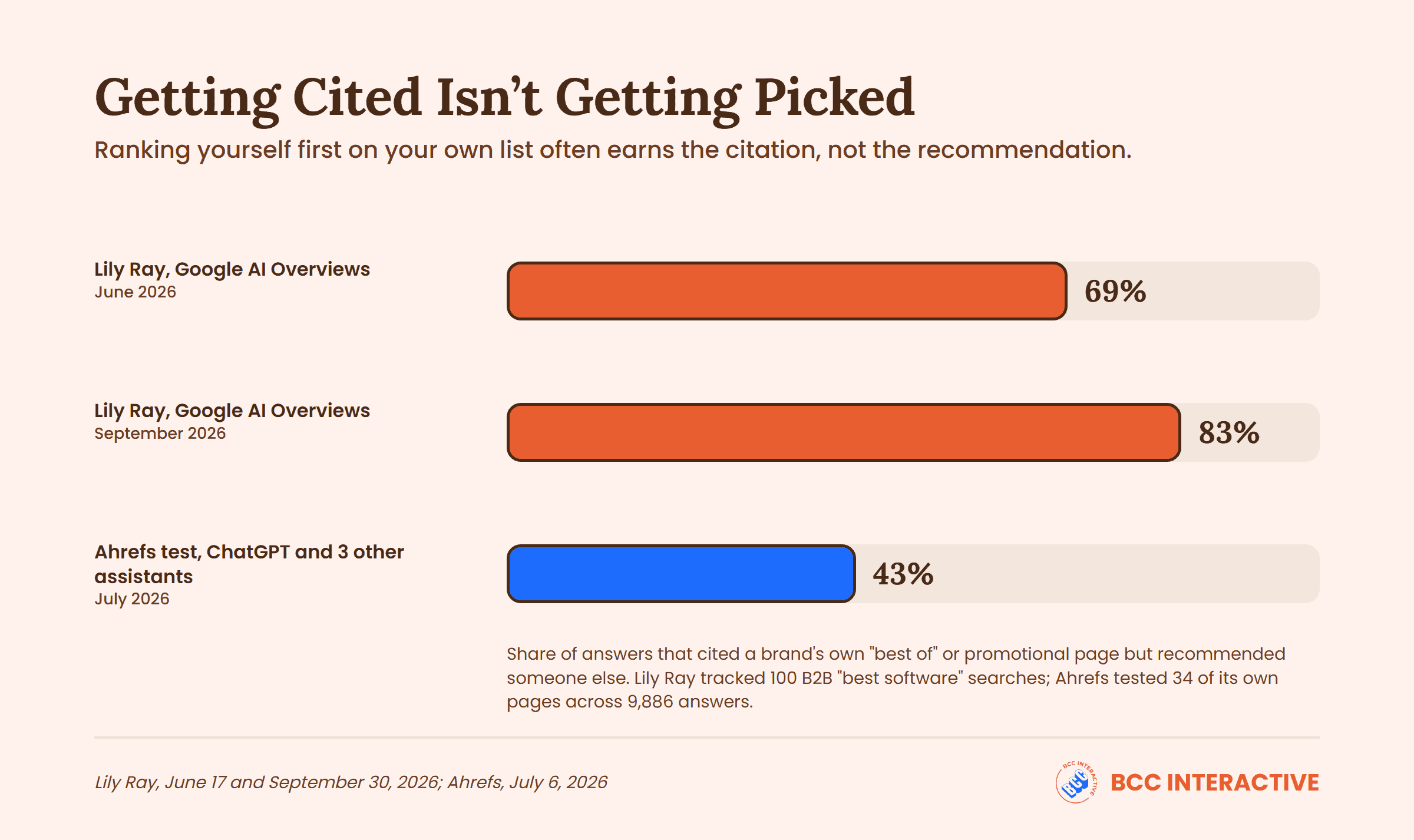
Being cited isn't being recommended. In an Ahrefs experiment, 43% of AI answers that cited its own conference-promotion pages never mentioned the conference.
Other people's lists carry the weight. Ahrefs found "best X" lists were 43.8% of ChatGPT's sources on recommendation prompts, and self-ranking lists are now getting filtered out.
Local answers lean on Yelp and your website. Yelp appeared in 80% of ChatGPT's local business answers in BrightLocal's August 2026 study.
What "Ranking" On ChatGPT Actually Means
Google gives you a position in its search results. ChatGPT gives you a sentence. Three things can happen to your business in it:
- Mentioned: ChatGPT names you.
- Cited: ChatGPT links to one of your pages as a source.
- Recommended: ChatGPT tells the person to pick you.
A page can be cited while the answer recommends your competitor. (More on mentions vs. citations.)
The answer also changes every time. SparkToro and Gumshoe had 600 volunteers run 12 recommendation prompts through ChatGPT, Claude and Google’s AI 2,961 times (January 28, 2026). The brand lists almost never repeated. What held steady was how often a brand appeared across many runs.
So “rank #1 on ChatGPT” is the wrong goal. “Show up in most answers to the questions my buyers ask” is the right one.
How ChatGPT Decides What To Say: Training Data Vs. Live Search
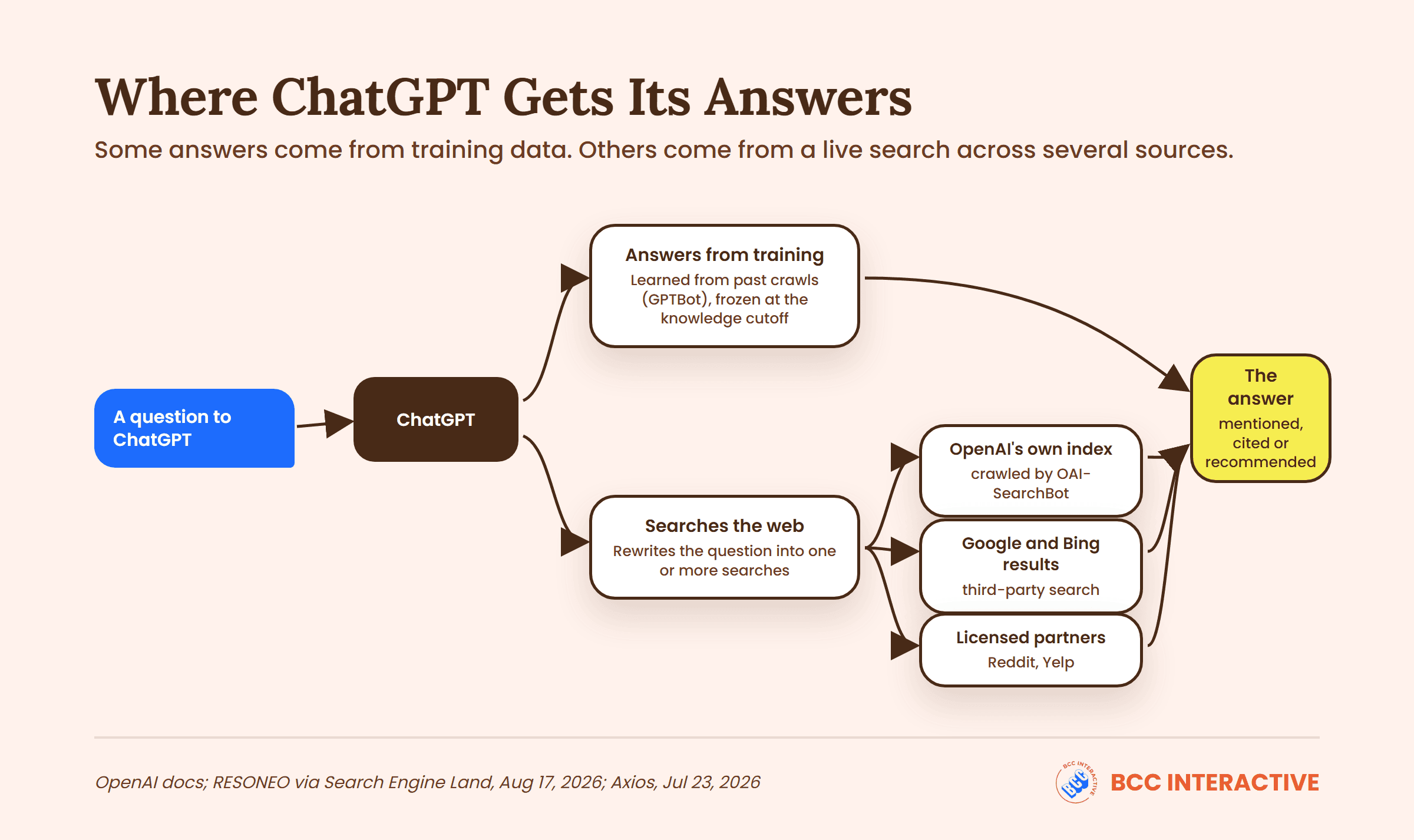
Training data is what AI models learned before their knowledge cutoff. OpenAI’s GPTBot crawler collects content that “may be used in training.” You can’t change what a model already learned, or when the next one comes out.
Live web search is where your influence lives. OpenAI’s help center says ChatGPT “may search the web automatically when your question would benefit from current information,” rewriting your question into one or more search queries. Local businesses, prices and “best” options usually qualify. (For the broader picture, see our guide to LLM SEO.)
Does ChatGPT Search Use Bing Or Google?
Both, plus its own index. Most guides say ChatGPT runs on Bing. That was true at launch. The evidence has moved since.
| Source | Date | What it says |
|---|---|---|
| OpenAI, "Introducing ChatGPT search" | October 31, 2024 | Uses "third-party search providers" plus partner content. No provider named |
| Seer Interactive | February 6, 2025 | 87% of ChatGPT search citations matched Bing's top 20 results, vs. 56% for Google (about 100 questions) |
| Nick Turley, OpenAI head of product, antitrust testimony (Courthouse News) | April 22, 2025 | ChatGPT pulls from Bing; Google declined OpenAI's request for search API access |
| The Information, via Search Engine Land | August 26, 2025 | OpenAI used scraped Google results for some answers. Not confirmed by OpenAI |
| RESONEO, in Search Engine Land | August 17, 2026 | Fast free answers drew almost entirely on OpenAI's own index, with only 1.5% overlap with Bing's top 20. Paid Thinking answers took 75.3% of results from scraped Google data |
Bing’s role has shrunk; OpenAI’s own index and Google’s results have grown. The 2026 detail comes from outside researchers reading ChatGPT’s network traffic, unconfirmed by OpenAI, and RESONEO says it doesn’t know which crawler fills OpenAI’s index.
OpenAI also licenses content directly: Reddit since May 16, 2024, and Yelp’s reviews, photos and business details since July 2026 (Axios, July 23, 2026).
So don’t optimize for one search engine. Be readable by OpenAI’s crawler, indexed in Google and Bing, and present on the sites ChatGPT licenses or cites. The same holds for other AI search engines.
Step 1: Make Sure ChatGPT Can Read Your Site
This is the technical SEO step, the only one OpenAI documents directly, and it takes ten minutes. OpenAI runs three user agents, each controlled separately in your robots.txt file (the plain-text file at yoursite.com/robots.txt that tells crawlers what they can access).
| User agent | What it does | If you block it |
|---|---|---|
| OAI-SearchBot | Finds pages for ChatGPT search answers | You're left out of search answers, though you can still appear as a plain navigational link |
| GPTBot | Collects content that may train future models | Signals your content shouldn't be used for training. Doesn't remove you from search |
| ChatGPT-User | Visits a page when a person in ChatGPT asks it to | OpenAI says robots.txt "may not apply," since a person started the visit |
OpenAI says “each setting is independent of the others.” For most small businesses, being known by future models beats staying out of training, so we’d allow both:
“`
User-agent: OAI-SearchBot
Allow: /
User-agent: GPTBot
Allow: /
“`
Three things trip people up:
- Your firewall can block what robots.txt allows. OpenAI says to confirm your host or content delivery network allows its published searchbot IP addresses. Security plugins and services like Cloudflare can block AI bots with one setting, so check you’re only blocking what you mean to.
- Changes take about 24 hours to register, per OpenAI.
- Blocking a page doesn’t always hide it. OpenAI says a blocked page can still appear as a link and title. Use a noindex tag instead, and leave the page crawlable so the tag gets read.
Step 2: Get Indexed Everywhere ChatGPT Looks
- Google. Traditional SEO still matters. RESONEO found paid Thinking answers are built mostly from Google’s results, so a page missing from Google’s search results is invisible to those users.
- Bing. Verify your site in Bing Webmaster Tools and submit your sitemap. It’s named in sworn testimony, powers Microsoft Copilot, and takes an afternoon. Treat it as hygiene, not the strategy.
- OpenAI’s own index. That’s Step 1.
Step 3: Write Pages ChatGPT Can Quote
RESONEO found ChatGPT opened no page at all in 93% of the fast, free answers it captured; those rested on titles and roughly 200-character snippets. In Thinking mode, pages it opened were cited 74% of the time, vs. 7% for pages it only retrieved. Pages that get cited are written for that:
- Answer in the title, the first heading and the first two sentences, using the keyword phrase a customer would type. “Roof Replacement In Columbus: Cost, Timeline And What’s Included” says more than “Our Services.”
- Give each service and location its own page. One “Services” page can’t answer “who installs metal roofs in Westerville?”
- Publish the specifics: price ranges, service areas, hours, licenses, warranties. ChatGPT has little to go on for anything your site never says.
Schema markup (structured data that labels your details for machines) is worth having for Google, but we haven’t seen evidence it changes what ChatGPT says. The full content playbook is in our LLM SEO guide.
Step 4: Get Recommended By Other Sites
When ChatGPT answers “what’s the best X,” it reads what other sites say about X. Ahrefs’ Glen Allsopp analyzed ChatGPT responses to 750 recommendation prompts about software, products and agencies (December 4, 2025). “Best X” blog lists were 43.8% of the source page types, and brands placed higher on them were more likely to be recommended.
Seer Interactive counted differently and got 16.6% of about 2 million ChatGPT citations (November 2025 to February 2026), with list citations falling 30% from December to January. Lists matter for buying questions. How much, and for how long, is contested.
The shortcut, your own “best roofers in Columbus” list with you at number one, is starting to backfire:
- Ahrefs tested it on itself (July 6, 2026). Across 9,886 AI answers, 43% of those citing its conference-promotion pages never mentioned its conference. “The page got the citation, but the competitor got the recommendation.”
- Lily Ray tracked 100 “best software” queries in Google’s AI Overviews. The self-ranking brand was left out of the recommendation 69% of the time in June 2026 and 83% by September. Sites heavy on these lists also lost Google traffic, and often ChatGPT citations, from January 2026.

Skip the self-ranking listicle. It hands your research to the competitors on your list. Spend that time earning brand mentions on lists other people write: local "best of" roundups, industry associations, partner pages, chamber directories, local news. This isn't backlink building. A link helps your Google rankings, but nobody has shown backlinks drive ChatGPT answers. Being named by someone else is the point.
For Local Businesses: Yelp, Reviews And Your Website
BrightLocal’s August 26, 2026 study of 1,967,762 AI citations across 1,355 locations found Yelp in 80% of ChatGPT’s local business answers, and about 93% of cited domains were individual business websites. So start with a claimed, complete Yelp page that matches your website. One warning: Yelp’s guidelines say “businesses should never ask customers to write reviews,” and its software may hide reviews that look requested. Ask for Google reviews and let Yelp reviews come on their own. (More local data: AI search statistics for local businesses.)
Step 5: Say The Same Thing Everywhere
If your website says you serve five towns, Yelp says three, and an old directory lists a phone number you dropped years ago, ChatGPT has to guess.
Pick one source of truth for your name, address, phone, hours, services and service areas, and match it on your website, Yelp, Google Business Profile, Facebook, Apple Business Connect and any directory ChatGPT cites. If ChatGPT already has something wrong, see what to do when ChatGPT gets your business wrong.
Find Out What ChatGPT Says About You Right Now
Before you change anything, get a baseline. Our free AI Visibility Playbook walks you through checking how ChatGPT, Gemini and Perplexity describe your business, who they compare you to, and which sources they cite. It's a 15-minute diagnostic you run yourself. Fixing what it finds is the work we do.
Get the free playbookStep 6: Test And Track Your ChatGPT Visibility
- Test like a customer. Use a logged-out window so past chats don’t shape the answer, and leave your business name out of the question.
- Run each prompt five times. One answer is one draw.
- Log three things: mentioned, cited with a link, recommended. The ChatGPT sources that keep showing up are your Step 4 targets.
Paste These Into ChatGPT, Then Swap In Your Details
- What are the best [your service] companies in [your city]?
- Who should I hire for [specific job] in [neighborhood or town]?
- [Your business name] vs. [top competitor]: which is better for [use case]?
- Is [your business name] a good choice for [service]? What do reviews say?
Prompts 1 and 2 test whether you get recommended when nobody names you. Prompt 3 tests how ChatGPT compares you. Prompt 4 tests whether it describes you accurately and which sources it trusts on reputation.
Track the traffic. OpenAI says ChatGPT adds utm_source=chatgpt.com to search referral links, so those visits show up in Google Analytics (GA4). RESONEO found Thinking-mode citations to pages ChatGPT opened itself carried no UTM tag, so some visits will still land as direct traffic.
The full method (15 to 25 fixed prompts, run monthly) is in how to measure GEO performance, and our guide to reporting AI visibility to your boss covers what to show leadership.
What You Can't Control
- OpenAI doesn’t publish ranking factors. It says ChatGPT ranks results “using multiple factors” and “placement is not guaranteed.” Every “ChatGPT ranking factor” list is built from correlation, this post’s studies included.
- Where ChatGPT searches keeps changing. Bing, Google, OpenAI’s index and licensed partners have traded weight in under two years.
- Training data moves on OpenAI’s schedule. An old fact about you can survive until a newer model replaces it.
- Answers vary by user. Location, plan and mode (fast vs. Thinking) change which sources ChatGPT reads.
- Citations churn daily. Ahrefs tracked about 37,500 citations for 20 days (October 29, 2026); 64% to 76% of cited pages on ChatGPT and Google AI Mode changed day to day.
- Ads don’t buy organic answers. OpenAI says advertisers “have no ability to shape, rank, or alter ChatGPT’s responses.” More in our guide to ChatGPT ads.
None of that makes it random. Work the inputs you control and judge the trend, not a single answer.
Earn The Recommendation, Then Measure It
Let OAI-SearchBot in. Get indexed in Google and Bing. Write pages whose titles and first lines answer the question. Get onto lists and review sites you don’t own. Keep your facts identical everywhere. Test the same prompts every month.
The businesses ChatGPT recommends aren’t gaming a ranking factor. Other sites vouch for them, and their own sites say clearly what they do. If you’d rather have that built for you, answer engine optimization (AEO) is what we do for B2B companies, e-commerce companies and local businesses, on top of the search engine optimization (SEO) that feeds it.
Frequently Asked Questions
Allow OAI-SearchBot in robots.txt and in your firewall, get indexed in Google and Bing, answer the question in your titles and opening lines, and earn mentions on the lists and review sites ChatGPT cites. OpenAI says placement is never guaranteed.
Not in any lasting way, because ChatGPT rarely returns the same brand list twice. Aim to appear in most answers to your buyers’ questions across repeated runs.
OpenAI’s publisher FAQ says any public website can appear in ChatGPT search. To rank your website on ChatGPT, start with the documented requirement: let OAI-SearchBot crawl it from its published IP addresses. Then give it clear pages for each service and location to cite.
It can. OpenAI has licensed Reddit content since May 2024, so threads show up as sources. Genuine answers in your customers’ communities help. Automated or fake posting is what Lily Ray warns spam updates are built to catch.
It’s one slice. GEO (generative engine optimization) and AEO (answer engine optimization) cover every AI search engine, including Gemini, Perplexity and Google’s AI Overviews. The work overlaps, but visibility doesn’t carry over between platforms, so test each.
Most of it. Checking robots.txt, claiming Yelp and Bing listings, rewriting titles and running a monthly prompt test are all doable. Earning third-party mentions and tracking consistently is where most businesses bring in help.
Want To Know Why ChatGPT Recommends Your Competitor?
- What ChatGPT says about your business today, and which sources it trusts
- Which third-party sites and lists you need to be on in your market
- A 90-day plan to get recommended in ChatGPT, with or without us
