


FilmTrack sells rights and royalty management software to film and TV companies. In March 2022, one guide on its site, Royalty Management 101, held #1 in Google for “movie royalties”, “film royalties” and “how do movie royalties work”. That single guide drew about a quarter of FilmTrack’s estimated organic visits (Semrush).
It wasn’t a content calendar or a volume play. It was one well-built answer to the question FilmTrack’s buyers actually had.
That’s what SaaS content marketing, and B2B SaaS content marketing in particular, looks like when it works. This guide covers how to pick those topics, how to get the answers out of the people who know them, and how to tell whether the content is bringing in demos.
Key Takeaways
Start from buyer questions, then check the searches. Keyword volume tells you how many people ask, not whether they'd buy.
One guide on the real question can beat a calendar. FilmTrack's royalty guide drew about a quarter of its organic visits in March 2022 (Semrush).
Your product experts are the bottleneck. The people who know the answers rarely have time to write, so build a process that asks them for 20 minutes, not a draft.
Build each piece from what only you know. Customer questions, product details and real numbers are what competitors can't copy.
Write for where your category is heading. The questions buyers are about to ask are easier to win than the ones everyone already covers.
Measure it in demos and pipeline. Traffic is a supporting number, not the result.
What SaaS Content Marketing Is (And Why It's Different For Software)
SaaS content marketing is creating guides, articles, comparisons and other content that bring buyers to a software company, help them choose it, and keep them using it. It’s content marketing for SaaS companies, with three things that make it different from B2B content marketing for most businesses. (If you’re still making the case for content at all, start with the benefits of content marketing.)
- The sale is a subscription. Content has to win the first purchase and help keep the customer, because churn undoes the win.
- More than one person decides. B2B buyers rarely decide alone. A B2B SaaS purchase usually has a user, a buyer and an approver, and each one searches for different things. We cover that in B2B SaaS SEO.
- The product changes. Features, integrations and pricing move every quarter, so content goes out of date faster than it does for most businesses.
Cory has a line for why content still matters when buyers aren’t ready yet. The topics a blog captures show “that you guys, you know, know what you’re talking about, but it’s also to capture. The folks who may not be ready to take action tomorrow”.
Pick Topics From The Questions Buyers Ask, Then Check The Searches
Most SaaS content strategies start with keyword research. We start one step earlier: what do buyers ask your sales team, your support team and your founders?
Those questions come in a few kinds:
- The job they’re trying to get done. “How do I calculate royalties across territories?” This is jobs-to-be-done content: it’s about the task, not your product.
- The pain point that sent them looking. “Why do our royalty statements keep coming out wrong?”
- The use case. “Can this handle music licensing as well as film?”
- The comparison. “How is this different from [competitor]?” and “[competitor] alternatives”.
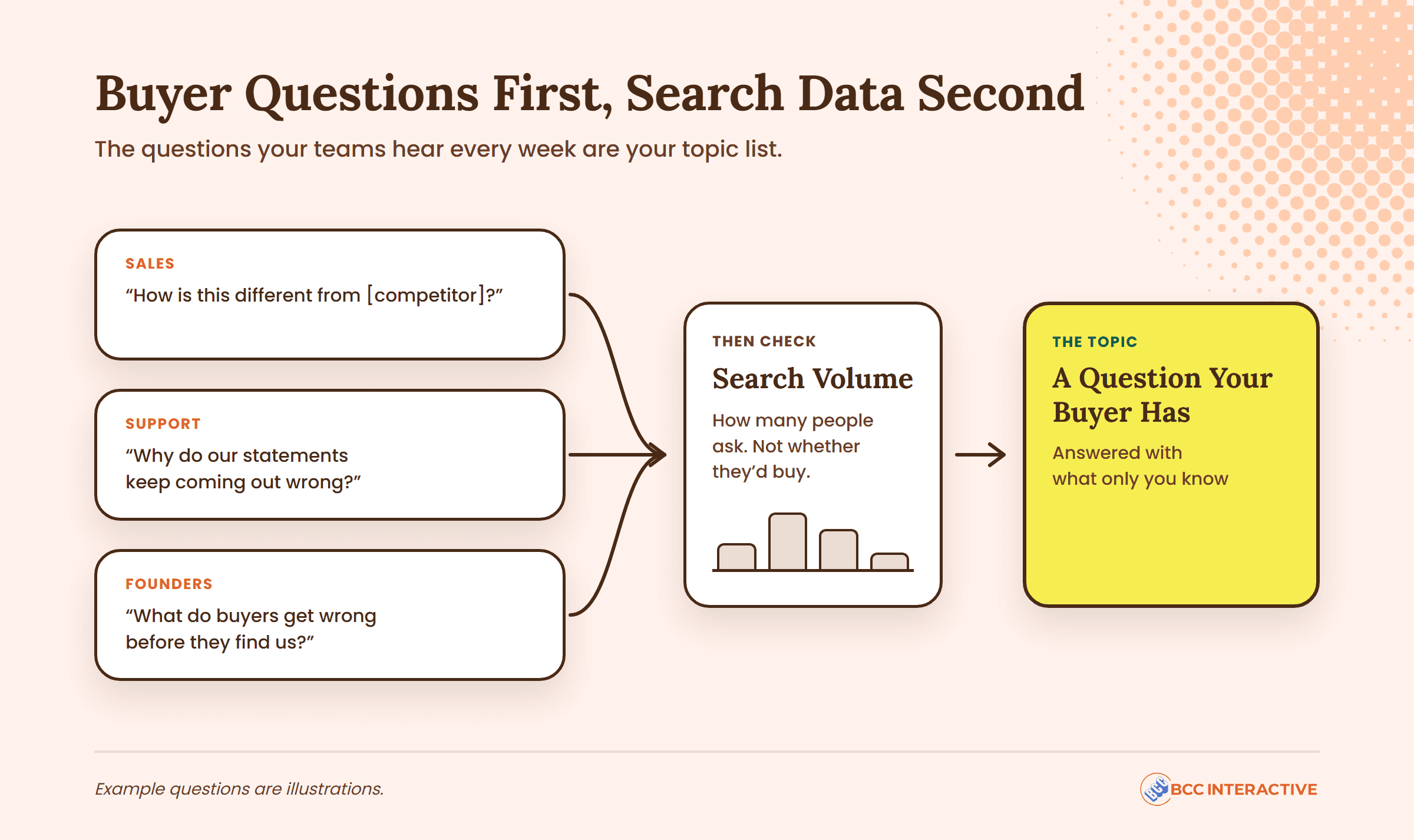
Then check the keyword data and build your keyword strategy around the questions that matter. Search volume tells you how many people ask the question. It doesn’t tell you whether they’re your buyer. A keyword with 200 searches a month from people who run licensing teams can be worth more than one with 20,000 from students. This is where SEO and content marketing have to work as one plan, not two teams.

Five posts that answer the real question will do more than twenty on the same topic. As Cory puts it: 'I'm not going to create 20 articles around the same topic when maybe five would suffice.'
Bottom Of The Funnel First: Comparisons, Alternatives, Use Cases
Bottom of the funnel content is the content closest to a purchase. It is usually the smallest in search volume and the highest in value. It includes comparison pages, alternatives pages, integration pages and use-case pages. If you don’t have them, build them before the top-of-funnel guides. Our guide to SEO for SaaS walks through each page type.
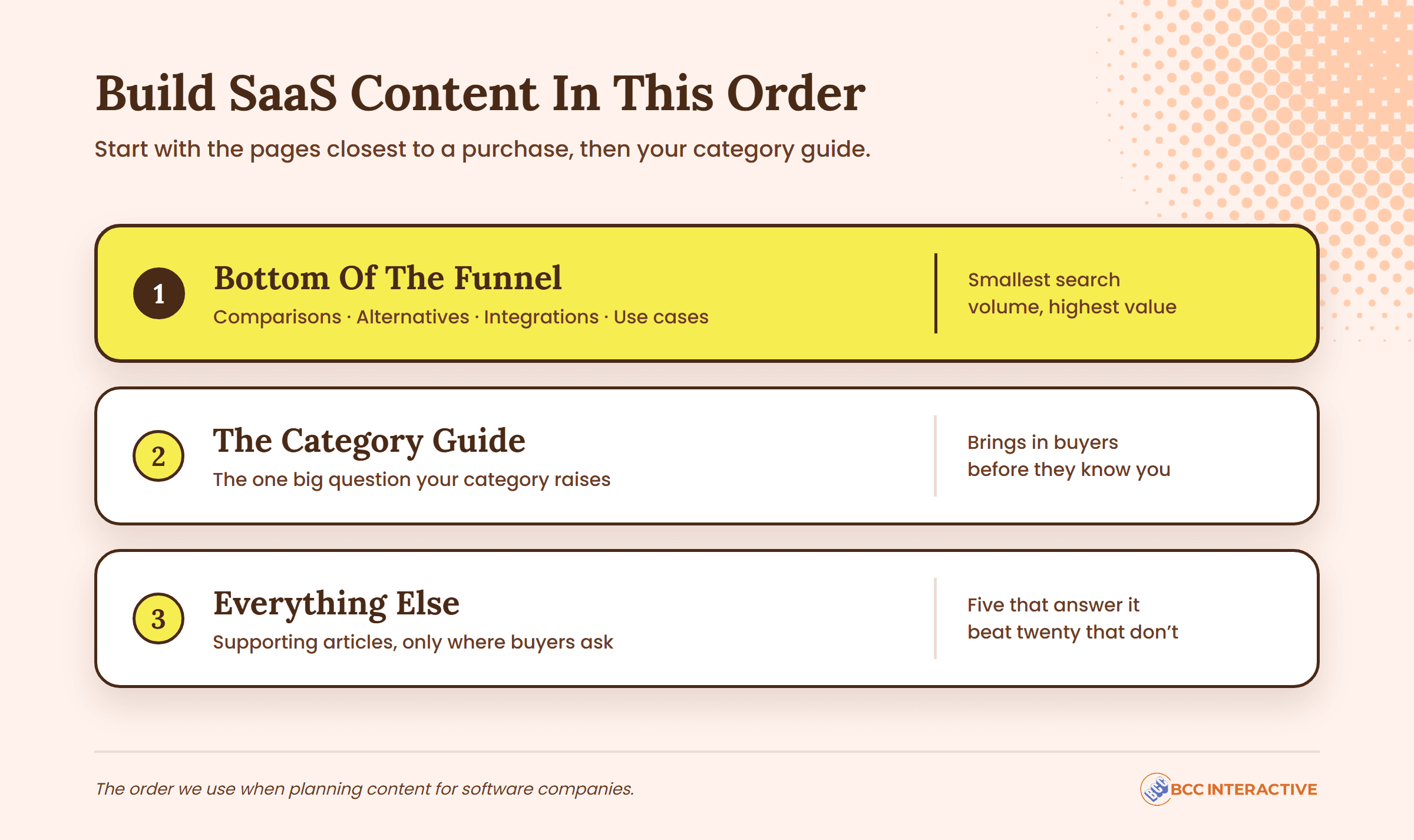
Then The Guide That Owns The Category Question
After the bottom-of-funnel pages, look for the one big question your category raises. For FilmTrack, that was how royalties for film and TV work. Every buyer needed the answer before they needed the software.
A guide like that does two jobs. It brings in people who don’t know your company yet, and it shows them you know their world better than anyone else they’ve found.
What One Guide Did For FilmTrack
FilmTrack’s case study lists what the approach was built on: a definitive guide that could own an entire topic cluster, writing for where the industry was heading and not just what it already searched for, and growing the content as FilmTrack’s own product grew.
By March 2022, the Royalty Management 101 guide held #1 for “movie royalties”, “film royalties” and “how do movie royalties work”, and drew about a quarter of estimated organic visits (Semrush). Over the full engagement, FilmTrack went from 335 to 885 ranking keywords (Semrush, January 2018 to December 2023).
"Thirty minutes and I had a clearer picture of our search problem than after two months of internal meetings."
Get The Answers Out Of Your Product Experts
The hardest part of SaaS content marketing isn’t content ideas or content production. It’s getting time with the people who know the answers: founders, engineers, product managers and customer success leads. They’re busy, they don’t want to write, and a blank document is the fastest way to lose them. Most in-house content stalls right here, whether the marketing team has one content marketer or a whole content marketing manager role.
So don’t ask them to write. Ask them for 20 minutes and a few specific questions, record it, and build the piece from what they said. The expert reviews the draft for accuracy. They never stare at a blank page.
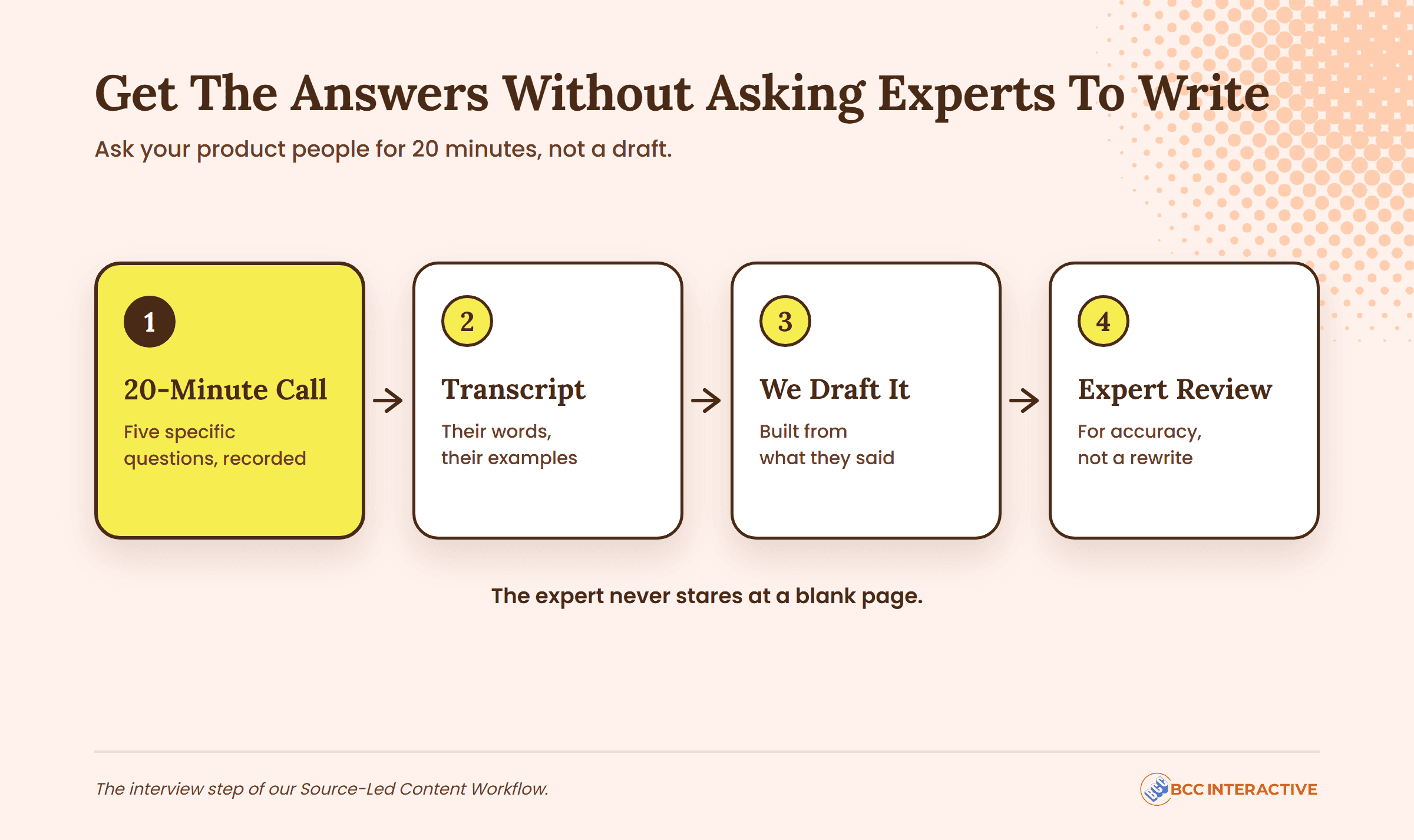
Ask Your Product Expert These Five Questions
2. What do they get wrong before they find us?
3. What do you wish every buyer knew before a demo?
4. What do our competitors get wrong about this?
5. What's a number or example from a real customer that proves it?
Each answer maps to a part of the piece: the topic, the problem, the angle, what everyone misses and the proof.
We built a whole method around this, the Source-Led Content Workflow, and the full version is free.
Content Built From What You Actually Know
The method we use to turn customer questions and expert interviews into content competitors can't copy
Get the Source-Led Content WorkflowBuild Your B2B SaaS Content Strategy On What Only You Know
Anyone can publish “10 SaaS Marketing Tips.” Your competitors already have, and generic content like that is why most content creation in software sounds the same. What they can’t publish is what’s inside your company:
- The questions your customers actually ask, in their words
- How your product solves a problem, with real screens and real steps
- Numbers from your own customers, with permission
- The mistakes you see buyers make before they find you
Before we write any piece, we map it out: who it’s for, what only we know, the proof for every claim, what the top results already cover and what they all miss. That map is what keeps each piece of content from sounding like everything else on the results page. It also gives AI platforms like ChatGPT and Gemini something specific to pull from, rather than one more generic summary.
Show The SaaS Product Doing The Job
Product-led content teaches the reader how to solve the problem and shows your SaaS product doing it, with real screens and real steps. It’s educational content first. The product shows up because it’s the fastest way to do the job, not because the post needs a pitch.
It works for software in a way it doesn’t for most businesses, because the reader can see exactly how the job would get done. A guide on calculating royalties that walks through the calculation in the tool answers the question and gives a demo at the same time.
Two rules keep it honest. Answer the question fully even for readers who never buy, and keep the screens current, because nothing undoes trust faster than a screenshot of a menu that no longer exists.
Write For Where Your Category Is Heading
FilmTrack’s content was written for where the media industry was heading, not only for what people already searched for. When the questions started showing up in search, FilmTrack already had the answers.
Cory saw the same thing at a much bigger company. At Comcast, his project was Xfinity Home, a home security and automation product. The team wrote articles on home automation (how to connect devices, what works with Nest) so Xfinity stayed in the conversation with people who already had another provider and would switch when their contract ran out.
Inside Comcast, people didn’t like the word “blog.” “We just called it a content repository,” Cory says. “And then all of a sudden they were like, oh, oh, let’s write all the articles in the one.”
Same content, different name, and suddenly every team wanted in. The lesson for a SaaS business: the content that catches future buyers is often the content your internal teams undervalue.
Distribute It Past Google
Search is where most SaaS content gets found over time, but it’s not the only marketing channel it should go through. A simple distribution strategy:
- Sales. Give your sales team the comparison and use-case pages to send after a demo.
- Email marketing. Use guides in onboarding and nurture emails, especially for trial users.
- LinkedIn and communities. Share the finding, not the link dump. Be where the conversations already happen.
- AI platforms. AI platforms take more than your word for it, so mentions, reviews and case studies on other sites help them describe you accurately.
Measure Content In Demos And Pipeline
Track your content marketing efforts on what they do for the business, not on output:
- Non-brand organic visits to the piece
- Demos, trials or sign-ups that started on it or passed through it
- Pipeline and revenue from those demos and trials, from your CRM
Rankings and page views in your marketing analytics are useful for seeing what’s moving. They aren’t the result. Our guide to measuring content marketing ROI covers how to set it up.
Fewer, Better Pieces Built On What Only You Know
SaaS content marketing works when each piece answers a question your buyer actually has, with knowledge your competitors can’t copy. Start with the bottom-of-funnel pages, find the one question your category raises, get the answers out of your experts in 20 minutes instead of three drafts, and judge it all on demos and pipeline.
Get A Content Plan Your Product Team Can Keep Up With
- The buyer questions you're not answering yet
- Which pages to build first for demos, not traffic
- A 90-day plan you can run with or without us

Frequently Asked Questions
Creating guides, comparison pages, use-case pages and other content that brings buyers to a software company, helps them choose it and helps keep them as customers.
To build a content strategy for SaaS, start with the questions buyers ask your sales and support teams, check search data to see which ones people search for, build the bottom-of-funnel pages first, then the guides that own your category’s big questions. Measure everything in demos and pipeline.
The best SaaS content is usually the most specific. Comparison, alternatives, integration and use-case pages convert best because they reach buyers close to a decision. In-depth guides on the category’s main question bring in buyers earlier. Case studies help at every stage. For more formats, see our list of types of content marketing.
Less than most think. A handful of strong pieces on the questions buyers actually ask will usually do more than a weekly blog on topics nobody in your market is asking about.
It depends on where you start. An established site that adds content on clear gaps can see movement in 60 to 90 days. Competitive categories often take 3 to 6 months, and a new site going after national searches against big brands can take 6 to 12 months or more.