


“It’s hard for me to go into a meeting and say like… we’re going to hire someone that’s just going to do SEO stuff and we don’t know what that is.”
A marketing lead at a B2B software company said that to us on an intro call. They knew search mattered. They called it “a bit of a white whale in the sense that we know it’s valuable, we know we want to chase it, but it’s always kind of been elusive.”
That’s where most B2B SaaS SEO stalls. Not on keywords or page speed, but in the room where someone has to explain what it is, what it costs and what it will bring back.
This guide covers the parts of SEO that are specific to selling software to businesses: who searches, what they search before they’ve heard of you, and how to report it so the people who sign the budget can follow it. For the full step-by-step build of SEO for B2B SaaS, start with our guide to SEO for SaaS.
Key Takeaways
Branded traffic isn't the win. Clicks from people who already know your name would mostly happen anyway; the work shows up in searches from people who don't.
Plan for three readers. The person who uses the software, the person who buys it and the person who approves the spend all search differently.
Win the category search, not the 40-search phrase. Ranking #1 for a phrase 40 people a month type doesn't move pipeline.
One great guide can carry a site. FilmTrack's royalty guide drew about a quarter of its estimated organic visits in March 2022 (Semrush).
Enterprise SaaS SEO is the same work at a bigger scale. More pages, more stakeholders, and more reasons to watch what competitors change.
Report it in pipeline terms. Non-brand visits, demos, trials and closed revenue, in that order.
What Makes B2B SaaS SEO Different
B2B SaaS SEO is search engine work for B2B SaaS companies: businesses that sell software to other businesses on a subscription. The basics are the same as any SEO for B2B: technical SEO, on-page SEO, content and links. What changes is who’s searching, how long they take to decide, and what counts as a result.
| B2B SaaS | B2B services | B2C SaaS | |
|---|---|---|---|
| Who searches | A user, a buyer and an approver, often at different times | Usually the owner or one manager | One person buying for themselves |
| How long the decision takes | Weeks to months, with demos and trials | Days to weeks | Minutes to days |
| What they search first | The problem, then the category, then "X vs Y" | The service plus a location or industry | The product type or a feature |
| What a win looks like | A demo, a trial that converts, pipeline | A call or a booked consult | A sign-up or a purchase |
| What usually goes wrong | Traffic grows, demos don't | Ranking for the wrong area | Ranking for curious browsers, not buyers |
The last row is the one to watch. A SaaS business can double its organic traffic and see no change in demos, because the traffic came from the wrong searches.
Start With The Searches Your Buyers Make Before They Know You
Marketing is doing its job when people who have never heard of you find you by searching for their problem. Cory put it this way on a client call: the way you can tell marketing is working is “when people who are unaware of you, but aware that they have a problem are able to find you via Google organic, Google ads.”
That rules out a lot of what shows up in a typical SEO report.
Brand Traffic Is Table Stakes
Most B2B SaaS websites get the bulk of their organic clicks from people searching the company’s own name. Those people already know you. They’d find you with or without SEO.
Cory told a prospect looking at their own numbers: “The keywords in which you guys are doing the best is your brand name.” He called that table stakes: the minimum, not the win.
One B2B software company we spoke with had non-brand commercial traffic, meaning people searching for what they sell rather than who they are, at 3 to 5% of its total organic traffic. Everything else was brand. That’s the number to move.
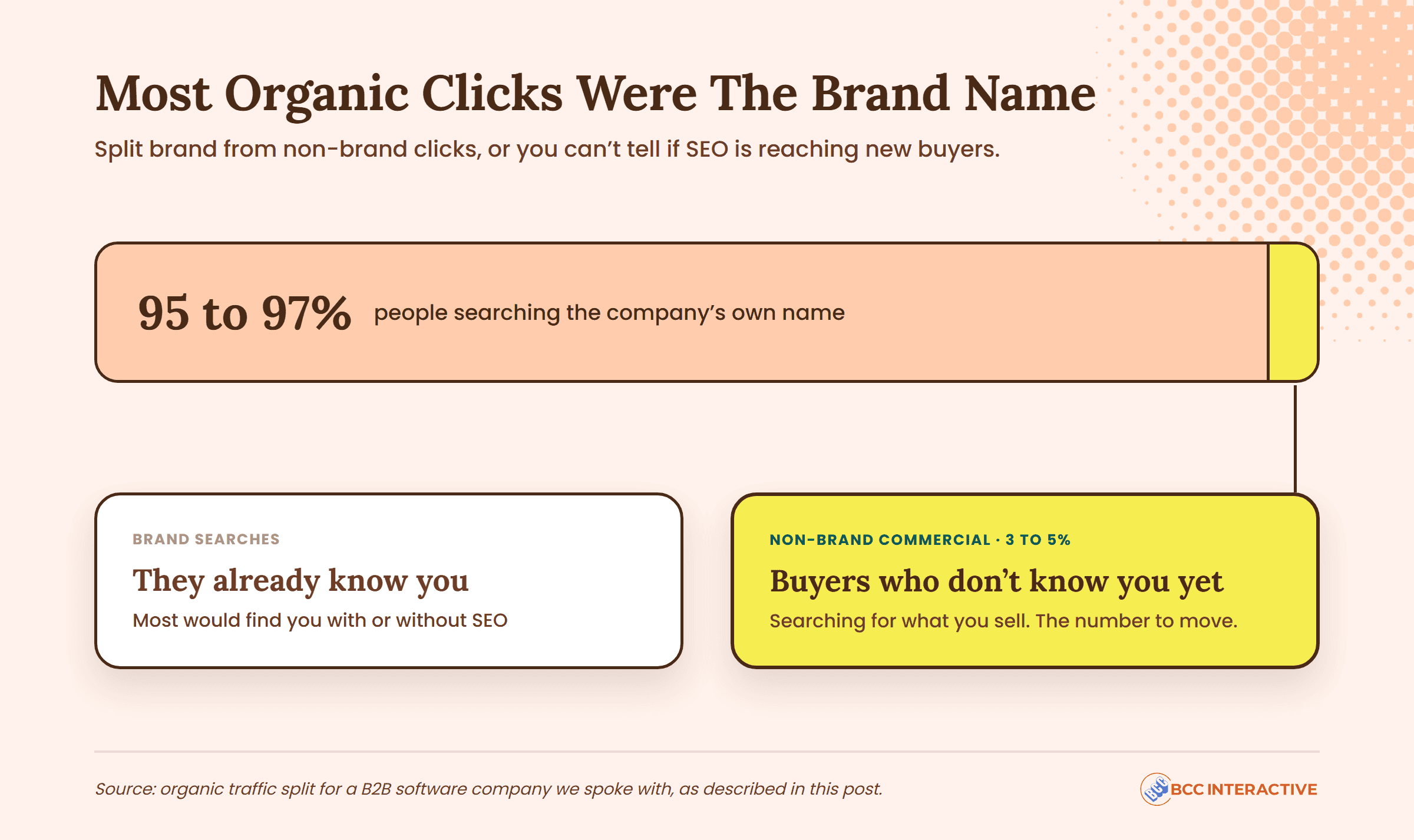
Ask for brand and non-brand clicks to be split in every SEO report. Google Search Console can do it with a query filter that excludes your company name. If your SEO reporting only shows total clicks, you can’t tell whether the work is reaching new B2B buyers.
Rank For The Category, Not The 40-Search Phrase
On another intro call, a B2B company’s strongest ranking was for a phrase that gets 40 searches a month and that the business didn’t care about. Meanwhile it sat around position 73 for the category search whose variations add up to about 20,000 searches a month.
“It gets 40 searches a month you’re in position for. Not a bad place to be, but 40 is not 1,000, 2,000, 5,000, right?”
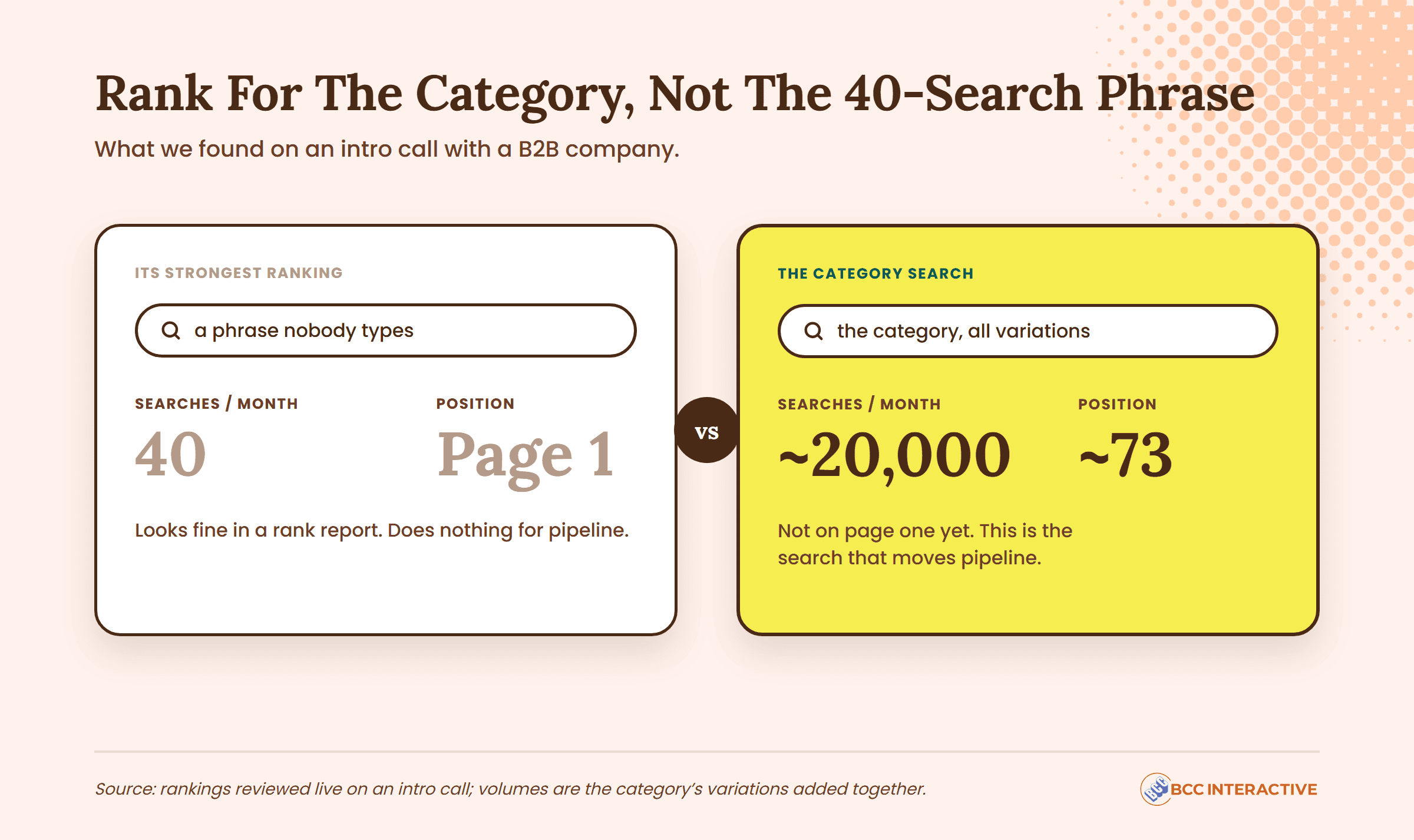
Being on page one for a phrase nobody types looks fine in a rank report and does nothing for pipeline. Start your SaaS keyword research with the searches your buyers actually make, then work back to the pages that answer them.
Build The SaaS SEO Strategy Around The Buying Committee
A B2B SaaS SEO strategy has to account for the fact that more than one person decides. The searches they make are different, and so are the pages they need.
Who Searches What: The User, The Buyer And The Approver
- The user has the problem every day. They search the problem itself and how-to questions: “how to calculate film royalties”, “how to track contract renewals”.
- The SaaS buyer is building a shortlist. They search the category and comparisons: “royalty management software”, “[your product] vs [competitor]”, “[competitor] alternatives”.
- The approver wants to know it’s safe and worth it. They search pricing, security, integrations and reviews, and they often go straight to your site.
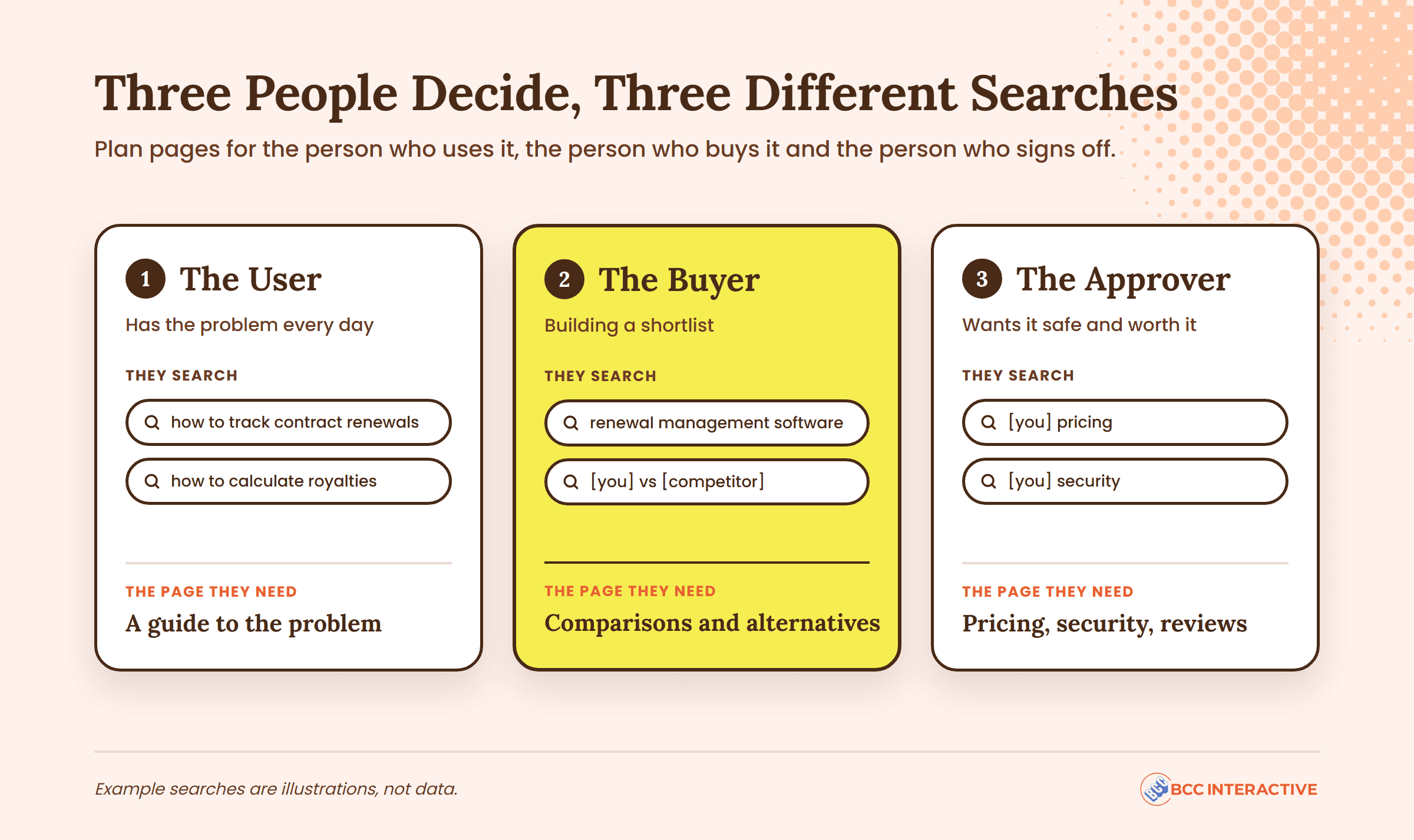
Each one needs a page that answers their question first. The comparison, alternatives, integration and use-case pages that buyers look for are covered step by step in our SaaS SEO guide. This piece is about the planning that comes before them.
Category Searches When Nobody Knows The Category Yet
Some software sits in a category most buyers don’t know exists. They don’t search for “rights management software” until they’re already buried in the problem it solves.
That was FilmTrack. It makes rights and royalty management software for film, TV and licensing teams. The product and the industry relationships were there. The searches for “royalty management software” mostly weren’t.
So the content strategy went after the questions the industry was already asking, not the category name. That’s where SEO and content marketing meet for most SaaS companies.
What One Guide Did For FilmTrack
FilmTrack’s Royalty Management 101 guide answered the question licensing and finance teams kept asking: how royalties for film and TV actually work.
By March 2022 it held #1 in Google for “movie royalties”, “film royalties” and “how do movie royalties work”, and it drew about a quarter of FilmTrack’s estimated organic visits (Semrush). One guide, aimed at the buyer’s real question, did more than any page about the SaaS product itself.
Across the engagement, FilmTrack went from 335 to 885 ranking keywords and from 23 to 34 page-one rankings (Semrush, January 2018 to December 2023).
"Thirty minutes and I had a clearer picture of our search problem than after two months of internal meetings."
The lesson isn’t “publish more guides.” It’s to find the question your buyer has before they know what to call your product, and own the answer.
Enterprise SaaS SEO Is The Same Work At A Bigger Scale
Enterprise SaaS SEO adds size, not new rules. There are more pages, more products, more regions, more teams editing the site and more people who need to sign off on a change.
Three things matter more at that scale:
- Watching competitors. When Cory ran SEO at Comcast, the team used BrightEdge, an enterprise platform that flagged when competitors changed their title tags and meta descriptions. The reason: “you don’t want to just be flying blind on like, oh, you know, this competitor all of a sudden started outranking us, but I have no idea why.”
- Governance. Who can publish, who can change a URL and who checks redirects before a release. A lot of the losses we’ve seen on big sites came from a change nobody reviewed.
- Templates. On a large site, one fix to a page template can fix thousands of pages at once, and one mistake can break them all.
For the SEO best practices at that size, see our enterprise SEO strategies.
The Technical SEO Basics SaaS Companies Get Wrong
B2B SaaS sites often run several sites under one brand: the marketing site, the app, the help docs and the blog. Each can trip up search engines in its own way, and a technical SEO audit usually finds the same few problems. The common ones are app pages that end up in Google’s index, marketing pages built so that Google can’t read them without running JavaScript, and duplicate pages competing with each other.
We cover what to fix first, and how to brief your developers, in our guide to technical SEO for SaaS.
Show Up In AI Search When Buyers Research Software
Buyers can now research software on AI platforms like ChatGPT, Gemini and Perplexity, and in Google’s own AI Overviews, as well as in the regular results. What we see across accounts is that AI platforms are used more for research than for the final step. Cory on a call: “right now what we’re seeing is Google still driving the majority of like transactional.”
That makes AI answers part of the shortlist stage. If an AI platform describes your category and leaves you out, the buyer may never search your name.
Two things we know affect it. First, your own pages have to say clearly what you do and who it’s for. Second, AI platforms look past your website: “AI platforms, they take more than just your word for it,” as Cory puts it. Reviews, comparison sites, case studies and mentions elsewhere count.
Everyone, the AI platforms included, is still working out how this works. We’d treat any agency that promises a guaranteed AI ranking with suspicion.
Make The Case To Your CEO In Pipeline Terms
The budget meeting from the start of this piece is where B2B SaaS SEO lives or dies. Leadership doesn’t need rankings. They need to know whether search brings in buyers.
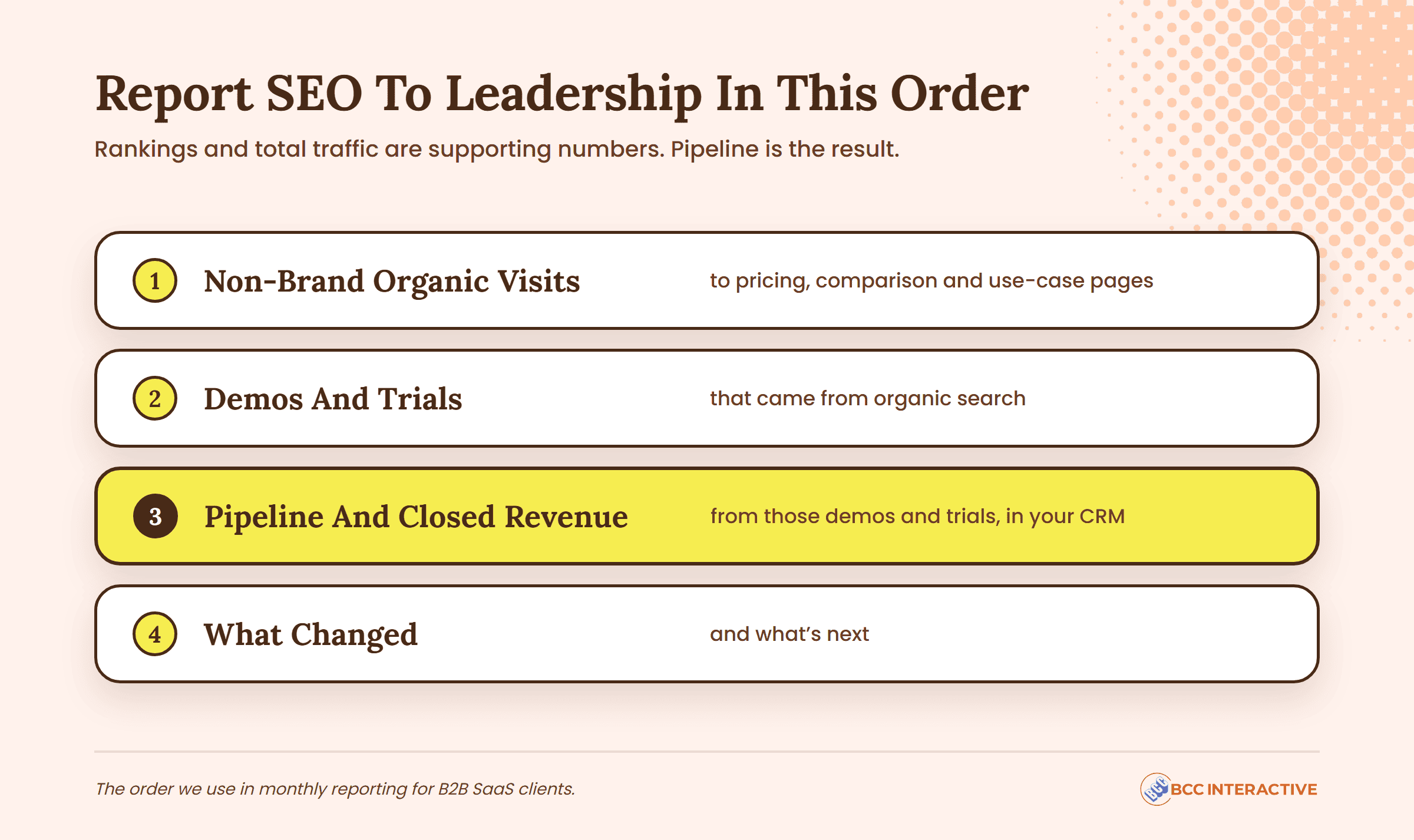
Report it in this order:
- Non-brand organic visits to commercial pages (pricing, comparisons, use cases).
- Demos and trials from organic search.
- Pipeline and closed revenue from those demos and trials, from your CRM.
- What changed and what’s next.
Our SaaS SEO guide has a five-line monthly report template that fits on one slide.
Say This In The Budget Meeting
It answers "what is SEO stuff?" in terms the room already uses.
Agency, In-House Or Both?
It depends on what you already have. An in-house marketer who knows the product is hard to replace, and an outside team is useful for the parts that take years of practice: technical audits, migrations, and knowing which tactics are worth the time.
Many B2B SaaS companies end up with both. The in-house lead owns the product knowledge and the internal sale. The agency brings the search depth and the reporting. If you’re comparing SEO agencies, including the SaaS SEO agencies that only work with software companies, our guide on how to choose an SEO agency has the questions to ask. If you want specialists, see our SaaS SEO agency page.
Win The Buyers Who Don't Know Your Name Yet
B2B SaaS SEO works when it reaches people before they’ve heard of you and when you can show leadership what it brought in. Split brand from non-brand, plan for every person on the buying committee, own the question your buyer has before they know your category, and report it in pipeline. That’s what SaaS growth from search looks like.
Get A Search Plan You Can Take To Your CEO
- Which buyer searches you're missing and what they're worth
- Where your site loses demos it should be getting
- A 90-day plan you can run with or without us

Frequently Asked Questions
The basics are the same. B2B SaaS SEO has to reach several people on a buying committee over a longer decision, and it’s judged on demos, trials and pipeline rather than traffic or calls.
It depends on where you start. An established site with gaps in its targeting or content can see movement in 60 to 90 days. A site that needs bigger fixes, or that competes in a crowded category, often takes 3 to 6 months. A new site going after national category searches against big brands can take 6 to 12 months or more. More on that in how long SEO takes.
Track non-brand organic visits to commercial pages, the demos and trials they produce, and the pipeline and revenue those turn into in your CRM. Rankings and total traffic are supporting numbers, not the result.
Yes, when it targets the searches buyers make before they know you. FilmTrack, a B2B software company, went from 335 to 885 ranking keywords between January 2018 and December 2023 (Semrush), with one guide drawing about a quarter of its organic visits in March 2022.
SEO for large software companies with many products, regions or teams. The work is the same as any B2B SaaS SEO, with more weight on templates, governance and tracking what competitors change.
Many do both: an in-house lead who knows the product and owns the internal case, and an agency for technical work, strategy and reporting.