


Someone asks ChatGPT for the best accountant near them. Or Google answers a question at the top of the page before anyone scrolls. Or Perplexity writes a three-paragraph summary and links four sources.
In each case, a machine picked the answer. If it didn’t pick you, you weren’t in the conversation.
That’s what answer engine optimization is about. It’s also the most overhyped acronym in marketing right now, so let’s be straight about what’s new and what isn’t.
Key Takeaways
AEO gets your business named and cited inside the answer. Answer engine optimization (AEO) is the work of making your content the source an AI answer, featured snippet or voice assistant pulls from, not just a link in a list.
The term is older than ChatGPT. Search Engine Watch covered AEO as a named idea in February 2018, crediting Jason Barnard, when the answer engines in question were featured snippets and voice search.
Google says it's still SEO. Google's guide to its generative AI features says optimizing for them "is optimizing for the search experience, and thus still SEO."
Where answers come from is contested. Ahrefs found 76% of AI Overview citations ranked in Google's top 10 in July 2025, then 38% in a larger March 2026 study, and only 12% for ChatGPT, Gemini and Copilot citations.
AI answers change constantly. SparkToro found less than a 1 in 100 chance that ChatGPT or Google's AI gives the same list of brands twice for the same prompt.
You measure it differently. Search Console now shows AI impressions but no AI clicks, so AEO is tracked with a fixed set of prompts run every month, plus AI assistant traffic in GA4.
What Is Answer Engine Optimization?
Answer engine optimization (AEO) is the practice of getting your business surfaced, accurately described and cited as the source when people ask an answer engine a question.
An answer engine is any AI system or search feature that replies with an answer instead of a list of links. Today that means:
- Google AI Overviews and AI Mode, the AI-generated summaries at the top of Google and its chat-style search
- AI assistants like ChatGPT, Gemini, Claude, Copilot and Perplexity
- Featured snippets, the answer boxes Google has shown above the regular search engine results pages for years
- Voice assistants, which read out one answer and skip the rest
Search engine optimization (SEO) tries to get your page ranked in traditional search. AEO tries to get your business into the answer itself, either named in the text (a mention) or linked as a source (a citation).
You’ll also see generative engine optimization (GEO), LLM SEO and AI search optimization used for the same work. We use AEO as the umbrella term because it’s the older one and it covers every answer engine, not just the generative AI ones. Our guide to generative engine optimization (GEO) covers where the GEO name came from.
When Did Answer Engine Optimization Start?
Before ChatGPT. Search Engine Watch ran “The rise of Answer Engine Optimization: Why voice search matters” on February 7, 2018, and Jason Barnard, who’s credited with the term, says he named it in 2017. Back then, the answer engines were featured snippets and voice assistants.
What changed is scale. Generative AI turned one boxed answer into a written answer with sources, at the top of Google and inside every AI assistant.
How Answer Engines Pick Their Answers
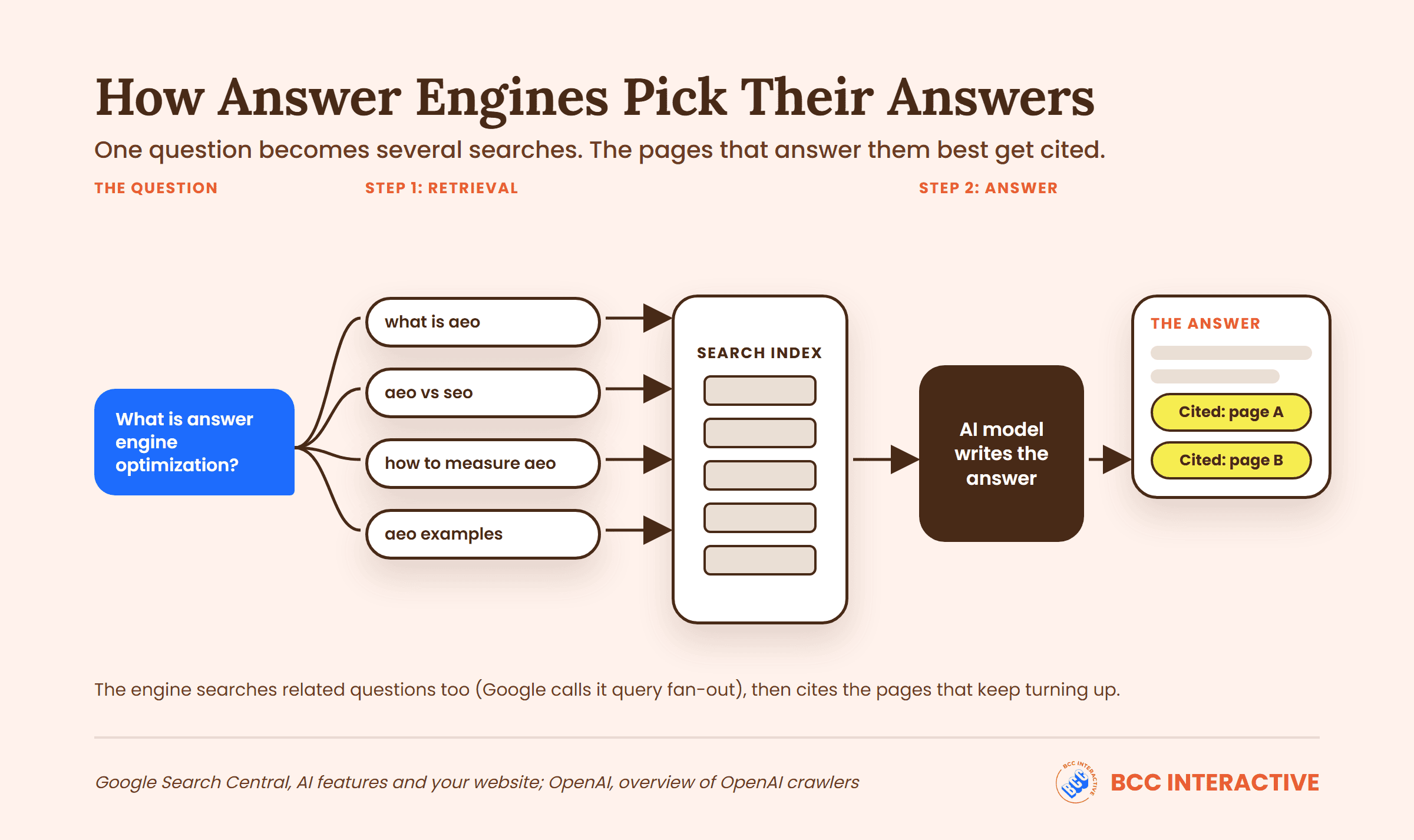
Most AI answers that cite sources are built in two steps: find pages, then write an answer from them.
Step 1: retrieval. The engine searches an index of web pages. Google says AI Overviews and AI Mode rely on its “core Search ranking systems to retrieve relevant, up-to-date web pages from our Search index.” ChatGPT and Perplexity run their own crawlers: OpenAI says its OAI-SearchBot crawler “is used to surface websites in search results in ChatGPT’s search features,” and Perplexity says the same of PerplexityBot.
Step 2: the answer. The AI model reads what it retrieved, writes an AI-generated answer and links some of the pages that support it. The pages the engine cites are the ones it decided gave the best answer.
Step 1 has a catch. The engine usually doesn’t search only your exact question. Google calls this query fan-out: “a set of concurrent, related queries generated by the model to request more information.” Ask about AEO and the engine may also search “AEO vs SEO,” “how to measure AEO” and a few more, then cite the pages that keep showing up across all of them.
That’s why ranking #1 for one keyword and getting cited are related but not the same thing.
How Much Do Answer Engines Rely On Google Rankings?
This is where the research disagrees, and the disagreement is the honest answer.
| Study | Published | Sample | Share of cited pages in Google's top 10 |
|---|---|---|---|
| Ahrefs, AI Overviews | July 2025 | 1.9 million citations from 1 million AI Overviews | 76% |
| Ahrefs, AI Overviews (new study) | March 2026 | 863,000 keywords, 4 million AI Overview URLs | 38% (31% ranked 11 to 100, 31% beyond 100) |
| Ahrefs, AI assistants | August 11, 2025 | 15,000 long-tail prompts | 12% for ChatGPT, Gemini and Copilot; Perplexity close to a third |
The AI Overview number fell by half, but not cleanly. Ahrefs says its citation detection improved between the two studies, so some of the drop is better measurement, not a change in Google. Ahrefs suggests fan-out queries play a bigger role in which pages get cited. Google hasn’t confirmed that.
The assistant number isn’t a like-for-like comparison. Ahrefs checked citations against Google’s results for the original prompt, but the assistants were likely searching fan-out variations and, in some cases, other search indexes. Every study here also comes from a company that sells AI tracking tools.
What holds up across all three: organic search rankings get you in the running for an AI answer, but it doesn’t guarantee a citation, and a lot of cited pages come from outside the top 10.
The Answers Don't Sit Still
Ask an AI tool the same question twice and you’ll often get a different AI response.
SparkToro and Gumshoe had 600 volunteers run 12 prompts through ChatGPT, Claude and Google’s AI, 2,961 times in total, in late 2025. They published the results on January 28, 2026: there was less than a 1 in 100 chance that ChatGPT or Google’s AI returned the same list of brands for the same prompt, and about 1 in 1,000 that it came back in the same order.
That changes how you measure AEO. More on that below.
Is AEO Just SEO?
Mostly. Not entirely.
The case that it’s just SEO is strong, and it comes from Google. Its guide to optimizing for generative AI features says optimizing for them “is optimizing for the search experience, and thus still SEO.” The same guide says you don’t need AI text files, special schema markup, or content chopped into tiny chunks, and that “You don’t need to write in a specific way just for generative AI search.”
The skeptics have a point too. Robert Rose at the Content Marketing Institute argued in June 2025 that AEO is “a familiar trap”: brands handing their content to another platform for visibility that may never turn into a click. Pew Research Center’s March 2025 browsing data backs up the click worry. People clicked a link inside Google’s AI summary on just 1% of visits where one appeared.
But Google’s guide covers Google Search. It can’t speak for ChatGPT, Perplexity or Claude, and the data above shows real differences:
| Traditional SEO | Answer engine optimization | |
|---|---|---|
| The goal | A ranked link that earns a click | A mention or citation inside the answer, click or no click |
| Who you're optimizing for | Mostly Google | Google plus ChatGPT, Perplexity, Gemini, Claude and Copilot, each with its own crawler or index |
| What gets you there | Rankings for a keyword | Rankings, plus showing up across the fan-out queries and on other sites the engine trusts |
| How stable the result is | Rankings move, but slowly | The answer can change on every run |
| How you measure it | Rankings, clicks, conversions | How often you're mentioned and cited across a fixed set of prompts, plus AI referral visits |
The on-page work and the SEO fundamentals are mostly the same. How you win and how you measure it aren’t. For the full comparison, see our post on GEO vs SEO.

Don't buy AEO from anyone who treats it as a separate thing from SEO. If your pages can't rank and your business facts don't line up across the web, no AI trick fixes that. Treat AEO as SEO with a wider set of engines and a different way of measuring results.
Where Does GEO Fit?
GEO, generative engine optimization, is the name for the same work, focused on AI-generated answers. The term comes from a November 2023 research paper titled “GEO: Generative Engine Optimization.” Most of the industry uses AEO and GEO interchangeably, and so do we in practice. We’ll dig into the small differences in a separate post.
What You Actually Optimize For AEO
At a high level, every set of AEO strategies comes down to four things you optimize. Three of them good SEO already covers.
| What you work on | What it means | Already part of good SEO? |
|---|---|---|
| Content that answers the question | Put the direct answer near the top of the page, then the detail. Cover the related questions people ask next, since those are the fan-out queries | Yes |
| Pages engines can read | Technical SEO basics: pages that are indexed, load properly and are open to the crawlers each answer engine uses, including OAI-SearchBot and PerplexityBot | Mostly. The AI crawlers are the new part |
| The same facts everywhere | Your name, services, location and who you serve stated the same way on your site, your Google Business Profile, directories and review sites | Yes, for local SEO |
| Mentions on sites you don't own | Reviews, press, roundups, forums and industry sites that talk about your business, because answer engines cite them | Partly. This leans more on PR and reviews than most SEO programs do |
Notice what’s not on the list: llms.txt files, AI-only copies of your pages, and schema markup sold as an AI shortcut. Google’s own guide says you don’t need them for its AI features. Our LLM SEO guide walks through the tactics behind each row, and our Google AI Overviews guide covers what Google specifically looks for.
One warning on mentions: Google’s guide says “seeking inauthentic ‘mentions’ across the web isn’t as helpful as it might seem.” Earned mentions count. Planted ones are a waste of money and a spam risk.
Where Do You Stand Right Now? Run The 15-Minute Check
Our free AI Visibility Playbook walks you through asking ChatGPT, Gemini and Perplexity about your business: whether they know what you do, who they think you serve, who they compare you to, and which sources they cite. It shows you how answer engines see you today. Changing that is the work we do.
Get the free playbookHow Answer Engine Optimization Is Measured
Clicks alone can’t tell you if AEO is working. A business can be named in an AI answer and get no visit at all, so you need a way to measure visibility in AI search directly.
So AEO gets measured with three sources:
- Google Search Console’s generative AI report. Google announced it on June 3, 2026 and rolled it out to all sites worldwide on August 31, 2026. It shows how often your pages appeared in AI Overviews, AI Mode and generative AI features in Discover. It shows impressions only. No clicks.
- GA4’s AI Assistant channel. Search Engine Journal reported on May 14, 2026 that Google Analytics 4 now groups visits from AI assistants like ChatGPT, Gemini and Claude into their own channel. Visits that arrive without a referrer still land in Direct, so it undercounts.
- A fixed set of prompts. The same questions your buyers would ask, run every month across the answer engines they use, logging whether you’re mentioned and whether you’re cited.
The SparkToro study is why the prompt set matters. A single check tells you almost nothing, because the answer changes from run to run. SparkToro’s conclusion was that the share of runs you appear in, across dozens of prompts run many times, is a reasonable metric. One screenshot of ChatGPT naming you isn’t. Our AEO strategy guide shows how we build that prompt set in the first week of an engagement.
Keep the same prompts for at least a quarter. Run each one more than once. Track how often you show up, not whether you showed up once.
For the full list of metrics and how to collect each one, see how to measure GEO performance. For what to put in front of your boss or board, see our AI visibility report guide.
AEO Is Good SEO, Measured Differently
Answer engine optimization isn’t a new discipline that replaces SEO, and it isn’t a one-time content optimization project. It’s what SEO looks like when the result is an answer instead of a list.
The foundation is the same: pages that rank, facts that line up, content that actually answers the question. What’s different is where answers come from, how often they change, and how you measure them.
If you’d rather have someone handle that across Google and the AI assistants, that’s what our AEO agency work does for B2B companies, e-commerce companies and local businesses.
Frequently Asked Questions
Answer engine optimization is the work of getting your business mentioned and cited when an AI tool, featured snippet or voice assistant answers a question. Answer engines include Google AI Overviews and AI Mode, ChatGPT, Gemini, Perplexity, Claude and Copilot. The goal is to be the source the AI answer engine cites, not just a link below it.
Answer engines search an index of web pages, often running several related searches for one question, then write an answer and cite some of the pages they found. AEO is how you optimize your pages so they’re easy to find and quote in that process: clear answers, pages the engines can crawl, consistent business facts, and mentions on other trusted sites.
Mostly. Google says optimizing for its AI features is still SEO, and the on-page work overlaps heavily. The differences are in the goal (a mention or citation, not a click), the number of engines involved, and how you measure results.
The term was in use by February 2018, when Search Engine Watch covered it in an article about voice search, crediting Jason Barnard. It originally referred to featured snippets and voice assistants. Generative AI tools like ChatGPT and Google AI Overviews made it a much bigger deal.
Because more searches end with an answer instead of a click. Pew Research Center found people clicked a regular search result on 8% of Google visits that showed an AI summary, compared with 15% without one. If the answer names a competitor and not you, you miss the visit and the recommendation.
Use Search Console’s generative AI report for AI Overview and AI Mode impressions, GA4’s AI Assistant channel for visits from AI tools, and a fixed set of prompts run every month to track how often you’re mentioned and cited. Because AI answers change from run to run, track the share of runs you appear in over time.
AI search optimization is another name for the same work: getting your business found and cited by AI search engines and AI summaries, and improving your search visibility beyond the blue links. AEO, GEO, LLM SEO and AI search optimization mostly describe the same thing under different labels.
Want To Know If Answer Engines Are Recommending You?
- What ChatGPT, Perplexity and Google's AI say about your business today
- Which of the four AEO areas is holding you back
- A 90-day plan to get cited more often, with or without us
