


Two days after Christmas, I was on a call with the owner of a yoga and barre studio in Philadelphia, one of our clients. We’d just published a new page for each of her three studios. I pulled up her rankings while we talked.
“Yoga studio philadelphia” had gone from ninth to third in about a day, the highest it had ever been for that search. “Fitness studio philadelphia” went from 11th to fourth. “Yoga classes” went from ninth to fourth. All of it a few days before New Year’s.
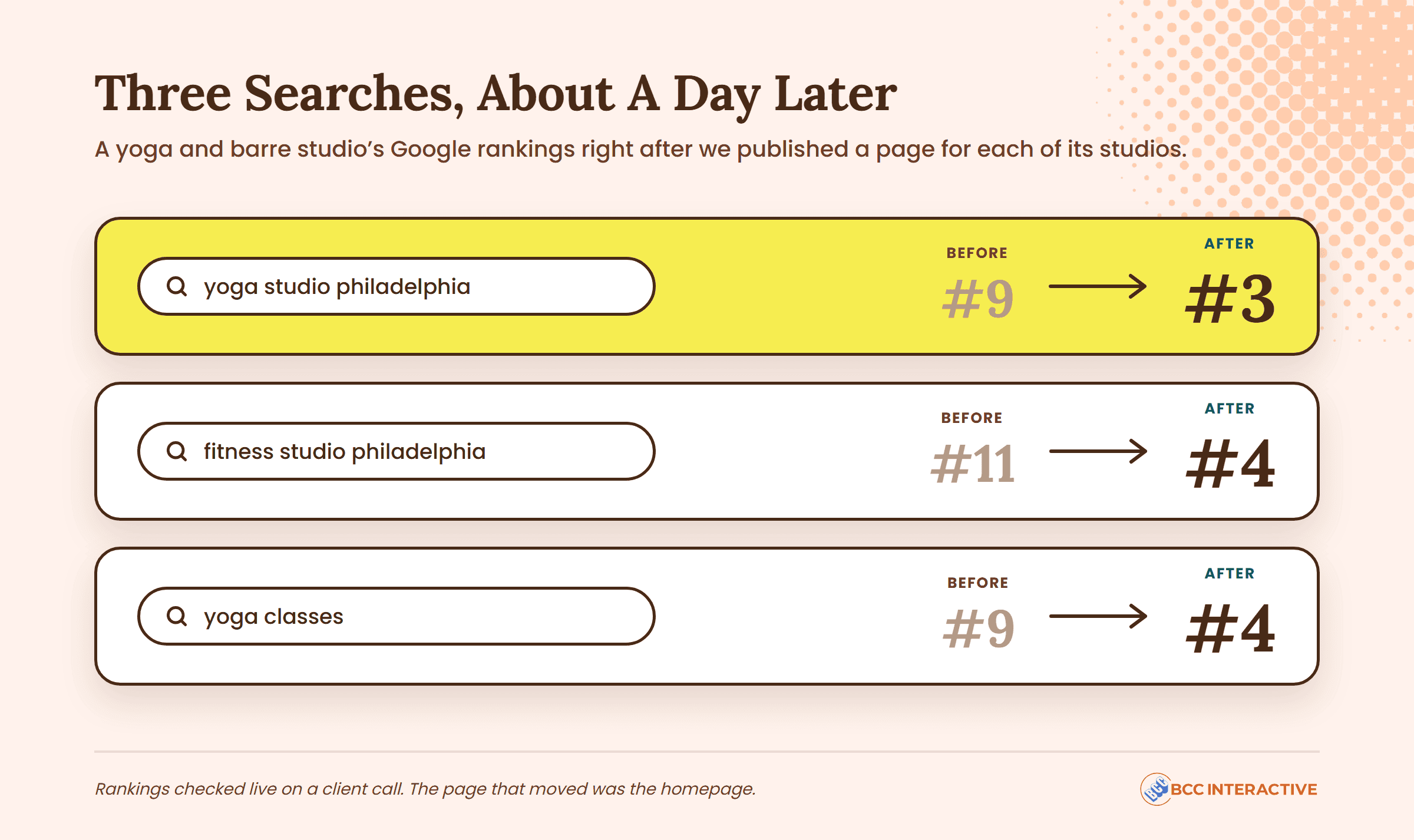
I can’t prove the new pages did all of that on their own. The page that moved was her homepage. But Google doesn’t judge pages one at a time. It judges what the whole site says about where you are and what you offer. Three new pages, each naming a studio’s neighborhood and the classes it teaches, said a lot more than the homepage could by itself.
Most SEO tips for gym and fitness business owners come as a 40-point checklist. After 17 years in marketing, I’ve found that only a handful of those points do most of the work for a local business. So we start there and do those few things well before touching the rest.
For that studio, and for a physical therapy and sports performance practice with three locations, the high-impact list was the same: a page for every location and everything people buy, a Google profile that matches, and nothing in the way of booking.
That’s the order we work in as a fitness marketing agency, and it’s the order this post follows.
Key Takeaways
Give every location its own page. The yoga studio's three locations are close together. Separate pages, each with its own schedule and offer, are how each one competes for its own neighborhood.
Build pages for what people buy, not what you call it. The PT practice's new stretching membership pages ranked first or second in virtually every location it served, shortly after they went live.
Your primary Google category matters most for the map. Whitespark's 2026 survey of 47 local search experts ranks it the top factor for the local pack.
Reviews win the click more than the ranking. In Localo's data on 16,098 profiles, businesses getting 30+ reviews a month ranked in the top three only slightly more often (73.5%) than ones getting less than one (70.2%).
Use class apps, but don't depend on them. ClassPass users say the app is how they found their studio. Your own site and profile are how they come back to you directly.
Give Every Location Its Own Page
Most owners we talk to want to rank across their whole city. Local search rankings don’t work that way. Google weighs how close a business is to the person searching, and so do your potential members: when Sogolytics asked 1,004 Americans what decides their gym, location (50%) came in right behind cost (54%).
So the goal is to be the obvious pick within a few miles of each of your doors. That’s where local SEO for gyms starts.
The yoga studio had one page trying to stand in for three studios. It’s the most common setup we see, and one page can’t hold a ranking in three neighborhoods.
Her studios made it harder. They’re close enough together that they compete for the same searches. On that call, I put it this way: “we’re basically just trying to corner as much of a radius of real estate as we can in that particular area.” A page for each studio is how you do that.
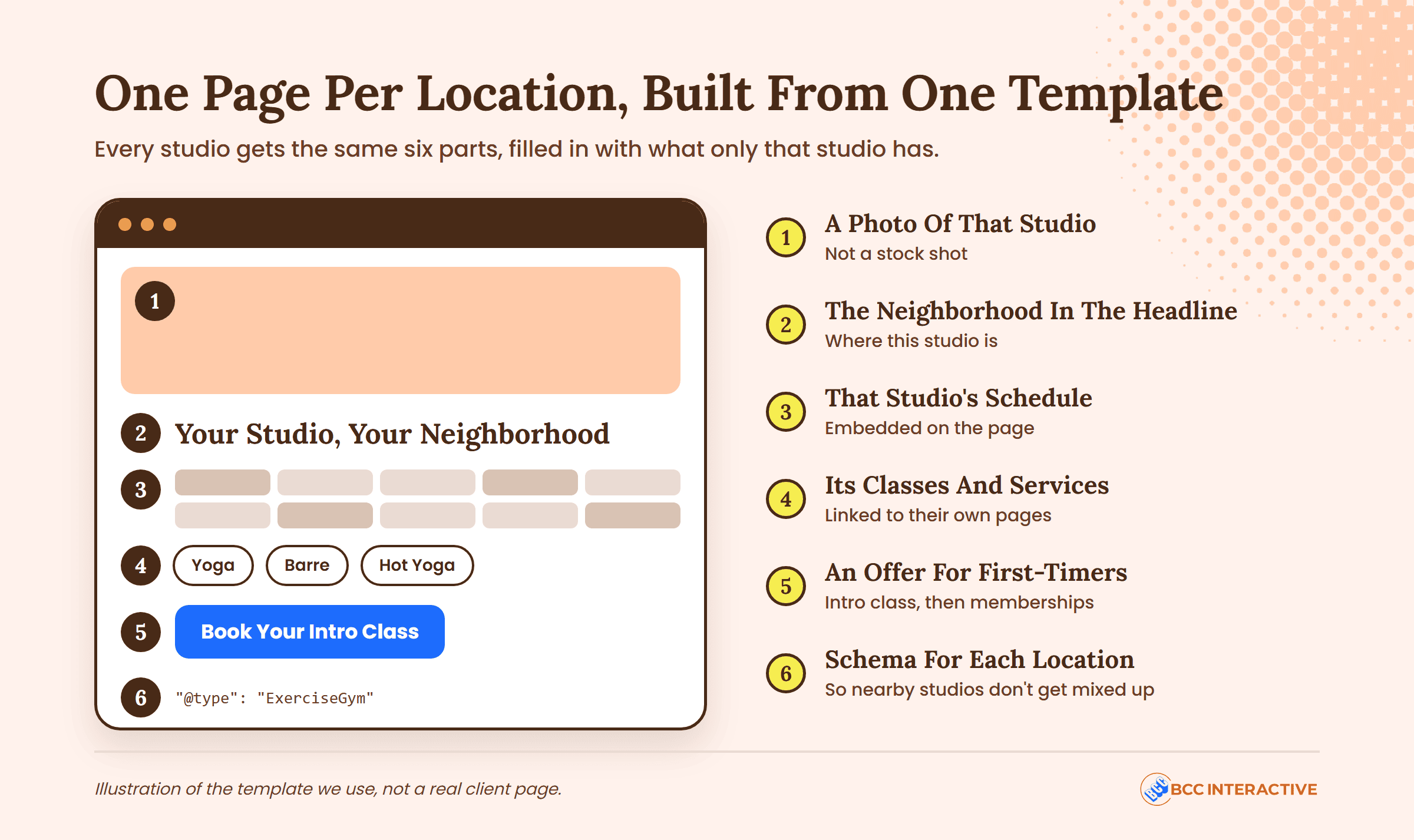
We built every one of its location pages from the same template, modeled on location pages we’d already built for the PT practice:
- A photo of that studio, not a stock shot
- A headline that names the studio’s neighborhood
- That studio’s class schedule, embedded on the page
- Links to the classes and services that location actually offers
- A clear offer for first-timers, like a free or intro class, plus memberships
- LocalBusiness schema for each location, so search engines don’t mix up studios a few blocks apart
A gym with locations in different parts of town needs the same thing, plus its own Google Business Profile for each address, with its own hours, coaches, parking and photos. A single “Locations” page with three addresses won’t rank in three places. Our guide to local SEO for multiple locations goes deeper on that.
Build Pages For What People Actually Buy
The PT practice taught us the next part: rank the thing people pay for.
In late 2024, the practice launched stretching and personal training memberships. We built a page for each, linked them from every location page and from the related service pages, and wrote them around why someone should pick that practice, not just what’s included. Shortly after they went live, I told the owner that the stretching membership pages were ranking first or second in virtually every location. Personal training is a more crowded search, so those pages had more competition to get past.
A few decisions on those pages mattered as much as the SEO work itself:
- One clear way to buy. The practice moved from 10- and 20-session packs to monthly memberships, so each page had one offer instead of a menu.
- A comparison table. Basic, standard and premium side by side, so people could pick without calling.
- A Book Now button at the top. As I said on that call, “Most of the time people are probably not gonna go all the way to the bottom.”
For a gym or fitness center, these are the pages we’d build first, because each one matches a keyword people search by name:
- Each class type: reformer pilates, hot yoga, spin, HIIT, boxing, strength. A CrossFit gym or boxing gym should have a page for each program it runs
- Personal training and small group training
- Memberships, class packs and drop-in pricing
- Your intro offer, free trial or first class
- Programs for specific people: beginners, seniors, teens, prenatal
On each one, say who it’s for and whether beginners are welcome, who teaches it, when it runs, and what it costs or how to try it. Put the button where a phone screen shows it first. The on-page SEO that matters most is simple: the keyword people search, usually the class plus the neighborhood, in the title tag, the headline and the first line of copy.

Specialty wins. When we looked at who ranked first for "yoga studio philadelphia," it was a long-running studio that only teaches yoga. Our client teaches yoga and barre, so beating a yoga-only studio on a yoga search was always going to be hard. If you're known for one thing, say that one thing clearly on its own page. If you do several, give each one a page instead of hoping your homepage covers them all.
Optimizing Your Google Business Profile For The Map
“Gym near me” gets about 2,240,000 searches a month in the U.S., per Semrush, and the local 3-pack shows up before any website does. Most gyms already have a profile, often still set up from the Google My Business days. The ones that win the map optimize a few settings and leave the rest alone.
Whitespark’s 2026 Local Search Ranking Factors survey asked 47 experts to rank every local ranking factor. For the local map pack, primary category came first, just ahead of how close the business is to the searcher. It’s expert opinion, not Google’s code, but it matches what we see.
- Primary category. Gym, Fitness center, Yoga studio, Pilates studio, Boxing gym, Personal trainer. Pick what most of your members would call you.
- Services listed for each location. On the yoga studio’s profiles, we updated the services for each studio separately, since they didn’t all offer the same classes.
- Your social profiles linked. It helps Google tie your Instagram, Facebook and website together as one business.
- A booking button. Connect your scheduling provider so people can book a class from Google Maps without opening your site. Our guide to Google’s Book Online button walks through it.
- Real photos. The floor, the classes, the locker rooms, the front desk.
- Google Business Profile posts when you have news. A new class, a schedule change, an intro offer. In Localo’s data, posting eight or more times a month didn’t help (70.5% top three, against 73.0% for under once a month). What did line up with better rankings was having 10 or more active posts in total.
- Your real business name. Adding keywords to it breaks Google’s guidelines and can get a profile suspended.
Our Google Business Profile checklist has every setting on one page.
Audit Your Profile Line By Line
The Google Business Profile Optimization Checklist is the same list we work through with clients: categories, service area, services, hours, photos and reviews. Print it and check your profile against it.
Download the GBP ChecklistReviews Win The Click More Than The Ranking
What most gym owners overestimate is how much reviews move rankings.
Localo compared Whitespark’s survey against data from 16,098 Google Business Profiles. Profiles getting fewer than one new review a month ranked in the top three 70.2% of the time. Profiles getting 30 or more a month did it 73.5% of the time. Localo also found that replying to most reviews didn’t line up with higher rankings.

Where reviews do decide things is the click. BrightLocal’s 2026 survey of 1,002 U.S. adults found 97% read reviews for local businesses, and 74% only care about ones written in the last three months. Reviews decide which of the three gyms on the map gets the tour, even if they won’t make you rank higher on their own.
So keep them coming and keep them recent. Ask after a milestone, like a member’s first month or a finished challenge. Never offer a free class or merch in exchange: Google bans incentives for reviews.
Send This After A Member's First Month
Send it after a milestone, when the member feels good about showing up. Asking for the class and the neighborhood gets reviews that say what you offer and where, without telling anyone what to write.
Use Class Apps, But Don't Depend On Them
When I pulled up “yoga studio philadelphia” on that call, ClassPass was one of the search results above our client. For a lot of studios, the apps are part of how people find them.
ClassPass’s own 2026 fitness industry report backs that up. In its survey of 816 users, 72% said they wouldn’t have found their go-to studio or gym without ClassPass. That’s ClassPass surveying its own users, so read it with that in mind. The tradeoff is the price: ClassPass pays studios a percentage of their direct rate, and the relationship starts on the app, not with you.
Use the apps for visibility and to fill open spots. Make your own site and profile the place people land when they search your name or your neighborhood. And keep your offer the same everywhere. On that same call, the owner mentioned her site’s pop-up still advertised a $10 first class a month after she’d changed the deal to three classes for $45. People noticed.
Content That Finds Members Before They're Shopping
Some of your future members aren’t searching for a gym yet. They’re searching for why their knee hurts.
That’s how we approached the PT practice. Most SEO content for gyms is generic fitness tips. We built guides around the pain people search by body part: knee, back, shoulder, and calf pain for runners. Each one pointed the reader toward booking an evaluation. As of June 2025, the IT band knee pain guide was Google’s top People Also Ask answer for “knee hurts when bent,” which gets 9,900 searches a month, per Semrush. The calf pain guide, timed around a big city marathon, went from #80 for “calf pain running” in January 2021 to the first source Google’s AI Overview cited for it by June 2025.
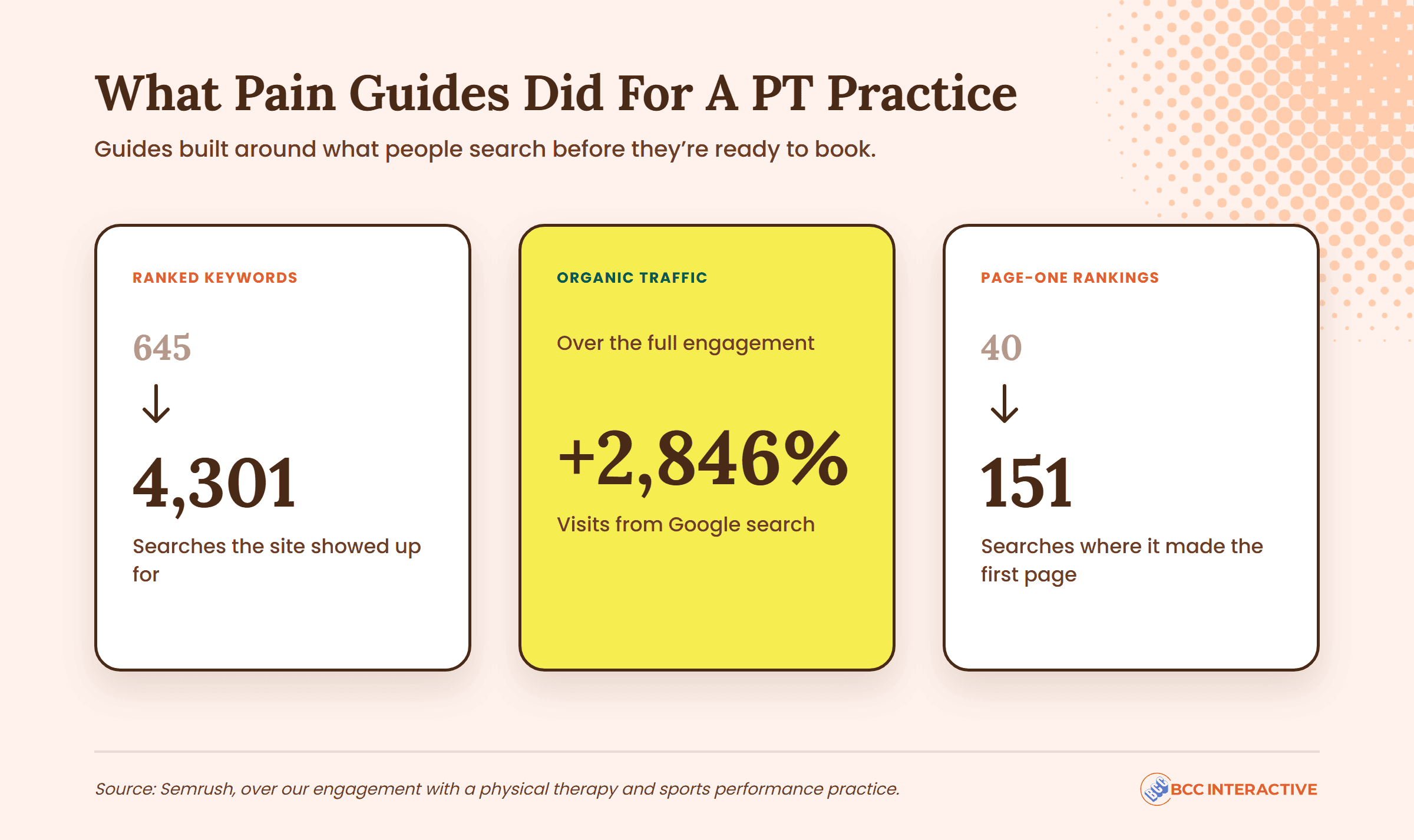
Over the engagement, the practice grew from 645 to 4,301 ranked keywords and from 40 to 151 page-one rankings, per Semrush, and organic traffic grew 2,846%. It opened another office. The full case study has the rest.
I said it to the owner this way: “the way that you can tell that marketing is doing its job is when people who are unaware of you, but aware that they have a problem are able to find you.” For a gym, that’s the beginner who searches “what to expect at your first CrossFit class,” or someone asking whether pilates helps back pain. Answer the common fitness questions your coaches already answer on the floor every week.
Where Search Fits Next To Instagram
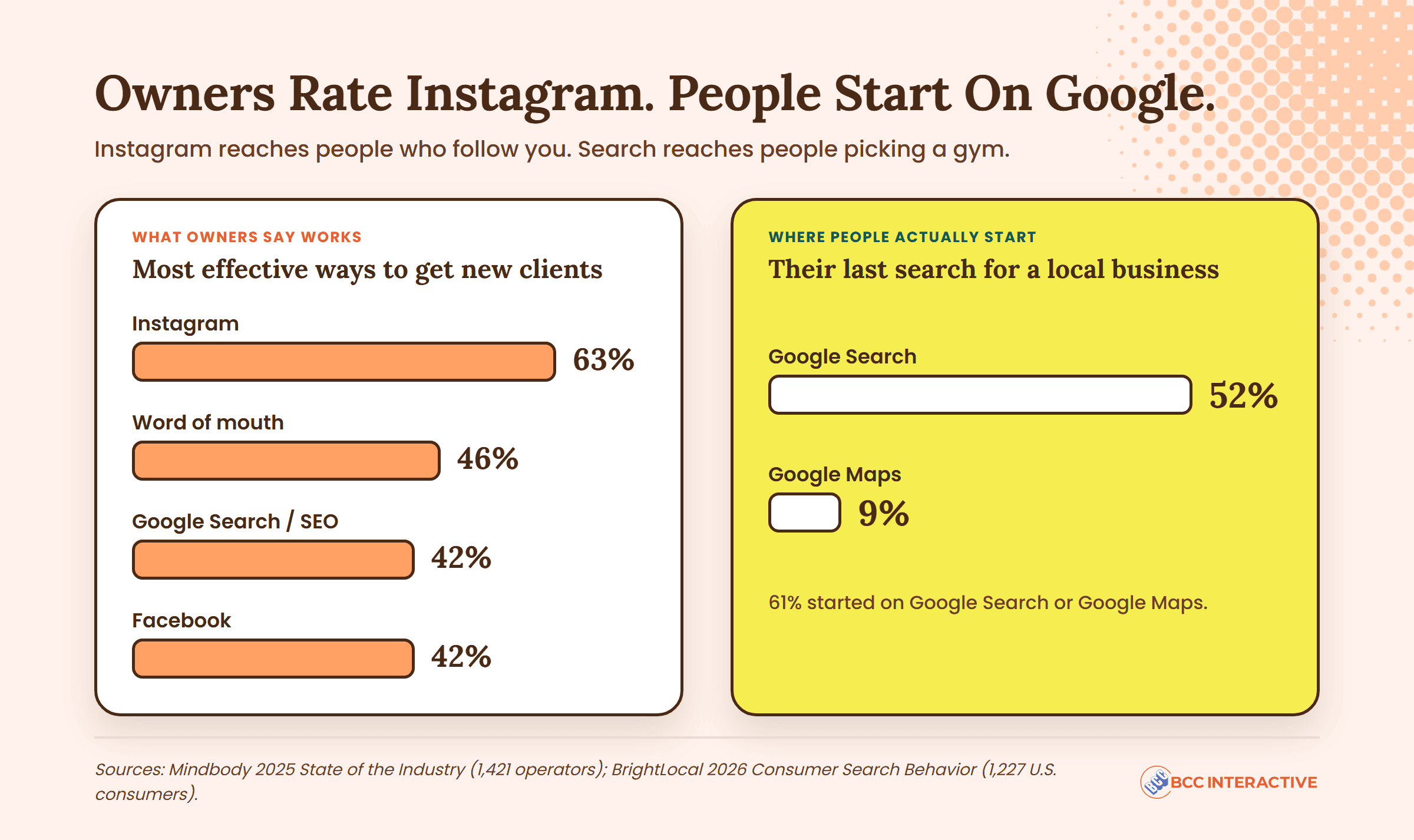
If Instagram already brings you members, keep it. Most of the fitness market agrees with you. In Mindbody’s 2025 survey of 1,421 fitness and wellness operators, 63% named Instagram as one of their most effective ways to get new clients. Word of mouth came next at 46%. Google Search and SEO tied with Facebook at 42%.
The two reach different people. Instagram reaches people who already follow you or a friend who does. Search reaches people with local intent who’ve decided they want a gym and are picking one. BrightLocal’s 2026 study of 1,227 U.S. consumers found 52% started their most recent search for a local business on Google Search, and another 9% on Google Maps. Only one of those catches a new member the week they’re ready to join.
Local Backlinks And Listings
Backlinks count toward prominence, one of the three things Google uses to rank the map. For a gym, the ones worth chasing are local and real:
- Partners who already send you people: physical therapists, chiropractors, running stores, nutritionists
- Your community: sponsoring a 5K, hosting a charity workout, working with schools and local teams, the local newspaper’s coverage of any of it
- Your chamber of commerce and neighborhood business groups
Then make every listing match, so your local presence looks the same everywhere: the same name, address and phone on Google, Apple Maps, Bing, Yelp, Facebook, local directories and every class app you’re on. Skip anyone selling hundreds of directory listings for a flat fee.
Technical SEO For Your Gym Website
- Speed on a phone. Near-me searches mostly happen on a phone. Compress and optimize your photos.
- The booking button at the top of every page, and test it after any software change.
- ExerciseGym schema on each location page, with name, address, hours and reviews, so search engines read it the same way your members do.
- A platform you can control. The PT practice’s site moved from Squarespace to WordPress so we could fix speed and site structure, and so clients could buy session packages and gift cards in one visit.
- Google Search Console. Submit your sitemap, check every class and location page is indexed, and see which keyword each one actually shows up for.
- Redirects before any redesign. If old page addresses change, point each one to its new page, or you lose what those pages had earned.
How Long Gym SEO Takes
It depends on where you start. As Aleyda Solis puts it about search engine optimization in general, “there’s no rule of thumb.” A gym with a decent site and gaps in its pages can see movement in 60 to 90 days. Bigger fixes or a crowded city market often take 3 to 6 months. A new gym or brand-new site should plan on 6 to 12 months or more. Our post on how long SEO takes breaks it down.
Measure it on members, not a ranking report: intro offers sold and first classes booked from search, profile calls and direction requests, and new memberships by source.
Start With The Pages Your Members Already Ask For
If you do one thing after reading this, list every location, class and membership you sell, and check whether each one has its own page that says who it’s for, what it costs and how to book. That list is your local SEO strategy for the next 90 days. Every other piece of optimization in this post builds on it, and it’s where the work started for both of these clients.
Frequently Asked Questions
In its own neighborhood, yes. Google ranks local results partly on distance, so a local gym or fitness business with a complete profile, a page for each location and class, and steady reviews can beat a chain that has one generic page per city.
Yes. The apps help people discover you, but the booking and the relationship start on their platform. Your own site and Google Business Profile are where people land when they search your name, and where you keep the full price.
There’s no magic number. Localo’s data on 16,098 profiles showed review pace barely changed how often a business ranked in the top three. Aim for a steady flow of recent reviews, because 74% of people only care about ones from the last three months.
Each location can rank around its own address. To show up in a neighborhood where you don’t have a location, you’d need real reasons to be relevant there, and the map favors businesses close to the searcher. Put your effort into the neighborhoods around your doors.
Not to start. Most SEO strategies that lead with blogging skip the pages that sell. Location, class and membership pages come first. Once those are done, guides that answer what your members ask before they join, like the PT practice’s pain guides, bring in people who weren’t shopping for a gym yet.
One page for every location, the schedule living only inside a booking widget, keywords stuffed into the Google profile name, an intro offer that says one thing on the site and another on the apps, and a redesign that changes page addresses without redirects.
SEO services for gyms and fitness studios depend on how many locations and classes you have and how much your profile and site need. Our guide to SEO pricing breaks down what drives the cost.
Ready To Turn More Searches Into Members?
- Which classes, programs and neighborhoods you can realistically win, and what that should cost
- Where your profile, reviews and website are sending people to the gym down the street
- A 90-day SEO plan you can run with or without us
